But the path isn't always obvious. Which country? What legal structure? Do you need a European address, a local director, a mountain of paperwork?
Many US entrepreneurs stall out here, not because expansion is a bad idea, but because the jurisdiction options and compliance rules feel foreign. Literally.
This guide breaks down who's eligible, which countries make sense for different goals, the actual registration steps, and what ongoing compliance looks like. Firms like VJM Global work with US businesses on exactly this kind of cross-border accounting and back-office compliance as they scale into new markets, so we'll draw on that practical lens throughout.
Key Takeaways
- US citizens can register companies in nearly every European country, often with 100% foreign ownership
- Estonia offers the fastest, fully remote registration through its e-Residency program
- Registration costs range from roughly $75 to $2,700+ depending on country and entity type
- US owners must still navigate CFC rules and Form 5471 reporting, no matter how simple the European process seems
Why US Businesses Are Expanding into Europe
The numbers back up what many founders already sense: Europe is becoming harder to ignore.
The US direct-investment position abroad grew by $206.3 billion in 2024, and Europe accounted for $88.4 billion of that increase, led by Luxembourg and Germany. The US is also the EU's single largest source of inward foreign investment, holding 31% of all inward FDI stock, worth roughly €2.24 trillion, according to Eurostat's foreign direct investment data.
These figures reflect capital flowing into the region, not a headcount of new company registrations. Still, they point to the same underlying trend, one driven by three specific advantages that make Europe worth the paperwork.
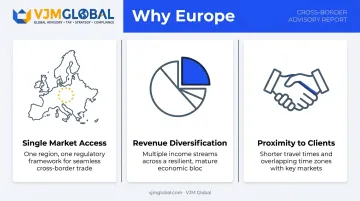
Three drivers explain why:
- Single Market access – one registration can open doors across 27 member states
- Revenue diversification – reduces dependence on the US market alone
- Proximity to clients – easier partnerships, faster support, local credibility
What's changed recently is the friction, not the opportunity. Digital registries and programs like Estonia's e-Residency mean an American founder in Chicago can form a European company without ever boarding a plane.
Can a US Citizen Register a Company in Europe? Understanding the Legal Basics
Yes. Nearly every European country allows non-EU citizens, including Americans, to register and own a business. Most permit 100% foreign ownership with no requirement to relocate or hold a visa.
That said, "allowed" doesn't mean "identical everywhere." Requirements shift by country:
| Country | Foreign founder rule | Local presence needed? |
|---|---|---|
| UK | Directors can be any age 16+, no residency requirement | Registered office in the UK |
| Germany | Nationality/residence of directors irrelevant | German business address |
| Estonia | E-residents can form and run an OÜ entirely online | Estonian legal address, sometimes a contact person |
| Ireland | Needs an EEA-resident director OR a €25,000 bond | Physical Irish office (no PO boxes) |
| Cyprus | No statutory resident-director rule | Cyprus registered office |
Ireland stands out as the clearest exception: without an EEA-resident director, you're looking at posting a bond, typically held for two years.
Does Europe Have an LLC Equivalent?
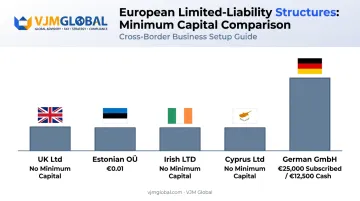
Not exactly. Europe has no single, uniform "LLC." Instead, each country has its own limited-liability structure:
- UK Ltd – simple, no minimum share capital required
- Estonian OÜ – minimum capital of just €0.01 for a single shareholder
- Irish LTD – no minimum capital requirement (that €25,000 figure applies to PLCs, not LTDs)
- Cyprus Ltd – no minimum capital for a private company
- German GmbH – requires €25,000 subscribed capital, with €12,500 in cash before registration
These entities function closer to a small corporation than a US LLC, with a separate legal identity, defined share capital, and a formal director/shareholder structure. What they don't offer is the pass-through tax flexibility Americans expect from an LLC back home.
That mismatch matters, and it's worth getting cross-border tax guidance before you pick a structure — firms like VJM Global that work across US, UK, and Indian tax frameworks can help map out the reporting implications early. A European entity can trigger Controlled Foreign Corporation (CFC) status and require Form 5471 reporting if you own more than 50% of the vote or value, or hold at least 10% as a qualifying US shareholder. Miss the filing, and the IRS penalty starts at $10,000 per failure, according to the IRS Form 5471 instructions.
Choosing the Right European Country for Your Business
There's no universal "best" country. The right choice depends on your tax strategy, industry, target customers, and how fast you need to move.
Compare options using four criteria:
- Registration speed and cost – hours versus weeks
- Corporate tax rate – headline rate, not just marketing copy
- Minimum share capital – some countries need €0.01, others need €25,000
- Remote registration availability – can you do this without local travel?
Estonia: Best for Remote, Digital-First Registration
Estonia's e-Residency program is built for founders who never plan to set foot in the country. Once you have your digital ID (which itself takes 3–8 weeks to process), forming an OÜ takes just 1–2 days. The electronic registration fee is €265.
This makes Estonia the go-to for solo founders, digital agencies, and SaaS startups that don't need a physical European presence.
Hungary and Cyprus: Best for Low Corporate Tax Rates
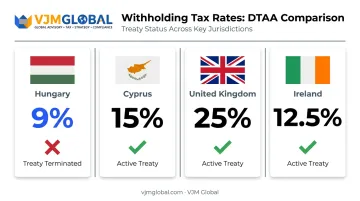
Hungary maintains the lowest corporate tax rate in the EU at 9%. That's attractive, but there's a catch: the US terminated its tax treaty with Hungary, effective January 2023. That removes a layer of protection against double taxation that founders in other countries still enjoy.
Cyprus previously advertised a 12.5% rate, but that changed. As of January 1, 2026, Cyprus's corporate tax rate rose to 15%. It still maintains an active US tax treaty and a strong network of double-taxation agreements, which keeps it popular for holding company structures despite the rate increase.
| Country | Corporate Tax Rate | US Tax Treaty Status |
|---|---|---|
| Hungary | 9% | Terminated (Jan 2023) |
| Cyprus | 15% (as of Jan 2026) | Active |
| UK | 25% (main rate) | Active |
| Ireland | 12.5% | Active |
UK and Ireland: Best for Market Access and Familiar Legal Systems
For American founders, the UK and Ireland feel like home turf. Both use common-law systems, English-language filings, and processes that don't require translating unfamiliar legal concepts.
- UK: Online incorporation usually completes within 24 hours; registration fee is around £100 (roughly $125)
- Ireland: Standard online filing (Form A1) typically takes 5–10 working days; fee is €50
Both countries maintain active US tax treaties. The IRS's UK tax treaty documentation confirms this for the UK specifically, giving founders clearer footing on double-taxation relief. With the country shortlisted, the next step is understanding what the registration process actually involves.
Step-by-Step Process to Register a Company in Europe
The mechanics are largely consistent across countries, even though the details shift.
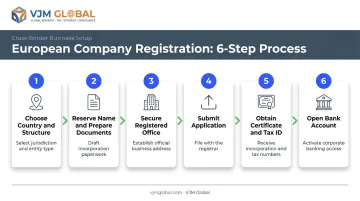
- Choose your country and legal structure based on tax goals, target market, and how quickly you need to be operational
- Reserve a company name and prepare documents — Articles of Association, shareholder and director details, passport copies
- Secure a registered office address in your chosen country, often through a virtual office or formation agent service
- Submit your application to the local company registry, either directly online or through an authorized agent, and pay the registration fee
- Obtain your certificate of incorporation, tax identification number, and VAT registration if your business requires it
- Open a corporate bank account: expect additional KYC/AML documentation, and budget more time here than for the registration itself
That last step trips up more founders than any other part of the process. We'll cover it in detail below.
Costs, Timelines, and Tax Compliance for US Business Owners
Budget roughly $75 to $2,700+, depending on country and entity type. Registration itself moves fast in some places and moves slowly in others:
- Estonia: 1–2 days (after digital ID approval)
- UK: Usually 24 hours online
- Ireland: 5–10 working days
- Cyprus: No fixed timeline published, though expedited service is available for an extra fee
- Hungary: 1–3 weeks in practice
- Germany: No fixed national timeline; notary and capital deposit steps control the pace
Why Tax Treaties Outweigh the Headline Rate
Double taxation treaties often matter more than the headline tax rate. A country with a slightly higher corporate rate but an active US treaty can leave you better off than a low-tax country with no treaty protection. Hungary's 9% corporate rate is one of the lowest in Europe, but treaty status can shift, so confirm the current US-Hungary treaty terms with a tax advisor before assuming that rate translates into real savings.
Once your company is live, compliance doesn't stop. Track these ongoing obligations:
- Annual filings with the local company registry
- VAT returns, if your business crosses the local threshold
- US-side reporting, including FBAR for foreign accounts and Form 5471 for foreign corporation ownership
Skipping any of these isn't a minor paperwork slip. Penalties on both sides of the Atlantic add up quickly.
Opening a Bank Account and Managing Ongoing Compliance
If registration is the easy part, banking is where reality sets in. EU anti-money laundering rules require banks to verify not just your company, but every beneficial owner and the purpose of the account itself, per EU Directive 2015/849.
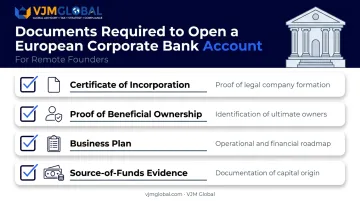
Expect banks to request:
- Certificate of incorporation and constitutional documents
- Proof of beneficial ownership, often down to individual shareholders
- Business plan outlining what the company actually does
- Source-of-funds evidence showing where your capital originated
This verification process gets stricter for remote applicants, meaning founders who never visit the bank in person. Some banks require video verification or additional documentation before approving non-resident accounts.
Once the account is open, the real work begins: bookkeeping, tax filings, and staying ahead of two countries' worth of deadlines simultaneously. Many founders underestimate this ongoing burden, treating registration as the finish line rather than the starting point.
Building a relationship with a local accountant or compliance advisor early on prevents small filing gaps from turning into penalties down the road. Budgeting for this support from day one is far cheaper than fixing missed deadlines after the fact.
Frequently Asked Questions
How do I register my company in Europe?
Choose a country and legal structure, then prepare incorporation documents like your Articles of Association and passport copies. Submit these to the local registry, often online, then obtain your tax ID and open a bank account.
Can a non-EU (for example, American) citizen register a company in Europe?
Yes. Most European countries permit 100% foreign ownership for non-EU citizens. Some jurisdictions, like Ireland, require a local director or a bond if you don't have an EEA resident on your team.
What is the easiest EU country to register a company in?
Estonia is the easiest, thanks to its e-Residency program. Once your digital ID is approved, company formation typically takes just 1-2 days.
Does Europe have an equivalent to an LLC?
Structures like the UK Ltd, Estonian OÜ, or German GmbH offer similar limited-liability protection. They differ from a US LLC in taxation and governance, functioning more like small corporations.
Do I need to live in Europe to own and run a company there?
No. Most countries allow full remote ownership and management. You'll still need a local registered address, and in some cases, a local director or agent.
How long does it take to register a company in Europe as an American?
It ranges from a few hours in Estonia to a few weeks in the UK, Ireland, or Cyprus. Bank account opening usually takes longer than the registration itself, which is where cross-border advisors like VJM Global can help speed things along.