Introduction
Getting GST registration wrong costs Indian businesses more than time. It costs them input tax credit, client trust, and sometimes a penalty notice they never saw coming.
Avoiding this starts with understanding what GST registration actually involves. GST registration is the process by which a business obtains a unique GSTIN (Goods and Services Tax Identification Number) from Indian tax authorities, authorizing it to legally collect and remit GST. This applies to Indian companies, startups, foreign subsidiaries, and NRIs or OCIs setting up operations in India.
Many businesses misjudge the turnover thresholds, miss registration deadlines, or submit mismatched documents that trigger rejection notices. These errors delay operations and invite closer scrutiny from tax authorities.
This guide walks through eligibility rules, the full step-by-step process, common pitfalls, and what happens after you're registered.
Key Takeaways
- GST registration is mandatory once turnover crosses set thresholds or your business falls under specific mandatory categories
- Applications run entirely through the GST portal, with approval in 7 working days once documents check out
- Foreign entities and NRIs without an Indian establishment typically need Non-Resident Taxable Person (NRTP) registration with distinct deposit rules
- Mismatched documents and incorrect business details remain the top reasons applications get delayed or rejected
- Professional guidance helps foreign-owned entities avoid structuring errors domestic filers rarely encounter
What Is GST Registration?
GST registration enrolls a business under India's Goods and Services Tax regime, resulting in a 15-digit GSTIN. Once issued, this number authorizes the business to collect GST from customers, claim input tax credit on purchases, and file periodic returns.
GST registration is a tax compliance step, separate from any business formation registrations you may already hold. It differs from:
- Company incorporation with the Ministry of Corporate Affairs (MCA)
- PAN/TAN registration with the Income Tax Department
- Shop & Establishment license issued by state labor departments
You can incorporate a company and never need GST registration if your turnover stays under the threshold and none of the mandatory triggers apply. Conversely, a sole proprietor with no formal incorporation may still need to register the moment they cross the limit.
Decoding the GSTIN Structure
Under Rule 10(1) of the CGST Rules, a GSTIN follows a fixed 15-character format:
| Position | Content |
|---|---|
| 1–2 | State code |
| 3–12 | PAN (or TAN for specified deductors) |
| 13–14 | Entity code |
| 15 | Checksum character |
Recognizing this structure helps you spot an invalid or fabricated GSTIN when verifying a vendor or client.
Four Registration Categories
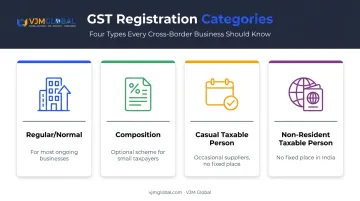
Not every business registers the same way. The GST portal supports four distinct categories:
- Regular/Normal – the standard route for most ongoing businesses
- Composition – an optional simplified levy scheme for eligible small taxpayers
- Casual Taxable Person (CTP) – for occasional suppliers with no fixed place of business in that state
- Non-Resident Taxable Person (NRTP) – for those with no fixed place of business or residence in India at all
Who Needs to Register for GST in India
Registration hinges on two things: your turnover, and whether you fall into a category that requires registration no matter what you earn.
Turnover Thresholds
Following Notification 10/2019, effective 1 April 2019, the exemption limits break down like this:
| Supply Type | Threshold | Applicable Region |
|---|---|---|
| Exclusive supply of goods | ₹40 lakh | Most states/UTs |
| Exclusive supply of goods | ₹20 lakh | Arunachal Pradesh, Manipur, Meghalaya, Mizoram, Nagaland, Puducherry, Sikkim, Telangana, Tripura, Uttarakhand |
| Services or mixed supplies | ₹20 lakh | Generally applicable |
| Services or mixed supplies | ₹10 lakh | Manipur, Mizoram, Nagaland, Tripura |
The ₹40 lakh goods exemption excludes ice cream, pan masala, and tobacco manufacturers, along with anyone already caught by a mandatory category below. Thresholds are notification-driven and can shift, so always confirm current limits on the GST portal before assuming you're exempt.
Mandatory Registration Categories
Certain businesses must register regardless of turnover. These include:
- Interstate taxable suppliers
- Casual taxable persons and non-resident taxable persons
- E-commerce operators required to collect TCS, and specified sellers through them
- TDS/TCS deductors under Section 51
- Agents supplying goods or services on behalf of other taxable persons
- Input Service Distributors
- OIDAR (online information and database access) service providers supplying to unregistered persons in India
- Anyone liable to pay tax under reverse charge
There are carve-outs worth knowing. Since October 2023, qualifying intra-state goods sellers operating through one e-commerce platform within a single state can stay unregistered under specific conditions, so not every online seller is automatically caught.
Exemptions and Voluntary Registration
Registration isn't required if you deal exclusively in exempted goods or services, or if your turnover sits below threshold with no mandatory trigger applying. Agriculturists supplying only produce from their own cultivation also fall outside the requirement.
Plenty of businesses under the threshold register anyway. Common reasons include:
- Claiming input tax credit on business purchases
- Building credibility with B2B clients who prefer GST-registered vendors
- Avoiding a scramble later when growth pushes turnover past the limit
Step-by-Step GST Registration Process
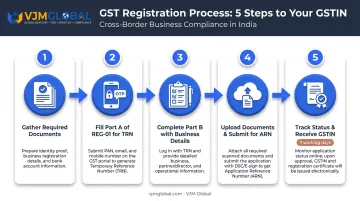
The entire flow runs online through the GST portal, from document upload to GSTIN issuance. Here's what to prepare and how each stage unfolds.
Step 1: Gather Required Documents
Document needs vary by entity type. At minimum, expect to submit:
| Entity Type | Core Documents |
|---|---|
| Proprietorship | Proprietor's photograph, principal place-of-business proof |
| Partnership | Partnership deed, partner photographs, place-of-business proof |
| LLP | Certificate of incorporation, stakeholder photographs, authorization/resolution evidence |
| Private limited company | Certificate of incorporation, director photographs, board resolution, place-of-business proof |
| Foreign entity (Non-Resident Taxable Person – NRTP) | Passport, foreign tax ID, business constitution evidence, an Indian authorized signatory |
Accepted place-of-business proof includes a property tax receipt, electricity bill, rent agreement, or municipal khata. If you're a foreign national, passports typically need notarization by the relevant embassy, and any non-English documents need certified translation.
Step 2: Fill Part A of GST REG-01
Applicants enter the legal name (as per PAN), PAN, mobile number, and email in Part A. Separate OTP verification on both mobile and email generates a Temporary Reference Number (TRN), which you'll use to resume the application.
Step 3: Complete Part B With Business Details
Log back in using the TRN to finish Part B. This section covers:
- Business details and principal place of operation
- Promoter/partner information
- Authorized signatory details, including their designation (Proprietor, Partner, Director, or Authorized Signatory)
- Goods/services details with HSN or SAC codes
Bank account details are typically added after GSTIN is granted, through a non-core amendment, rather than as a Part B prerequisite.
Step 4: Upload Documents and Submit for Verification
Once every field is complete, upload the supporting documents and authenticate the application. Companies and LLPs must use a Digital Signature Certificate (DSC); other applicants can use e-sign or EVC. Successful submission generates an Application Reference Number (ARN), your tracking ID for everything that follows.
Step 5: Track Application Status and Receive GSTIN
Use the ARN under Services > Registration > Track Application Status to check progress. Applications typically move through these stages:
- Pending for Processing – under initial review
- Pending for Clarification – officer has raised a query (Form REG-03); you must respond within 7 working days via REG-04
- Approved – GSTIN issued and registration certificate generated
- Rejected – application declined, usually due to unresolved discrepancies
Standard applications are approved within 7 working days. Cases requiring Aadhaar authentication issues, risk flags, or physical verification can take up to 30 days, per CBIC's April 2025 instruction.
Common Mistakes, Penalties, and Why Professional Guidance Matters
Most rejected applications share a common thread: preventable errors, not complex circumstances.
Where Applications Go Wrong
- Name and address mismatches between PAN records and business documents
- Incorrect HSN/SAC code selection for goods or services offered
- Missing or invalid authorized signatory proof
- Outdated address proof (bank statements and utility bills should be no more than 2–3 months old)
- Uncertified or untranslated documents for foreign nationals, which stall NRTP applications
Each of these triggers a clarification notice at best, or outright rejection at worst, adding weeks to a process that should take days.
The Cost of Skipping Registration
Operating without registration when you're legally required to hold one isn't a minor oversight. Under Section 122(1)(xi) of the CGST Act, the penalty is ₹10,000 or an amount equal to the tax evaded, whichever is higher. That "equivalent amount" clause means the penalty can effectively double your tax liability, on top of losing input tax credit for the unregistered period.
Where Professional Support Pays Off
Given the size of these penalties, most foreign investors bring in an experienced GST practitioner rather than risk costly mistakes on their own. Foreign companies, NRIs, and OCIs entering India also face structuring questions domestic applicants rarely encounter: Does a branch office need NRTP registration, or does the underlying subsidiary register normally? What documentation satisfies a foreign passport requirement? How is the authorized signatory appointed when directors live abroad?
VJM Global's team of Chartered Accountants runs a structured process for these situations, starting with a business analysis of supply type and registration category before a single document is submitted.
Clarification queries from the GST department are common with cross-border structures. When they arise mid-process, VJM Global's consultants interpret and respond on the client's behalf, rather than leaving the applicant to decode tax department language alone.

Post-Registration Compliance and Maintaining Active GST Status
Getting your GSTIN is only the first step. Registered businesses must file returns on schedule to keep their registration active.
Normal and casual taxpayers typically file GSTR-1 (outward supply details) and GSTR-3B (summary return with tax payment), due monthly or quarterly depending on your filing scheme.
Composition scheme taxpayers and non-resident foreign taxpayers follow different return formats entirely, so don't assume GSTR-1/GSTR-3B applies universally. Missing these deadlines carries consequences beyond late fees.
What Puts Your Registration at Risk
- Suspension – can occur while cancellation proceedings are pending, if the officer believes grounds for cancellation exist
- Cancellation – triggered by non-filing for six consecutive months (monthly filers) or two consecutive tax periods (quarterly filers), among other non-compliance grounds
- Voluntary cancellation – when a business closes or restructures
Check your current status anytime using your GSTIN on the GST portal. If your business structure changes, or you cross a new threshold that shifts your registration category, you'll usually need to amend the existing registration rather than start a fresh application.
Firms like VJM Global track these deadlines and handle registration amendments for businesses expanding into India.
Frequently Asked Questions
What is the meaning of designation status in a GST registration application?
Designation refers to the applicant's role within the business, such as Proprietor, Partner, Director, or Authorized Signatory, entered in the GST REG-01 form. It determines who has the authority to sign and submit the application on the business's behalf.
How do I check the status of my GST registration?
It shows the current stage of your application or existing registration, such as Pending for Processing, Approved, Suspended, or Cancelled. Track it via ARN (for applications) or GSTIN (for existing registrations) on the GST portal.
How long does it take to get GST registration in India?
Standard applications are approved within 7 working days once documents are verified. Cases involving Aadhaar authentication issues, risk flags, or clarification requests can extend this to 30 days.
What is the penalty for not registering under GST when required?
Under Section 122(1)(xi) of the CGST Act, the penalty is ₹10,000 or an amount equal to the tax evaded, whichever is higher. This applies on top of losing input tax credit for the unregistered period.
Can a foreign company register for GST in India without a local office?
Yes, through the Non-Resident Taxable Person (NRTP) route using Form REG-09, filed at least 5 days before starting business. It requires an advance tax deposit and an authorized signatory based in India.
Is there any fee for GST registration in India?
Registering directly on the GST portal carries no government fee. If you engage a consultant or CA firm like VJM Global to manage the process, professional service fees apply separately.