But "simple" doesn't mean "foolproof." The deed clauses, document list, and filing steps often trip up first-time applicants, and a rejected application can set your launch back by weeks. This guide walks through eligibility, the exact registration steps with the Telangana Registrar of Firms, required documents, cost factors, common mistakes, and how to decide between a Partnership Firm, LLP, or Private Limited Company.
Key Takeaways
- Telangana's Registrar of Firms, not the Ministry of Corporate Affairs (MCA), handles registration
- Registration isn't mandatory, but unregistered firms can't sue third parties to enforce contracts
- Core process: draft a stamped deed, file Form I, and pay the fee
- Choose Partnership, LLP, or Pvt Ltd based on liability, funding, and compliance needs
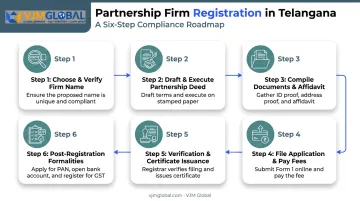
How to Register a Partnership Firm in Telangana: Step-by-Step Process
Telangana runs its partnership registration through an online portal, though original documents still need to reach the District Registrar physically. Here's how the process unfolds from start to finish.
Step 1: Choose and Verify a Unique Firm Name
Your firm's name can't be identical or deceptively similar to an existing firm, LLP, company, or registered trademark. It also can't include certain restricted terms.
Section 58(3) of the Indian Partnership Act specifically bars names using "Crown," "Emperor," "Empress," "Empire," "Imperial," "King," "Queen," "Royal," or any wording implying government sanction, approval, or patronage, unless the State Government gives written consent.
Before finalising a name, it's worth running two quick checks: a MCA name search to confirm no registered company or LLP uses an identical name, and a trademark search on the IP India portal to avoid future goodwill disputes. Neither is an official Telangana approval, but both count as smart due diligence that can save you from a rebranding headache down the line.
Step 2: Draft and Execute the Partnership Deed
The Partnership Deed is the foundation document of your firm. It must be printed on stamp paper of appropriate value (based on your declared capital contribution) and signed by every partner.
At minimum, the deed should cover:
- Firm name and principal place of business
- Nature of the business
- Capital contribution of each partner
- Profit and loss sharing ratio
- Duration of the partnership (if fixed)
Beyond these basics, well-drafted deeds also include clauses on partner remuneration, interest on capital, admission or retirement of partners, and dispute resolution mechanisms. Skipping these often leads to messy disagreements later, especially when a partner wants to exit or a dispute over profit-sharing surfaces years down the line.
Step 3: Compile Required Documents and Affidavit
Telangana's official checklist for Form I is fairly lean, listing the original Form I, a copy of the partnership deed, and ID proof of the partners. In practice, most District Registrar offices also expect:
- Address proof of each partner
- Address proof for the principal place of business (rent agreement or ownership document)
- An affidavit affirming that the submitted details are true and correct
Having all of this ready before you file avoids a back-and-forth with the Registrar's office that can stretch your timeline unnecessarily.
Step 4: File the Application with the Registrar of Firms and Pay Fees
Applications go to the District Registrar of Firms covering your principal place of business. Filing typically starts online through the Telangana e-Registration of Firms service, where you enter details, upload documents, and make the payment.
The original papers then need to reach the District Registrar afterward, by courier, registered post, or in-person drop-off.
Fees are charged on a nominal per-partner basis, plus stamp duty that varies with your declared capital contribution. Because these figures are revised periodically, always confirm the current fee schedule directly on the Telangana Registration Department's portal before filing.
Step 5: Verification and Issuance of Registration Certificate
Once your originals reach the District Registrar, a Senior Assistant or Registrar's staff compares the documents against your online submission. After verification, the entry gets recorded in the Register of Firms, and the District Registrar approves and digitally signs the certificate.
Processing time depends heavily on document accuracy and how busy your local Registrar's office is. Firms that submit clean, complete paperwork the first time generally move through this stage far faster than those needing multiple rounds of corrections.
Step 6: Complete Post-Registration Formalities
Registration isn't the finish line. Three formalities typically follow right away:
- Apply for a firm PAN using Form 49A. A partner other than a minor signs the application, and either the partnership deed or the registration certificate serves as identity/address proof.
- Open a current bank account in the firm's name, using the registration certificate, deed copy, and firm PAN as your core KYC documents.
- Register for GST if your turnover crosses the threshold. Telangana's GST registration threshold sits at ₹20 lakh for both goods and services, subject to compulsory registration rules for certain categories of suppliers.
Many foreign founders bring in firms like VJM Global at this stage, since PAN, GST, and bookkeeping setup often need to happen within days of receiving the registration certificate.
What You Need Before Registering: Eligibility, Documents & Expert Support
Eligibility Criteria for a Partnership Firm
A partnership needs a minimum of two partners, each with the legal capacity to enter into a contract. Minors, for instance, can be admitted only to the benefits of a partnership, not as full partners.
On the upper end, the Companies Act rules cap partnership membership at 50 persons. Beyond that number, the business must register as a company or operate under a different law entirely.
Eligible partners can include individuals, Hindu Undivided Families, companies (where permitted), and trustees of family or religious trusts.
Documents Checklist for Registration
For a smooth filing, keep these ready:
- Certified copy of the Partnership Deed
- Form No. 1 application
- Identity and address proof of all partners (PAN, Aadhaar, or voter ID)
- Address proof of the principal place of business
- NOC from the property owner, if the office premises are rented
Applications most often bounce back due to mismatched PAN and Aadhaar details or an improperly stamped deed. Both issues are entirely avoidable with a careful pre-submission review.
Firms with more complexity, such as NRI partners, multi-tiered capital structures, or deeds with several custom clauses, often bring in professionals like VJM Global. These experts draft compliant deeds and handle document filing correctly the first time, avoiding delays from an inexperienced first attempt.
Key Factors That Affect Your Registration and Common Mistakes to Avoid
Key Factors That Affect Your Registration
- Stamp duty on the deed scales with your declared capital contribution, directly affecting your upfront cost
- Your District Registrar's location, based on your principal place of business, influences processing speed and any local documentation quirks
- Clarity in your deed's profit-sharing and exit clauses reduces the odds of future litigation between partners.
Common Mistakes to Avoid
Getting these factors right doesn't guarantee a smooth approval, though. Most rejection notices trace back to one of a handful of avoidable errors:
- Picking a firm name too close to an existing entity or trademark, inviting rejection or a later dispute over goodwill
- Relying on an oral or unstamped deed, which holds no value for tax or legal purposes
- Delaying the PAN application or bank account setup after registration, which stalls billing, vendor payments, and compliance timelines
Partnership Firm vs LLP vs Private Limited Company: Which Structure Fits Your Business
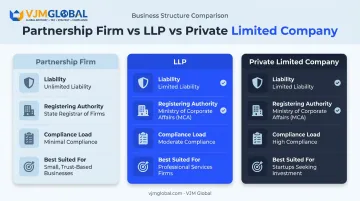
Choosing the right structure comes down to how much liability protection you need versus how much compliance you're willing to manage.
| Factor | Partnership Firm | LLP | Private Limited Company |
|---|---|---|---|
| Liability | Unlimited, personal | Limited to capital contribution | Limited to unpaid share value |
| Registering authority | State Registrar of Firms | MCA (via FiLLiP) | MCA (via SPICe+ Part B) |
| Compliance load | Minimal | Moderate | Higher |
| Best suited for | Small, family-run, or professional practices | Businesses wanting liability protection without heavy compliance | Startups planning to raise equity funding |
A Partnership Firm works well for small, family-run, or professional practices comfortable accepting personal liability in exchange for minimal paperwork.
An LLP suits businesses that want limited liability protection with moderate compliance, registered centrally through the MCA rather than a state Registrar. LLPs file through the FiLLiP form, not SPICe+, which is reserved for companies.
A Private Limited Company fits startups planning to raise equity funding or scale quickly, even though it carries the highest compliance burden of the three.
Foreign-backed founders face one more consideration before finalizing a structure: FEMA rules govern how much capital they can contribute and how. For NRIs, OCIs, and foreign-backed founders, capital contributions to an Indian firm are permitted under FEMA rules, but only on a non-repatriation basis through banking channels. These contributions are never allowed for agricultural, plantation, or real estate businesses.
VJM Global's business setup team helps founders and OCIs/NRIs assess purpose, FDI permissibility, and long-term goals before recommending a structure.
Frequently Asked Questions
What documents are required for firm registration in Telangana?
You'll need the partnership deed, Form No. 1, ID and address proof of all partners, and address proof of your business premises (plus an NOC if rented). Most District Registrar offices also expect a supporting affidavit.
How to register a company in Hyderabad?
Company registration (Pvt Ltd, OPC, or LLP) happens online through the MCA's SPICe+ Part B form for companies, or FiLLiP for LLPs. This differs entirely from state-level partnership firm registration through Telangana's Registrar of Firms.
What is the cost of company registration in Hyderabad?
Company registration costs vary based on authorised capital, stamp duty, and professional fees. Partnership firm registration is comparatively cheaper, involving a nominal per-partner state fee plus stamp duty on the deed.
Is partnership firm registration mandatory in Telangana?
No, registration is optional under the Indian Partnership Act, 1932. However, an unregistered firm can't sue third parties to enforce contracts, making registration strongly advisable for credibility and legal protection.
How long does it take to register a partnership firm in Telangana?
Processing time depends on document accuracy and your District Registrar's workload. Firms that submit clean, complete documents the first time generally see faster turnaround than those needing corrections.
Can NRIs or foreign nationals register a partnership firm in Telangana?
NRIs and OCIs can contribute capital to an Indian partnership on a non-repatriation basis under FEMA rules, subject to sector restrictions. Given the cross-border compliance involved, firms like VJM Global that specialize in FEMA advisory can help structure the contribution correctly before filing.