Introduction
India has become one of the most attractive emerging markets for UK investors. With over 450,000 active LLPs registered as of late 2025—representing 21.8% year-on-year growth—the country offers a dynamic ecosystem for foreign businesses.
For UK investors entering India, a Limited Liability Partnership (LLP) is one of the most accessible and cost-effective entry routes available. All LLP registrations are governed by the Limited Liability Partnership Act, 2008 and processed through the Ministry of Corporate Affairs (MCA).
LLP registration costs are not fixed — they vary significantly based on capital contribution size, registration state, number of partners, and whether foreign stakeholders are involved. UK investors also face a distinct layer of obligations that Indian nationals do not, including:
- Apostille fees for overseas documents
- Higher Digital Signature Certificate (DSC) charges
- FEMA (Foreign Exchange Management Act) advisory requirements
This guide breaks down every cost component UK investors must budget for—from MCA government fees to UK-specific documentation expenses—so you can build an accurate financial plan before beginning the registration process.
Key Takeaways
- Total LLP registration cost typically ranges from ₹5,000 to ₹15,000+ (approximately £50–£145), covering government fees, DSC, and professional charges
- UK investors pay extra for apostille (£35–£100/document), notarisation (£40–£100+VAT), and DSC charges (₹9,000–₹15,000, compared to ₹1,350 for Indian residents)
- Capital contribution is the primary cost driver—MCA filing fees increase with capital size across four official slabs
- At least one designated partner must be an Indian resident (120+ days in India)—budget for the cost of appointing one if needed
- Ongoing compliance (Form 8, Form 11, tax filing) carries penalties of ₹100/day per form for late filing—with no upper cap
How Much Does LLP Registration in India Cost?
LLP registration does not have a single fixed price. Total outlay is determined by a combination of government-mandated fee slabs, state-specific stamp duty, professional service charges, and—for UK investors—cross-border documentation costs that can push your budget well beyond initial figures.
UK investors commonly underestimate total costs by focusing only on MCA government fees and overlooking state stamp duty variations. Failing to budget for foreign partner documentation — apostille, notarisation, and premium DSC charges — can inflate final costs by 40–60% beyond initial projections.
Lean Registration (Capital below ₹1 Lakh)
- RUN-LLP name reservation: ₹200
- Form FiLLiP incorporation fee: ₹500
- Form 3 LLP Agreement filing: ₹50
- DSC for 2 designated partners: ₹800–₹1,500 each (Indian residents)
- DIN included in FiLLiP for up to 2 partners at no extra charge
- Total government fees: approximately ₹1,200–₹2,500 before professional costs
This tier suits UK-based consultants, freelancers, or small service businesses testing the Indian market with nominal initial contribution and low overhead. VJM Global has assisted 250+ UK businesses with India market entry — including lean LLP setups for service providers at exactly this scale.
Mid-Range Registration (Capital ₹1 Lakh to ₹10 Lakhs)
- Higher MCA filing fees: ₹2,000–₹4,000 per form (FiLLiP and Form 3)
- State stamp duty: varies by location (₹500–₹10,000)
- Professional fees: ₹4,000–₹9,000
- Total typically: ₹10,000–₹20,000 when factoring in all components
Best For: Small-to-medium UK businesses entering India in sectors like professional services, IT consulting, or trading. Most UK investors registering an LLP for the first time land in this capital range.
Higher-Contribution Registration (Capital Above ₹10 Lakhs)
- MCA filing fees capped at ₹5,000 per form (FiLLiP and Form 3)
- Stamp duty climbs significantly with capital size—varies dramatically by state
- Professional fees may increase with agreement complexity
- Total can exceed ₹25,000–₹30,000+ depending on state
Best For: UK businesses with larger India market commitments seeking a well-capitalised LLP for long-term operations.
Note: LLPs in this tier trigger mandatory audit requirements if capital exceeds ₹25 lakh or annual turnover exceeds ₹40 lakh — factor this into your ongoing compliance budget.
Key Factors That Affect LLP Registration Costs
Total registration cost is shaped by both regulatory and business-specific variables. UK investors should understand each lever before finalising budgets.
Capital Contribution Slab
MCA fees for both Form FiLLiP (incorporation) and Form 3 (LLP Agreement filing) are directly tied to capital contribution. The same slab table applies to both forms, effectively doubling the impact of higher capital on government fees.
Official Capital Contribution Slabs and Fees:
| Capital Contribution | FiLLiP Fee | Form 3 Fee |
|---|---|---|
| Up to ₹1,00,000 | ₹500 | ₹50 |
| ₹1,00,001 to ₹5,00,000 | ₹2,000 | ₹100 |
| ₹5,00,001 to ₹10,00,000 | ₹4,000 | ₹150 |
| Above ₹10,00,000 | ₹5,000 | ₹200 |
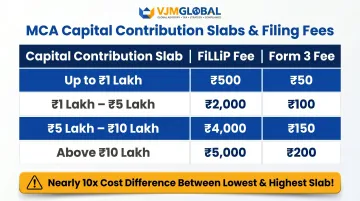
A UK investor with ₹12 lakh capital pays ₹5,200 in government filing fees (FiLLiP + Form 3), while an investor with ₹75,000 capital pays just ₹550—a nearly 10x difference driven solely by capital slab.
State of Registration and Stamp Duty
Stamp duty on the LLP Agreement is a state-level charge that varies dramatically across India. Some states levy nominal duty; others can cost ₹10,000+ for higher-capital LLPs.
State Stamp Duty Examples:
| State | Stamp Duty Basis | Rate/Amount | Maximum Cap |
|---|---|---|---|
| Tamil Nadu | Flat fee | ₹300 | Fixed |
| Rajasthan | Flat fee | ₹500 | Fixed |
| Telangana | Flat fee | ₹500 | Fixed |
| Delhi | % of capital | 1% of capital | ₹5,000 |
| Gujarat | % of capital | 1% of capital | ₹10,000 |
| Maharashtra | % of capital | 1% of capital | ₹50,000 |
For a UK investor with ₹10,00,000 capital, stamp duty ranges from ₹300 in Tamil Nadu to ₹10,000 in Maharashtra—a 33x difference. State selection is a material cost decision, particularly for higher-capital LLPs.
Number of Designated Partners
Each designated partner requires a Digital Signature Certificate (DSC) and a DIN. Costs differ significantly based on where partners are based:
- DSC — Indian residents: ₹800–₹1,500 per partner
- DSC — UK-based partners: ₹9,000–₹15,000 per partner via international certifying authorities (approximately 6–7x the Indian rate)
- DIN via FiLLiP: Free for the first two designated partners
- Additional DINs: ₹500 per partner via separate DIR-3 filing
For UK investors with multiple foreign partners, DSC costs alone can add ₹18,000–₹30,000 to the total budget.
Choice and Expertise of Professional Services
The FEMA and FDI requirements that apply to UK investors add a layer of complexity that standard Indian LLP registrations don't carry. Professional fees for a straightforward domestic LLP typically run ₹4,000–₹9,000, but advisors with cross-border India expertise—covering FEMA compliance, FDI rule applicability, and customised LLP Agreement drafting for foreign partners—charge more to reflect that scope.
For UK investors, that additional fee is a practical safeguard. Errors in FEMA filings or LLP Agreement terms can trigger penalties that far exceed the cost of getting specialist advice upfront. VJM Global has supported 250+ UK businesses through India entry, including LLP registration, FEMA advisory, and post-incorporation compliance.
Complete LLP Registration Cost Breakdown
LLP registration in India involves five distinct cost categories — government fees, digital signatures, stamp duty, professional fees, and annual compliance. For a UK investor, total first-year costs typically range from ₹25,000 to ₹60,000+ depending on capital contribution, state, and engagement scope.
For a ₹10 lakh capital LLP, total MCA fees come to approximately ₹4,350.
MCA Government Fees
One-Time
Covers three mandatory filings:
- RUN-LLP name reservation: ₹200
- Form FiLLiP incorporation fee: ₹500–₹5,000 (based on capital slab)
- Form 3 LLP Agreement filing: ₹50–₹200 (based on capital slab)
Digital Signature Certificates (DSC)
One-Time (renewable)
Cost per designated partner:
- Indian residents: ₹800–₹1,500
- UK-based partners (Foreign Class 3 DSC): ₹9,000–₹15,000
Required for all partners to sign MCA forms electronically. UK-based partners must obtain DSCs from MCA-authorised certifying agencies. The Foreign Class 3 DSC runs roughly 6–7x the Indian resident rate, reflecting the enhanced identity verification required for non-resident applicants.

Stamp Duty on LLP Agreement
One-Time
Varies by state and capital contribution. Pay stamp duty before or when executing the LLP Agreement. Many UK investors underestimate this cost — it ranges from ₹500 to ₹10,000+ depending on the state and capital contribution.
An unstamped or insufficiently stamped LLP Agreement is not legally enforceable in Indian courts and may be rejected by MCA.
Professional and Legal Fees
One-Time (for registration)
Typically ₹4,000–₹9,000 for standard Indian LLP registrations. Fees increase when the engagement includes:
- FEMA advisory for foreign stakeholder compliance
- Drafting of a customised LLP Agreement
- Coordination with foreign partners
- Sector-specific compliance review
For UK investors, FEMA advisory and foreign partner coordination are typically necessary additions — budget for the higher end of this range.
Post-Registration Annual Compliance Costs
Recurring
Mandatory annual filings:
- Form 11 (Annual Return): Due 30 May each year
- Form 8 (Statement of Accounts and Solvency): Due 30 October each year
Non-compliance attracts a penalty of ₹100 per day per form with no cap. A one-year delay on both forms accumulates approximately ₹73,000 in penalties (₹100/day × 2 forms × 365 days).
Statutory audit is mandatory if:
- Annual turnover exceeds ₹40 lakh, OR
- Capital contribution exceeds ₹25 lakh
Approximate annual professional fees for basic Form 8 and Form 11 filings: ₹5,000–₹15,000 for small LLPs. Audit and tax filing add further costs.
Additional Costs UK Investors Must Budget For
UK investors face a distinct set of costs not relevant to Indian nationals, arising from foreign partner documentation requirements, FDI regulations, and cross-border compliance obligations.
Foreign Partner Documentation and Apostille Charges
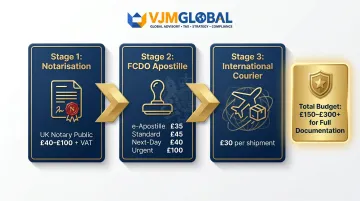
UK partners must submit notarised and apostilled identity and address proof documents (passport, overseas address verification). Apostille authentication in the UK is managed through the Foreign, Commonwealth and Development Office (FCDO).
FCDO Apostille Fees (per document):
| Service Type | Fee (GBP) | Processing Time |
|---|---|---|
| Standard (paper-based) | £45 + courier | Up to 15 working days |
| e-Apostille | £35 | Up to 2 working days |
| Next-Day | £40 | Next working day |
| Restricted Urgent | £100 | Same day |
UK Notarisation Fees: £40–£100+VAT per document for standard certification. Private documents (powers of attorney, contracts, ID copies) must be certified by a UK notary public or solicitor before apostille.
Document courier from UK to India adds further cost (approximately £30 per 1.5kg international shipment). UK investors with multiple partners should budget £150–£300+ for complete foreign documentation and legalisation.
FEMA and FDI Compliance Considerations
LLPs in India can receive Foreign Direct Investment (FDI) under the automatic route only where 100% FDI is permitted and no FDI-linked performance conditions apply. LLPs are restricted from FDI in sectors requiring government approval, those with FDI caps below 100%, or those carrying performance conditions.
Sectors explicitly prohibited for FDI in LLPs:
- Agricultural and plantation activities
- Print media
- Real estate business
- NBFCs, construction-development projects, multi-brand retail (sectors with performance conditions)
Additionally, FEMA filings may be required post-registration for inward remittances. Professional FEMA advisory fees typically range from ₹15,000–₹50,000+ depending on complexity.
FEMA penalties for non-compliance: Up to 3 times the sum involved in contravention (where quantifiable), or up to ₹2,00,000 where the amount is not quantifiable, plus up to ₹5,000 per day for continuing contraventions. Given the scale of potential penalties, engaging a FEMA advisor before remitting capital is the lower-cost option.
Mandatory Indian Resident Designated Partner
Indian law requires at least one designated partner to be resident in India (present for at least 120 days during the financial year). This threshold was reduced from 182 days to 120 days effective April 1, 2022 under the LLP Amendment Act, 2021.
UK investors without an existing Indian partner must identify and formally appoint one — which typically involves drafting a designated partner arrangement and associated legal fees. Sourcing a compliant resident partner is often the most time-sensitive step in the setup process.
VJM Global has assisted 250+ UK businesses with India entry, including navigating resident partner requirements, FEMA compliance, and full LLP registration.
What UK Investors Commonly Get Wrong About LLP Registration Costs
Three planning mistakes come up repeatedly among UK investors entering the Indian market through an LLP structure:
- MCA fees are only part of the total cost. Stamp duty, DSC procurement, and professional fees frequently exceed government fees combined. Investors who quote only the ₹500–₹5,000 FiLLiP fee range typically underestimate their actual outlay by 60–80%.
- LLP and Private Limited Company costs are not interchangeable decisions. LLPs do carry lower ongoing compliance costs, but Private Limited Companies face fewer FDI restrictions — including access to VC and institutional equity. For UK businesses planning future fundraising rounds, "cheaper to register" is not the same as "right structure."
- Late ROC filing penalties accumulate fast. The ₹100-per-day-per-form penalty has no upper cap, meaning a neglected annual filing can spiral into a significant liability. Budget for professional compliance management (₹5,000–₹15,000+ annually) rather than assuming you can monitor Indian regulatory deadlines from the UK.

Frequently Asked Questions
How much does LLP registration cost in India?
Total LLP registration cost typically ranges from ₹5,000 to ₹15,000+ (approximately £50–£145), depending on capital contribution slab, state stamp duty, number of designated partners, and whether professional services are used. UK investors face additional foreign documentation costs (apostille, notarisation, premium DSC charges) that can add £150–£300+.
Can a foreigner register an LLP in India?
Yes. Foreign nationals, including UK citizens, can be designated partners in an Indian LLP, provided at least one designated partner is an Indian resident (present in India for 120+ days during the financial year). A Designated Partner Identification Number (DPIN) must be obtained for all partners.
Is LLP profit tax free in India?
No. LLP profits are taxed at the LLP level at a flat rate of 30% plus applicable surcharge and cess (effective rate approximately 31.2–34.9% depending on income). However, profit distributions to partners are not subject to Dividend Distribution Tax, and partners' share of profit is exempt from tax under Section 10(2A) of the Income Tax Act—making the LLP structure more tax-efficient than a company for profit distribution.
How long does LLP registration take in India?
The process typically takes 7–10 working days from DSC procurement through Certificate of Incorporation, subject to MCA workload and documentation completeness. Foreign partner documentation (apostille, DSC) should be arranged in advance, as it can add 2–4 weeks to pre-filing preparation.
Does an LLP in India need an Indian resident partner?
Yes. The LLP Act mandates at least one designated partner to be ordinarily resident in India (present for at least 120 days in the preceding financial year). This threshold—reduced from 182 days in 2022—is a key planning consideration for UK investors and makes the LLP structure more accessible than a Private Limited Company.
What are the annual compliance costs for an LLP in India?
Core annual obligations are Form 11 (Annual Return, due 30 May), Form 8 (Statement of Accounts, due 30 October), income tax filing, and statutory audit if turnover exceeds ₹40 lakh or contribution exceeds ₹25 lakh. Professional fees for small LLPs range from ₹5,000–₹15,000. Non-filing attracts ₹100/day/form with no cap—one year of non-compliance can accumulate ₹73,000 in penalties alone.