Introduction
DIFC company formation is the process of registering a legal entity inside Dubai's independent financial free zone, which operates under English common law rather than UAE civil law. For US entrepreneurs, that distinction matters more than most guides admit.
DIFC shows up constantly in US business media as a Middle East hub for finance and tech. What gets skipped is the operational reality: DIFC doesn't work like Dubai mainland, and forming an entity there doesn't erase your US tax obligations.
Many US founders struggle with this gap, assuming DIFC registration alone satisfies IRS reporting requirements.
This guide covers what DIFC formation actually involves from a US vantage point: the step-by-step process, required documents, and realistic costs and timelines. It also flags the mistakes that catch American founders off guard after they've already filed.
Key Takeaways
- DIFC allows 100% foreign ownership for US individuals and companies, no local sponsor required
- Non-regulated setups typically take 6-10 weeks; DFSA-regulated financial entities need 4-6 months
- The UAE is not a Hague Apostille member, so US documents need embassy legalization, not a simple apostille
- Year-one costs range from $5,000 for a subsidized innovation license to $150,000+ for a DFSA-regulated entity
- US shareholders face IRS reporting (Form 5471, GILTI/Subpart F) regardless of DIFC's 0% qualifying income rate
What Is DIFC Company Formation and Why US Businesses Choose It
DIFC is an independent financial free zone in Dubai with its own courts and its own regulator, the DFSA. It sits legally apart from onshore UAE, running on common-law principles rather than the UAE's civil law framework.
The zone was built to give international firms, particularly finance and professional services companies, a familiar legal footing plus a launchpad into the wider region. DIFC itself puts MEASA (Middle East, Africa, South Asia) at roughly 77 countries, 3.8 billion people, and an estimated $11.2 trillion in GDP. That's the market access US founders are actually buying into.
How DIFC differs from Dubai mainland:
- DIFC Courts apply common-law principles and procedure, similar to what US lawyers already know
- The DFSA regulates financial services independently of federal UAE regulators
- No requirement for a UAE national sponsor or local shareholder
- Financial free zones sit outside UAE federal civil and commercial law (though UAE criminal law still applies)
Why does this pull in US businesses specifically? Three reasons stand out:
- Legal familiarity: a common-law court system reads much closer to US contract and corporate law than mainland UAE's civil code
- Favorable tax treatment: under the UAE's Qualifying Free Zone Person rules, qualifying income is taxed at 0%, with 9% applying only to income that falls outside the qualifying-income definition, subject to a de minimis threshold (UAE Federal Tax Authority, 2024)
- No barrier on profit movement: DIFC doesn't restrict a US parent from receiving distributions, though your US tax return still needs to account for them
Legal Structures Available to US Investors
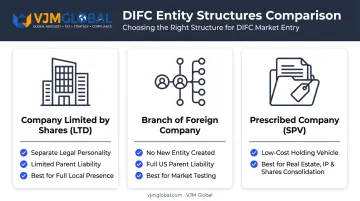
Most US founders choose from three structures, each suited to a different stage of market entry.
- Company Limited by Shares (LTD): the standard route for a US company creating a separate DIFC subsidiary with its own legal personality, ideal for a genuine local presence and limited parent liability.
- Branch of a Foreign Company: lets a US firm test the MEASA market without spinning up a new entity, though the US parent carries full liability for the branch's obligations.
- Prescribed Company (SPV): a low-cost holding vehicle that US investors use to consolidate regional real estate, shares, or IP under one ring-fenced structure without the overhead of a trading entity.
License Types and Which Fits US Business Models
The license you need depends entirely on what your business actually does in-market, not what you call yourself.
- Non-Financial/Professional Services License: the fit for US consulting, advisory, and tech firms, avoiding DFSA review so approval moves faster.
- Financial Services License (DFSA-regulated): mandatory for US asset managers, fund managers, and fintechs conducting regulated activity, with a longer, more document-heavy review process.
- Innovation/FinTech License: designed for early-stage US startups, with substantially reduced fees and access to coworking space during the subsidized period.
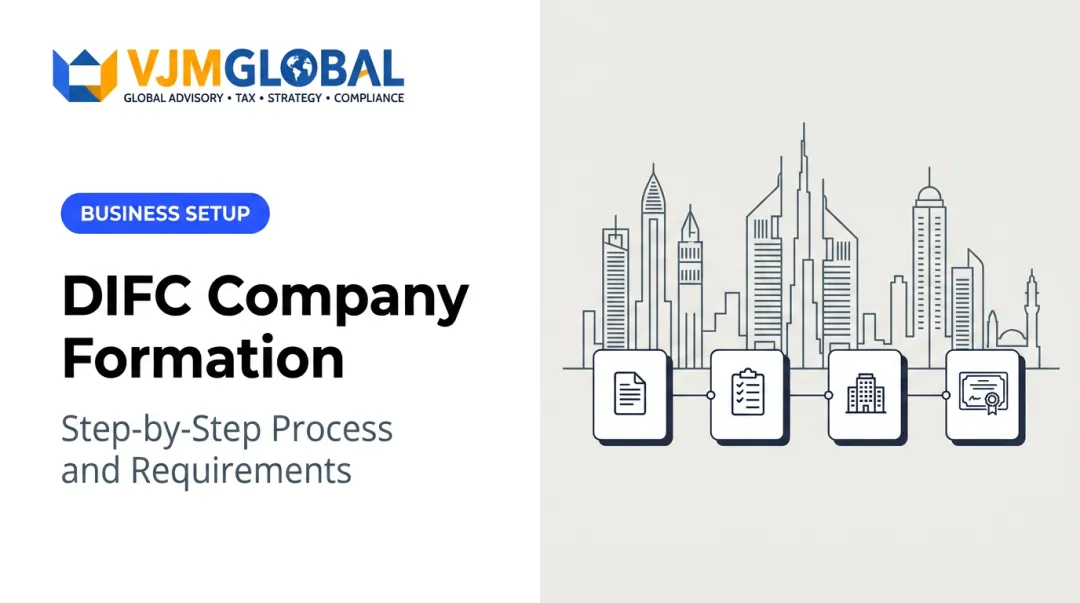
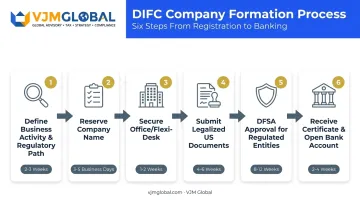
DIFC Company Formation Process: Step-by-Step From the US
Nearly the entire process runs through the DIFC Authority's online portal, with the DFSA layered in for regulated entities. Office leasing and final signing are the two steps where US founders typically can't stay fully remote.
Step 1: Define Business Activity, Entity Type & Regulatory Path
Decide upfront whether your activity is financial or non-financial. That single call determines your entity structure and whether DFSA review gets triggered; getting it wrong means redoing paperwork later.
Step 2: Reserve the Company Name
Name checks run through the portal and typically clear within a few business days. Avoid restricted terms (banking, insurance, and similar regulated words trigger extra scrutiny). Prepare two or three backup names, since the Dubai-to-US time difference means a rejected name can cost you a full day's turnaround.
Step 3: Secure DIFC Office Space or a Flexi-Desk
A physical DIFC address is mandatory, even if you never relocate. Most license types require this before final approval, and the size of space you lease directly caps how many employment visas you can allocate later.
Step 4: Submit the Application With Legalized (Not Apostilled) US Documents
Here's where most competitor guides get it wrong, and where US founders lose the most time. You'll submit passport copies, a Secretary of State certificate of good standing for corporate shareholders, a business plan, and KYC/AML forms.
The mistake: assuming a US apostille alone satisfies UAE requirements. It doesn't. The UAE is not a signatory to the 1961 Hague Apostille Convention (HCCH status table). US corporate and personal documents generally need consular legalization through the UAE Embassy's authentication process, not a standalone apostille. Building in extra time for this step avoids a scramble later. Cross-border formation specialists like VJM Global coordinate the US-side document prep and UAE-side legalization together, which removes much of that back-and-forth.
Step 5: Obtain DFSA Approval (Regulated Entities Only)
Financial services applicants submit a Regulatory Business Plan covering activities, three-year projections, budget, and resourcing. The DFSA works through acknowledgment, an initial review letter, and a full recommendation — a process that, combined with satisfying in-principle conditions, commonly stretches to 4-6 months for US financial services applicants.
Step 6: Receive the Certificate of Incorporation and Open a UAE Bank Account
The license itself issues digitally through the portal. Opening the corporate bank account is the slower part. UAE banks apply risk-based customer due diligence and FATCA self-certification for US-linked entities, which typically means more document requests and a longer review than a non-US-owned company would face.
Documents and Requirements US Applicants Need to Prepare
Getting documentation right the first time saves weeks. Break it into four categories.
Personal documents (each shareholder/director):
- Valid passport copy
- CV and professional qualifications
- Proof of address where required by the specific license checklist
Corporate documents (when a US LLC or Corporation is the shareholder):
- Certificate of Good Standing from the Secretary of State
- Articles of Incorporation/Organization
- Board resolution authorizing the DIFC investment
These corporate documents need UAE embassy legalization, not just a US apostille — the correction covered in Step 4 above applies directly here.
Financial and funding evidence:
- Individual funders: typically the latest six months of personal bank statements
- Corporate funders: typically the latest two years of audited financials
- Clear source-of-funds documentation supporting AML/KYC checks
Business plan: Write it for MEASA (Middle East, South Asia and Africa) market entry specifically. A recycled US business plan template signals to reviewers that you haven't thought through regional demand, pricing, or competition.
US tax flag most guides skip: forming a DIFC entity can trigger Form 5471 filing and require a GILTI or Subpart F analysis for US shareholders. Treat this as a separate compliance track that needs coordination alongside the DIFC filing, not after it.
Common document pitfalls:
- Notarized paperwork mistaken for legalized paperwork
- Documents older than three months at submission
- Name mismatches between US legal filings and passport spelling
Costs, Timeline, and Common Mistakes US Founders Make
| Entity Type | Typical Year-One Cost Range | Timeline |
|---|---|---|
| Innovation/Startup License | ~$5,000-$15,000 (subsidized fee + office/visa costs) | 6-10 weeks |
| Standard Professional Services LTD | ~$70,000-$90,000 (ROC fees alone run ~$20,000) | 6-10 weeks |
| DFSA-Regulated Entity | $150,000-$250,000+ (DFSA fees alone span $4,000-$170,000) | 4-6 months |
Regulatory filing fees are only the floor. Office space, visas, legal support, and apostille/legalization costs stack on top of every category above.
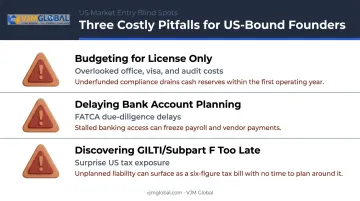
Where US founders consistently trip up:
- Budgeting for the license only: then getting surprised by office, visa, and audit costs that weren't in the original quote
- Delaying bank account planning: FATCA-related due diligence takes longer for US-owned entities, and starting that conversation late stalls operations after incorporation
- Discovering GILTI/Subpart F exposure too late: often only when their US CPA files the annual return and asks about the new foreign entity
A cross-border advisory partner closes this gap by handling both sides of the file at once. Firms like VJM Global, with CPAs and Chartered Accountants working across more than 100 countries, coordinate DIFC entity formation alongside the corresponding US filings, such as Form 5471. This keeps founders from discovering a compliance gap months after the entity is already live.
Conclusion
DIFC gives US businesses a common-law legal base, full ownership, and tax-efficient access to a genuinely large regional market. None of that removes the need to run through a specific documentation and approval sequence correctly.
Understanding both sides (the DIFC filing steps and the US tax consequences around legalization rules, Form 5471, and GILTI) is what separates a smooth six-week setup from a costly six-month correction.
If you're weighing DIFC against other jurisdictions, get your cross-border structure reviewed before you file. VJM Global supports entity formation in DIFC alongside the corresponding compliance obligations back in the US, so both sides of the file move together.
Frequently Asked Questions
Can a US citizen own 100% of a DIFC company?
Yes. DIFC permits full foreign ownership for US individuals and US corporate shareholders, with no requirement for a local UAE sponsor or partner.
How long does DIFC company formation take from the US?
Non-regulated entities typically take 6-10 weeks. DFSA-regulated financial services entities usually need 4-6 months. Document legalization turnaround can add extra time for US applicants.
Do US shareholders of a DIFC company have any US tax reporting obligations?
Yes. Despite DIFC's 0% qualifying income tax, US shareholders may still need to file Form 5471 and assess GILTI or Subpart F exposure. Coordinate with a cross-border tax advisor before filing to confirm your obligations.
Is a physical office required if I plan to run the business remotely from the US?
Yes, for most license types. A DIFC address, whether a flexi-desk or a full office, is mandatory even if the owner never relocates to Dubai.
What is the minimum capital required to set up a DIFC company?
It varies by entity and activity. Many non-financial services structures have no fixed minimum, while financial services entities and public companies require substantially more capital.
How does DIFC differ from Dubai mainland for a US business?
DIFC operates under English common law with its own courts and regulator, while Dubai mainland follows UAE civil law and federal courts. DIFC also allows full foreign ownership without a mainland-style local sponsor requirement.