Getting the formation sequence wrong doesn't just cost money. It can delay licensing by months and create compliance headaches years down the line. DIFC ranks among the top financial hubs in the Middle East, Africa, and South Asia region, yet the actual mechanics of registration, entity selection, and documentation trip up a surprising number of first-time applicants.
Many assume the process mirrors mainland UAE setup. It doesn't. This guide breaks down what DIFC company formation actually involves: the entity options available, the step-by-step registration process, realistic costs and timelines, and the mistakes that push straightforward applications into month four or five.
Key Takeaways
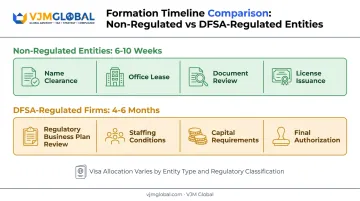
- Formation takes 6-10 weeks for non-regulated entities, or 4-6 months for DFSA-regulated firms
- Entity options span Private/Public Companies, LLPs, Branches, Foundations, and Prescribed Companies (SPVs)
- Key benefits include 100% foreign ownership, English Common Law rules, and 0% tax on qualifying income
- A physical DIFC registered office is mandatory; capital minimums vary by entity type
- Annual audits, UBO declarations, and data protection registration maintain good standing
What Is DIFC Company Formation and Why Businesses Choose It
DIFC company formation means incorporating a legal entity inside the Dubai International Financial Centre, a purpose-built free zone with its own courts, regulator, and companies law separate from the rest of the UAE. Non-financial businesses register through the DIFC Authority and Registrar of Companies. Anyone conducting a financial service in or from DIFC needs separate authorization from the DFSA, the centre's independent financial regulator.
The appeal isn't just the Dubai address. Setting up here gives you:
- An independent common law jurisdiction, modeled on English law, with its own courts and judges
- A springboard into the Middle East, Africa, and South Asia (MEASA) market
- A corporate structure that's easier to explain to Western investors and lenders unfamiliar with civil law systems
DIFC vs. Mainland and Other Free Zones
Dubai Mainland companies operate under UAE civil law and can trade directly with local customers anywhere in the Emirates. DIFC entities operate under common law and generally conduct business from within the centre or internationally, though many businesses choose DIFC precisely because clients and counterparties recognize the legal framework.
Tax Positioning: What "0% Corporate Tax" Actually Means
A DIFC company that qualifies as a Qualifying Free Zone Person pays 0% corporate tax on Qualifying Income and 9% on income that doesn't meet the definition, according to the Federal Tax Authority's Corporate Tax Guide for Free Zone Persons.
Qualifying status depends on:
- Maintaining adequate substance in the free zone
- Keeping non-qualifying revenue under the lower of AED 5 million or 5% of total revenue
- Meeting audit and transfer-pricing documentation requirements every tax period
Slip up, and you lose the 0% treatment retroactively for that period plus the next four.
Ownership is more straightforward: DIFC permits 100% foreign ownership with no requirement for a local UAE partner, and there's no restriction on repatriating capital or profits out of the jurisdiction.
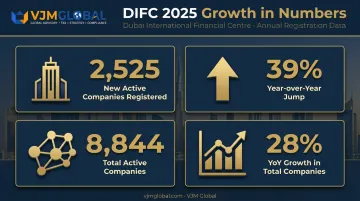
Demand backs up the reputation. DIFC added 2,525 new active registered companies in 2025 alone, a 39% jump that pushed its total active company count to 8,844, up 28% year-on-year, according to DIFC's 2025 annual results announcement.
Legal Structures and Entity Types Available in DIFC
Entity choice in DIFC comes down to two questions: is your activity regulated by the Dubai Financial Services Authority (DFSA), and how much liability protection and governance flexibility do you need? Here's the current lineup under DIFC Companies Law:
- Private Company (LTD): The standard vehicle for an active trading, consulting, or holding business with one or more shareholders
- Public Company (PLC): Same governance base as an LTD, but with public-company rules and a higher capital floor
- Recognised Company (Branch): A registered extension of a foreign parent rather than a new legal entity, useful when you want to trade under an existing name and track record
- Limited Liability Partnership (LLP): Built for professional service partnerships, requiring at least two members sharing management and liability
- Foundation: Governed by a separate Foundations Law, used for succession planning and family governance rather than day-to-day trading
- Prescribed Company (formerly known as SPV): A Private Company granted Prescribed Company status, built for holding assets or structured transactions rather than active operations
DIFC's 2018 Companies Law overhaul folded the old LLC category into the Private Company type, so don't expect a like-for-like LLC option here if you're comparing against other UAE free zones.
| Business need | Typical structure |
|---|---|
| Holding assets or family succession | Foundation or Prescribed Company |
| Professional services partnership | LLP |
| Active trading or consulting | Private Company (LTD) |
| Extending an existing foreign company | Recognised Company (Branch) |
Regulated financial activity, regardless of which structure you pick, adds a DFSA authorisation layer on top of DIFC registration. That distinction shapes your document checklist and your realistic timeline, which is where the actual process gets interesting.
Step-by-Step DIFC Company Formation Process
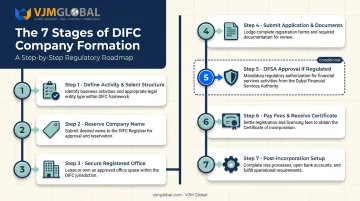
The process runs in a fairly fixed sequence: define your activity, pick your structure, reserve a name, lease an office, submit documents, clear regulatory approval if needed, then pay fees. Here's how each stage plays out.
Step 1: Define Business Activity and Select Entity Structure
Start by classifying your activity as regulated or non-regulated. This decision determines whether you're dealing with the DIFC Authority alone or the DFSA too. From there, choose your legal structure based on liability exposure, ownership structure, and how many people hold governance rights.
Step 2: Reserve the Company Name
Your company name needs to end in "Limited" or "Ltd" for a Private Company. Certain terms, including "Bank," "Insurance," and "Trust," require specific DFSA consent before use. Have a backup name ready in case your first choice includes a restricted term.
Step 3: Secure a Registered Office Within DIFC
You cannot obtain a license without a physical office address inside DIFC's boundaries. Options range from flexi-desks and coworking spaces to fully fitted private offices. Office size caps how many employment visas you can sponsor, so undersizing your space early can force a costly upgrade later.
Step 4: Submit Application and Supporting Documents
Standard documentation includes:
- UBO biographies for each beneficial owner
- Board resolutions for corporate shareholders
- Articles of Association
- Director declarations
- Identity documents
Higher-risk or regulated activities may also require a business plan and proof-of-funds material. DIFC runs a completeness review before moving your file forward, and incomplete submissions are the single biggest cause of delay here.
Step 5: Obtain DFSA Approval (For Regulated Activities Only)
Financial services applicants follow a distinct approval path:
- File through DFSA Connect with a Regulatory Business Plan
- Complete a DFSA completeness review and risk assessment
- Attend an interview, if required, before conditional or in-principle approval
Conditions typically include completing DIFC incorporation, securing premises, and hiring required controlled-function staff before final authorization. This is the stage that stretches timelines from weeks to months.
Step 6: Pay Fees and Receive Certificate of Incorporation and License
Once your application clears, you'll pay incorporation, licensing, and data protection registration fees. DIFC then issues your Certificate of Incorporation and Commercial License, the two documents that make your entity officially live.
Step 7: Complete Post-Incorporation Setup
Incorporation isn't the finish line. Post-incorporation tasks include:
- Opening a corporate bank account (a separate KYC process with no guaranteed timeline)
- Applying for employee and investor visas through an Establishment Card and Personnel Sponsorship Agreement
- Registering for Corporate Tax
VAT registration becomes mandatory once taxable supplies cross AED 375,000, with voluntary registration available from AED 187,500.
DIFC Company Formation Cost, Timeline, and Capital Requirements
Budgeting for DIFC formation means looking well beyond the license fee. A standard non-financial Private Company runs roughly:
- Incorporation fee: around $8,000
- Annual Commercial License: around $12,000
- Data protection notification: $750 for non-financial entities (higher for financial and retail activities), with $250 annual renewal
These figures come from DIFC's Company Services Table of Fees. Office space adds another layer to the budget: flexi-desks sit at the lower end, while fitted private offices cost more and typically unlock a larger visa allocation.
Capital Requirements Vary Sharply by Entity
There's no universal minimum. A standard non-financial LTD needs issued capital greater than zero, with no fixed dollar floor attached. Public Companies are different: DIFC Companies Law sets a minimum issued capital of $100,000, with at least 25% paid up before incorporation completes. Prescribed Companies and Foundations generally follow the lower-capital model, part of why they're popular for holding structures.
Timeline: Why Regulated Firms Wait Longer
DIFC's own materials point to 3-5 working days for initial application approval, but that's one stage, not the full formation timeline. Actual timelines vary sharply based on regulatory status. Non-regulated businesses typically need 6-10 weeks end-to-end, covering name clearance, office lease execution, document review, and license issuance. DFSA-regulated financial services firms often wait 4-6 months, driven by Regulatory Business Plan review and conditions around staffing and capital.
Incomplete documentation and unclear business models are the most common culprits, especially when paired with slow responses to regulator queries.
Office decisions carry consequences beyond monthly rent, too. Visa allocation ties directly to office size: DIFC allocates roughly one visa per business-centre desk and up to three per kiosk arrangement, so a two-person flexi-desk won't support a ten-person hiring plan. If you're scaling headcount fast, lease office space sized for your 12-18 month hiring plan, not just your opening headcount.
Post-Incorporation Compliance and Common Mistakes to Avoid
Getting your license marks only the start of your compliance obligations. DIFC companies carry ongoing obligations that catch a lot of founders off guard:
- Annual Confirmation Statement, filed with the Registrar within 30 days of your incorporation anniversary
- Audited financial statements from a DIFC-registered auditor (small private companies under $5 million turnover and 20 employees may qualify for exemption)
- UBO declaration and register maintenance, kept current with the Registrar
- Data Protection Commissioner registration, renewed annually alongside your license
Where First-Time Applicants Go Wrong
The most frequent mistakes are simple, avoidable oversights:
- Budgeting for the license fee alone and getting blindsided by office, visa, audit, and data protection costs stacked on top
- Submitting expired bank statements or incomplete proof-of-funds documents, which restarts the completeness review clock
- Assuming UAE mainland labor law applies, when DIFC runs its own Employment Law No. 2 of 2019 with different rules on gratuity, notice periods, and termination
Compliance gets more complex once a DIFC entity sits alongside operations elsewhere, such as an India-based subsidiary handling sourcing, manufacturing, or back-office work. That combination brings transfer pricing rules, DTAA treaty positions, and FEMA reporting into play on the India side, layered on top of DIFC's own audit and UBO obligations.
Firms running a DIFC holding entity paired with an Indian operating company typically bring in cross-border specialists like VJM Global to coordinate entry strategy, bookkeeping, and tax compliance across both jurisdictions.
Frequently Asked Questions
How much does DIFC company formation in UAE cost?
Expect roughly $8,000 for incorporation and $12,000 for the annual commercial license, plus office, visa, and data protection fees. DFSA-regulated firms face higher costs due to added regulatory and capital requirements.
How long does DIFC company formation in UAE take?
Non-regulated businesses typically complete formation in 6-10 weeks. DFSA-regulated financial services firms usually need 4-6 months, given the added Regulatory Business Plan review and staffing conditions.
What are the benefits of DIFC company formation in UAE?
DIFC offers 100% foreign ownership, an independent English Common Law framework with its own courts, and 0% corporate tax on qualifying income for companies meeting Qualifying Free Zone Person conditions.
What is the minimum share capital required for DIFC company formation in UAE?
Requirements vary by entity. Standard Private Companies have no fixed minimum beyond issued capital greater than zero, while Public Companies require at least $100,000 in issued capital, with 25% paid up.
Do I need a local UAE sponsor for DIFC company formation?
No. DIFC permits 100% foreign ownership without requiring a UAE national partner or local sponsor, unlike some mainland business structures.
What is the difference between DIFC and Dubai Mainland company setup?
DIFC operates under English Common Law with its own courts, while Mainland follows UAE civil law. DIFC entities generally serve international and free-zone business, while Mainland companies can trade directly across the wider UAE market.