Introduction
The effective date of GST registration is the exact day your business becomes legally registered under India's Goods and Services Tax law, obligated to charge, collect, and report tax. Get this date wrong, and everything downstream — invoices, input tax credit, return filings — falls out of sync.
This matters most for foreign companies, NRIs (Non-Resident Indians), OCIs (Overseas Citizens of India), and multinational groups setting up Indian subsidiaries, liaison offices, or branch offices. A miscalculated effective date can trigger interest charges and blocked input tax credit, sometimes alongside statutory penalties, before your India entry even gets off the ground. Confusion often starts with three key dates that get mixed up early in the process.
Those three dates are: when the ARN is generated, when the GSTIN is issued, and the actual effective date recorded on the registration certificate. That confusion causes invoicing errors and compliance headaches.
This article breaks down what the effective date means, how Rule 10 of the CGST Rules determines it, the registration process and fees involved, and the mistakes that trip up first-time filers.
Key Takeaways
- Filing within 30 days of becoming liable locks your effective date to the liability date; late filing defaults to the grant date
- No government fee applies to GST registration; only professional advisory fees vary by complexity
- Foreign companies without a fixed Indian establishment may need Non-Resident Taxable Person registration plus an advance tax deposit
- Missing the correct effective date risks interest under Section 50 and penalties under Section 122
- GST registration cannot be backdated beyond the statutory 30-day window
What Is the Effective Date of GST Registration?
The effective date of GST registration is the day a business is legally treated as a "registered person" under GST, able to charge tax, issue GST-compliant invoices, and claim input tax credit. It fixes the starting point for every compliance obligation that follows.
Rule 10 of the CGST Rules, 2017, read with Section 25 of the CGST Act, governs how this date is set. The outcome depends entirely on two facts: when your liability to register arose, and when you submitted the application.
- Filed within 30 days of becoming liable: effective date equals the date liability arose
- Filed after 30 days: effective date equals the date the registration certificate is granted
The registration certificate (REG-06) issued after approval records your Date of Liability, Date of issue, and, for casual or non-resident taxpayers, the validity period. It doesn't carry a literal field labelled "effective date." That determination comes from Rule 10, not the printed certificate.
For a business that applies on time, the Date of Liability and the effective date happen to be identical, which is where much of the confusion starts.
Effective Date vs. ARN Date vs. Liability Date
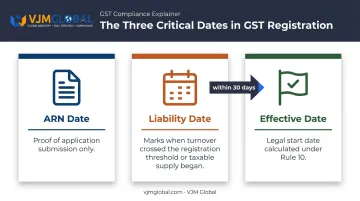
Three dates get mixed up constantly:
- ARN date – proof your application was submitted, nothing more
- Liability date – when turnover crossed the threshold or taxable supply began
- Effective date – the legal starting point calculated under Rule 10, based only on the two dates above
Only the liability date and application timing decide the outcome. The ARN date itself carries no weight in that calculation.
For voluntary registrants, businesses below the threshold registering by choice, there's no prior liability date to anchor to, so the effective date is simply the date registration is granted. Casual taxable persons and Non-Resident Taxable Persons follow a related but distinct timeline tied to their certificate validity, covered further below.
Why the Effective Date Matters for Indian Companies
Your effective date isn't a paperwork formality. It's the line that determines when GST liability starts, when input tax credit becomes claimable, and when return filing obligations kick in.
GST Liability and Input Tax Credit
GST liability begins on the effective date, full stop. Every outward supply made on or after that date must carry GST, even if your physical registration certificate hasn't arrived yet. Waiting for the certificate to start charging tax is a common trap that catches foreign subsidiaries off guard.
Input tax credit follows the same rule, with one exception. You can generally claim ITC only for supplies received from the effective date onward.
Section 18(1)(a) carves out a narrow exception: goods held in stock, and inputs contained in semi-finished or finished goods, on the day immediately before your liability arose — provided you applied within the 30-day window. Get the effective date wrong, and that stock ITC risks reversal during assessment.
Penalties, Interest, and Contract Risk
The financial exposure is real. Section 122 of the CGST Act penalises a person liable to register who fails to do so, with a fine of ₹10,000 or the amount of tax evaded, whichever is higher. Section 50 layers on interest, capped by statute at 18% per annum, for tax that should have been paid from the effective date but wasn't.
For foreign-owned Indian subsidiaries, liaison offices, and branch offices, this creates a specific risk. Contracts signed with overseas clients often assume GST compliance starts on a particular date, but the actual effective date may fall earlier or later depending on when the entity crossed the liability threshold.
That mismatch triggers invoicing disputes and client-side credit rejections.
India's system doesn't allow indefinite backdating, unlike jurisdictions where businesses can request a backdated registration for administrative convenience. The effective date is capped strictly by the 30-day filing rule, with no discretionary route to an earlier date beyond that window.
Filing Obligations Start Immediately
GSTR-1 and GSTR-3B filing obligations run from the effective date, not from the day the GSTIN gets allotted. If there's a gap between your liability date and your grant date, that intervening period's supplies still need reporting in your first return after registration.
How the Effective Date Is Determined (Rule 10 Process)
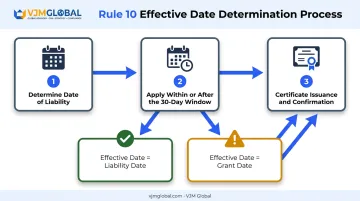
The portal's calculation is mechanical: it compares your date of liability against your date of application, then routes the file to a GST officer for verification.
- Inputs: the date you crossed the turnover threshold (or otherwise became liable), and the date you submitted Form REG-01
- Check performed: whether the application falls within 30 days of the liability date
- Output: an approval, a query, or a rejection, each shaping your final effective date
Once approved, your GSTIN activates, and the confirmed effective date becomes the starting line for every return you file and every invoice you issue.
Step 1: Determine the Date of Liability
Your date of liability is the trigger event, not the day you decide to register. For most Indian companies, that's the day cumulative turnover crosses the applicable threshold under Section 22, or the day you begin taxable supplies if registration is mandatory regardless of turnover.
Foreign entities without a fixed place of business in India face a different trigger: the day they commence taxable supply in India. This pushes them toward Non-Resident Taxable Person registration rather than the standard route.
Step 2: Apply Within or After the 30-Day Window
This is where most of the damage happens.
- Apply within 30 days of the liability date: your effective date equals the liability date. Clean, no gap, no back-reporting needed.
- Apply after 30 days: your effective date becomes the date registration is actually granted. Everything supplied before that date remains taxable, with interest and penalty due despite lacking formal registration.
Step 3: Certificate Issuance and Confirmation
Once submitted, a GST officer has a defined window to act. Under current rules, officers generally have seven working days to approve a straightforward application, extending to 30 days for cases requiring Aadhaar authentication issues or risk-based physical verification. If the officer doesn't act within that window, the registration is deemed approved.
The moment your REG-06 certificate arrives, check the Date of Liability and Date of issue shown on it immediately. Don't assume it matches what you expected. Errors here compound quickly once return filing begins.
GST Registration Process, Documents & Fees for Indian Companies
Registering for GST on the portal happens in two stages.
Part A covers preliminary verification:
- PAN, mobile number, and email entry
- OTP verification on both mobile and email
- Generation of a Temporary Reference Number (TRN)
Part B covers the substantive application, completed using the TRN:
- Business details and constitution
- Promoter, director, or partner details
- Principal place of business and additional places, if any
- Bank account details
- Authorised signatory appointment
- Verification via DSC (mandatory for companies and LLPs) or EVC
Documents Foreign-Owned Entities Typically Need
For an Indian subsidiary, branch, or LLP with foreign ownership, expect to submit:
- PAN of the Indian entity
- Certificate of incorporation
- Board resolution or letter authorising the signatory
- Passport details for foreign directors or promoters (a mandatory field for non-Indian citizens)
- Proof of principal place of business, such as a lease agreement, electricity bill, or property tax receipt
- Digital signature certificate for the authorised signatory
Requirements around MOA/AOA or LLP agreements vary by case. Confirm the current checklist before filing rather than assuming a fixed list applies.
What GST Registration Actually Costs
Here's what surprises many first-time applicants: the government charges nothing to register for GST on the portal. There's no statutory application fee.
What does cost money is professional assistance, and that varies with complexity:
- Multi-state registration, when operations span more than one state
- Foreign director documentation and cross-verification
- Non-Resident Taxable Person registration, which involves extra procedural steps
The NRTP Route for Companies Without a Fixed Indian Presence
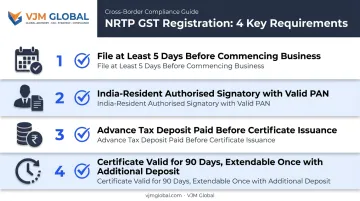
If your company makes taxable supplies in India but has no fixed place of business here, standard registration doesn't apply. You'll need Non-Resident Taxable Person (NRTP) registration using Form REG-09 instead.
This route requires:
- An application filed at least five days before commencing business in India
- An authorised signatory who is a resident of India with a valid PAN
- An advance tax deposit equal to estimated tax liability for the registration period, paid before the certificate is issued
- Certificate validity capped at the requested period or 90 days from the effective date, whichever comes first, extendable once with an additional deposit
This is exactly the kind of decision point where local guidance pays off. VJM Global works with foreign companies, NRIs, and OCIs setting up Indian operations.
The team determines whether standard or NRTP registration applies and maps the correct liability date. It also confirms the REG-01 or REG-09 application goes in before the deadline: 30 days for standard registration, five days for NRTP.
Common Mistakes and Misconceptions About the Effective Date
Three misunderstandings show up again and again in India market-entry conversations.
"We can backdate our registration if needed." Not under Indian law. The 30-day rule is the only mechanism connecting your effective date to your liability date. Miss that window, and the effective date locks to the grant date instead, no exceptions, no discretionary requests to the officer.
"The ARN date is our compliance start date." The ARN only confirms your application was submitted successfully. It sits before officer verification and certificate issuance in the sequence, and it has no bearing on Rule 10's calculation.
Businesses that start invoicing based on the ARN date often find their invoices don't match their actual GST compliance timeline.
"We'll just start charging GST once the certificate arrives." This is the costliest assumption. Liability accrues from the date of liability itself, not from registration completion.
If turnover crossed the threshold in April but the certificate wasn't granted until July, GST was still due on everything supplied from April onward. Delaying registration doesn't delay the tax obligation—it just adds interest and penalty on top of it.
Frequently Asked Questions
What is the effective date of GST registration?
It's the date recorded on your REG-06 certificate from which you're legally registered under GST. Under Rule 10, it equals your liability date if you applied within 30 days, or the grant date if you applied later.
What is the time limit for registration under GST?
Businesses must apply within 30 days of becoming liable to register under Section 25 of the CGST Act. Casual taxable persons and Non-Resident Taxable Persons must instead apply at least five days before commencing business.
How to know GST registration date?
Check the Date of Liability and Date of issue on your REG-06 certificate, downloadable from the GST portal. You can also verify registration details using the "Search Taxpayer" tool with your GSTIN.
Can GST registration be backdated in India?
India doesn't permit discretionary backdating of GST registration. The earliest possible effective date is your date of liability, achievable only by applying within 30 days; otherwise, it defaults to the grant date.
Can a foreign company register for GST in India without a local office?
Yes, through Non-Resident Taxable Person registration using Form REG-09. This route requires an India-resident authorised signatory and an advance tax deposit before the certificate is issued.
What happens if I don't register for GST on time in India?
You face interest under Section 50 on unpaid tax and a penalty under Section 122, ₹10,000 or the tax evaded, whichever is higher. Both apply from your actual date of liability, not your registration date.