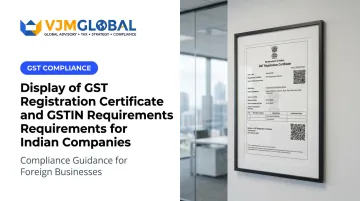
The answer is yes, and it's not a suggestion. Rule 18 of the CGST Rules makes displaying your GST certificate and GSTIN a legal obligation, not a nice-to-have. Many businesses, especially newly incorporated entities and foreign subsidiaries setting up in India, miss this step entirely because it feels like paperwork trivia compared to bigger compliance milestones.
It isn't trivial. Non-compliance can attract penalties, and tax officers do check for it during field visits. This guide covers what to display, where to display it, how composition dealers differ, and what happens if you skip this step.
Key Takeaways
- GST Registration Certificate and GSTIN display is mandatory under Rule 18 of the CGST Rules
- Both must appear at your principal place of business and every additional location
- Composition scheme taxpayers must also display "Composition Taxable Person"
- Skipping this can trigger penalties under Section 125 of the CGST Act
- Foreign-owned entities should add this to their post-incorporation compliance checklist
What is a GST Registration Certificate and GSTIN?
Every business registered under GST receives two things: a GSTIN (Goods and Services Tax Identification Number) and a registration certificate in Form GST REG-06, both issued through the GST portal.
The GSTIN is a 15-character code, structured as follows:
| Position | What it represents |
|---|---|
| 1-2 | State code |
| 3-12 | PAN of the business entity |
| 13-14 | Entity code (distinguishes multiple registrations under one PAN in a state) |
| 15 | Checksum digit (for verification) |
Knowing this structure helps you spot errors quickly, especially when your accounting team enters GSTINs manually across multiple state registrations.
What the certificate actually contains
Form GST REG-06 is a structured government document that includes:
- Registration number (GSTIN)
- Legal name and trade name (if applicable)
- Constitution of business (private limited, LLP, branch office, and so on)
- Principal place of business address
- Date of liability and registration validity period
- Type of registration (regular, composition, casual taxable person)
A separate annexure lists every additional place of business, along with details of proprietors, partners, or directors. This is the exact document you're required to display, not a summary or screenshot.
Rule 18 of the CGST Rules: Is Display Legally Mandatory?
Yes. This isn't open to interpretation. Rule 18 of the CGST Rules states it plainly:
Rule 18(1): "Every registered person shall display his certificate of registration in a prominent location at his principal place of business and at every additional place or places of business."
Rule 18(2): "Every registered person shall display his Goods and Services Tax Identification Number on the name board exhibited at the entry of his principal place of business and at every additional place or places of business."
The rule has been active since 22 June 2017, inserted via Notification No. 03/2017-Central Tax. It's been a legal requirement since GST's earliest days, not a recent addition.
Who does this apply to?
Everyone with a GST registration. There's no carve-out for:
- Small businesses or startups
- Foreign-owned subsidiaries or liaison offices
- Composition scheme taxpayers (they get additional rules, covered below)
The obligation attaches the moment you hold a GST registration, regardless of incorporation date, ownership structure, or turnover.
Why does this rule exist?
The purpose is straightforward: it lets customers, vendors, and tax officers instantly verify that a business is legitimately registered and authorised to collect tax. A visible certificate and GSTIN prevent unregistered sellers from charging GST they aren't entitled to collect.
The law doesn't define "prominent location" with precision. It's generally understood to mean a spot visible to anyone entering the premises, not tucked away in a back office or filing cabinet.
States take this seriously too. Maharashtra's Trade Circular No. 43T of 2017 reinforces the display obligation and composition-specific wording requirements at the state level.
Where and How to Display the GST Certificate and GSTIN
There are two distinct display duties here, and businesses often only handle one of them:
- The registration certificate itself: printed and placed prominently at the entrance or billing counter
- The GSTIN on a name board: displayed at the entry point of each business location
Most businesses handle this by framing the certificate near reception or the billing desk, and printing the GSTIN on an A4 sheet or incorporating it into the main entrance signage.
Displaying at Principal and Additional Places of Business
This is where foreign companies often trip up. The obligation isn't limited to your registered head office. It extends to every additional place of business listed on your registration, including branch offices, warehouses, and satellite units across states.
If your company has a warehouse in Gujarat and a sales office in Delhi under the same GSTIN registration structure, both locations need the certificate and GSTIN displayed, not just the Delhi head office.
What Counts as a "Place of Business" Under GST?
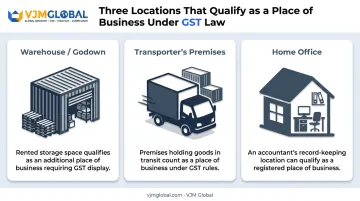
GST law defines "place of business" broadly, extending well beyond your office lease. It can include:
- Warehouses or godowns where you store goods, even if rented from a third party
- A transporter's premises where your goods sit temporarily during transit
- Home offices used by an accountant or authorised person to maintain your books of account
If your goods sit in a transporter's godown, CBIC guidance confirms that location may need to be declared as an additional place of business, with display compliance following from there.
Run through every location where your business stores goods, maintains records, or operates through an agent. Check whether each one appears on your registration.
Displaying GSTIN and Business Details on Tax Invoices
Physical display isn't the only requirement. Every tax invoice you issue must carry your GSTIN, legal business name, and address, per GST invoice rules. This applies regardless of whether the buyer is registered or unregistered.
Separately, under Section 139A(5)(c) of the Income Tax Act, PAN must be quoted on transaction documents for specified goods or services exceeding ₹2,00,000 per transaction. This is a documentation requirement on invoices and records, not a signboard obligation, so don't confuse it with your Rule 18 display duty.
Special Display Rules for Composition Scheme Taxpayers
If you're registered under the composition scheme, Rule 18 isn't the only display rule you follow. Rule 5 of the CGST Rules adds two more duties on top of it:
- Signboard and notice: Display "Composition Taxable Person" at both your principal and additional places of business, alongside your GSTIN and certificate.
- Bill of Supply: State "Composition taxable person, not eligible to collect tax on supplies" on every document you issue.
This requirement carries real consequences. A composition dealer isn't permitted to charge CGST, SGST, or IGST on their invoices at all, so the Bill of Supply excludes these tax fields entirely. Charging tax you're not entitled to collect is a separate contravention that carries its own consequences, distinct from a simple non-display issue.
For composition dealers, treat this as a checklist item every time you update signage or reprint invoice templates, not a one-time setup task.
Penalties for Non-Compliance and How to Stay Audit-Ready
When a business fails to display its certificate or GSTIN and no specific penalty applies to that contravention, Section 125 of the CGST Act kicks in with a general penalty of up to ₹25,000.
Related invoicing errors carry their own consequences:
- Incorrect or false tax invoices fall under Section 122(1), which sets a penalty of ₹10,000 or the amount of tax involved, whichever is higher — not a flat figure
- Composition dealers misrepresenting their status face action under Section 10(5), read with Sections 73 or 74. The demand equals tax payable plus applicable interest and penalty, not a single fixed cap
Enforcement isn't theoretical. In May 2023, central and state tax officers ran a nationwide special verification drive that included checking premises for GSTIN signboards and displayed registration certificates.
Field officers look for this during routine and targeted inspections. Treating display compliance as optional is a real risk, not a paperwork technicality.
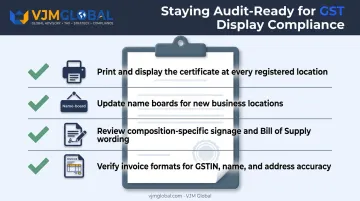
Staying audit-ready means:
- Printing and displaying the certificate at every registered location
- Updating name boards whenever you add a new place of business
- Checking composition-specific wording on signage and Bill of Supply templates
- Reviewing invoice formats for GSTIN, name, and address accuracy
How VJM Global Helps Foreign Businesses Stay GST-Compliant
For foreign companies, OCIs, and NRIs setting up in India, GST registration is usually the easy part. Staying compliant with the smaller, ongoing obligations is where gaps tend to appear, including:
- Displaying the GST registration certificate at every place of business
- Updating name boards across new locations as the business expands
- Formatting invoices correctly with GSTIN and other mandatory details
VJM Global's chartered accountants handle GST registration as part of a broader post-incorporation compliance package for foreign-owned subsidiaries and liaison offices entering India. Beyond registration, this package covers secretarial compliance, accounting, and tax advisory, keeping clients unfamiliar with Indian regulatory nuances from missing requirements like these.
That's especially relevant if you're setting up a subsidiary, branch office, or warehouse network across Indian states. Building certificate and GSTIN display into your compliance checklist from the outset is far easier than discovering the gap during a tax inspection.
Frequently Asked Questions
What does a GST registration certificate look like?
It's Form GST REG-06, a government-issued document downloadable from the GST portal. It shows your legal name, trade name, GSTIN, registration date, and registration type.
Is it mandatory to display a GST certificate?
Yes. Rule 18 of the CGST Rules legally requires every GST-registered business to display its certificate at every place of business. Non-compliance can attract penalties under Section 125 of the CGST Act.
How to display GST certificate in office?
Print or frame the certificate and place it somewhere visible, such as your entrance or billing counter. Separately, display your GSTIN on the name board at the main entry point.
What is the penalty for not displaying a GST registration certificate or GSTIN?
The general penalty under Section 125 can reach ₹25,000. Related invoicing or composition-status violations carry separate, additional consequences under other sections.
Do composition scheme dealers have different display requirements?
Composition dealers must display "Composition Taxable Person" on signboards alongside their GSTIN, and their Bill of Supply must carry specific wording confirming they cannot collect tax on supplies.
Is GSTIN required on tax invoices as well as the name board?
Yes. GSTIN must appear on your entrance name board and on every tax invoice, along with your business name and address, per GST invoice rules.