
Introduction
India's consumer market — projected to become the world's third-largest by 2030 — draws UK businesses seeking growth beyond domestic and European boundaries. Yet many underestimate their first regulatory hurdle: GST (Goods and Services Tax) registration, the mandatory compliance step to legally collect and remit tax in India.
Here's the surprise: the Indian government charges ₹0 in fees to register for GST. But the total cost depends entirely on your entity type, operational complexity, and whether you engage professional help.
For UK businesses, professional help is rarely optional. Without an Indian PAN, Aadhaar authentication, or a local authorised signatory, UK companies cannot self-register on India's GST portal.
This guide breaks down all cost components — government fees, CA charges, optional costs like Digital Signature Certificates, and ongoing compliance expenses — from the perspective of a UK company entering India. What follows covers what you'll actually pay, not just the headline figure of free government registration.
Key Takeaways
- Government GST registration fee: ₹0 — all costs stem from professional services and compliance tools
- UK businesses face three routes: NRTP (₹9,999–15,000), Indian subsidiary (₹1,499–15,000), or bundled packages (₹5,000–10,000/year)
- NRTPs must pay an advance tax deposit equal to estimated liability — it locks up working capital for up to 90 days, separate from any registration fee
- Ongoing compliance costs (monthly filing ₹2,000–10,000) typically exceed one-time registration within the first year
- Multi-state operations multiply costs — separate GSTIN per state means separate fees, deposits, and monthly filings
How Much Does GST Registration Cost in India for UK Businesses?
The Indian government charges ₹0 for GST registration on the official portal (www.gst.gov.in). This applies to all business types, including foreign companies registering as Non-Resident Taxable Persons or through Indian subsidiaries. Confirmed by official sources.
UK businesses fall into two cost traps:
- Underbudgeting: Assuming "free government registration" means no cost at all
- Hidden add-ons: Low-fee platforms (₹1,499 advertised) that exclude critical extras like officer query responses, Digital Signature Certificates, or post-registration compliance
Typical Cost Range by Route
Route 1 — NRTP (Non-Resident Taxable Person)
Professional fees: ₹5,000-15,000
Use this route if your UK company operates temporarily in India — exhibitions, project work, or short-term contracts. The NRTP registration requires:
- Apostilled Certificate of Incorporation from Companies House
- Notarised board resolution appointing an Indian-resident signatory
- Advance tax deposit equal to estimated GST liability for the registration period (90 days maximum, extendable once)
The deposit isn't a fee — it's credited to your electronic cash ledger and refunded after filing final GSTR-5 returns — but it ties up working capital for months.
What's included: Document apostille guidance, Form GST REG-09 filing, authorised signatory arrangement, deposit calculation
What's excluded: Monthly GSTR-5 filing (add ₹2,000-5,000/month), amendments, multi-state registrations
Route 2 — Indian Subsidiary (Private Limited Company)
Professional fees: ₹1,499-15,000 (varies by complexity and CA expertise)
For UK businesses planning a permanent Indian presence, incorporating a subsidiary is the more common path — and it brings higher documentation requirements:
- Digital Signature Certificates for all directors
- Board resolution authorising the registration
- PAN application for the Indian entity
Market rates range from budget platforms (₹1,499 standard plans) to full-service CA firms (₹10,000-15,000).
What's included: Basic registration, document upload, GSTIN issuance
What's excluded: DSC procurement (₹1,500-15,000), PAN application (₹1,011), ongoing monthly filing, amendments
Route 3 — Full Compliance Package (Registration + Ongoing Support)
Annual bundled cost: ₹5,000-10,000/year for registration plus monthly filing
UK businesses with consistent Indian operations often prefer all-in packages covering registration, monthly GSTR-1 and GSTR-3B filing, and compliance management. Annual GST filing services typically cost ₹5,000-10,000, though transaction limits apply (often capped at 100-200 invoices monthly).
What's included: Registration, 12 months monthly filing, basic advisory, annual GSTR-9
What's excluded: Multi-state registrations, amendments (directorship changes, address updates), officer query responses beyond standard clarifications
Key Factors That Affect GST Registration Costs for UK Businesses
For UK businesses, pricing hinges not just on business type but on cross-border complexity, regulatory route, and professional expertise required.
Type of Indian Entity or Registration Category
NRTPs face added burdens: advance tax deposits and 90-day validity limits (extendable once to 180 days per Section 27 CGST Act). After 180 days, you must re-register — multiplying professional fees every six months.
Wholly Owned Subsidiaries (Private Limited Companies) require prior company incorporation through MCA (Ministry of Corporate Affairs), adding ₹15,000-50,000 in setup costs before GST registration begins.
Liaison Offices cannot conduct commercial activities or generate revenue in India, making them unsuitable for GST registration in most cases.
Complexity of Documentation
UK businesses must provide apostilled foreign documents, including:
- Certificate of Incorporation
- Constitutional documents (Memorandum and Articles of Association)
- Board resolutions
- Certified English translations of any non-English documents
These verification steps — unfamiliar to CAs handling only domestic clients — increase effort and fees by 50-100% versus Indian entity registrations. Specialist firms with foreign company experience charge premiums (₹9,999-15,000) justified by their knowledge of apostille requirements, FEMA rules, and cross-border advisory.
Number of States and Places of Business
GST operates on a state-by-state basis. Per Section 25(1) CGST Act, businesses must obtain separate 15-digit GSTINs for each state where they make taxable supplies.
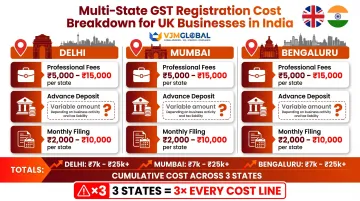
A UK company supplying services across Delhi, Mumbai, and Bengaluru needs three separate registrations. Each carries:
- Separate professional fees (₹5,000-15,000 × 3 = ₹15,000-45,000)
- Separate advance deposits for NRTPs
- Separate monthly filings (₹2,000-10,000 × 3 states = ₹6,000-30,000/month)
Location and Expertise of the CA Firm
Metro city firms (Delhi, Mumbai, Bengaluru) charge ₹10,000-15,000 for NRTP registrations. Tier-2 city firms may quote ₹5,000-8,000.
Expertise matters more than geography, though. Firms specialising in foreign company compliance understand NRTP nuances, FEMA interactions, and repatriation rules that generic domestic CAs routinely miss. VJM Global, for instance, has supported 250+ UK businesses through India entry and is familiar with the specific documentation and regulatory hurdles this involves.
Urgency and Turnaround Time
Standard GST registration takes 3-7 working days if documents are in order (Rule 9 CGST Rules). NRTP applications or cases flagged for physical verification, however, can take up to 30 days. Some firms charge 25-50% premiums for priority service, though this doesn't accelerate government processing. It only ensures your CA responds to officer queries within hours, not days.
Complete GST Cost Breakdown for UK Businesses
GST compliance involves more than a one-time registration fee. Here's what UK businesses actually pay — from setup through ongoing filing.
Government Registration Fee
One-time cost: ₹0 for all regular registrations.
However, NRTPs must pay a security deposit equal to estimated GST liability for the registration period. Under Section 27(2) CGST Act, this deposit:
- Must be paid via bank challan (Form GST PMT-06) before registration approval
- Cannot use Input Tax Credit
- Is credited to your electronic cash ledger
- Is refunded within 60 days after filing final GSTR-5 return
Example: A UK event company estimating ₹5,00,000 GST liability for a 90-day trade fair must deposit ₹5,00,000 upfront. This isn't a fee — it's advance tax — but it's worth factoring into your working capital plan.
Professional/CA Fee for Registration
| Entity Type | Fee Range (₹) | Typical Scope |
|---|---|---|
| NRTP | 5,000-15,000 | Apostille guidance, Form REG-09, authorised signatory, deposit calculation |
| Indian Pvt Ltd (budget platform) | 1,499-5,000 | Basic registration, document upload, GSTIN issuance |
| Indian Pvt Ltd (full-service CA) | 4,000-15,000 | Complete documentation, officer query management, post-registration support |
| LLP | 2,000-12,000 | Similar to Pvt Ltd, varies by transaction volume |
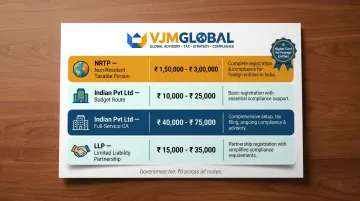
Source: IndiaFilings.
Optional One-Time Costs
Digital Signature Certificate (Class 3) — Required for Company/LLP Directors
| DSC Type | Cost Range (₹) |
|---|---|
| Indian individual, 2-year | 1,500-2,595 |
| Organisation DSC, 1-year | 2,595-5,000 |
| Foreign national DSC, 3-year | 15,000+ |
Foreign national DSCs carry higher costs over standard Indian DSCs. Proprietorships may use Aadhaar-based e-sign instead.
PAN registration is the other key one-time cost to account for before registration.
PAN Application for Indian Entity
- Indian address: ₹91 (excluding GST)
- Foreign address: ₹862 (excluding GST)
- Total with GST and physical PAN dispatch: ₹1,011
Foreign companies apply using Form 49AA via NSDL or UTIITSL portals.
Ongoing Compliance Costs
Monthly/Quarterly Return Filing
- GSTR-1 (outward supplies) + GSTR-3B (summary return): ₹2,000-10,000/month combined
- GSTR-5 (NRTP monthly return): ₹2,000-5,000/month
- Annual Return (GSTR-9): Typically included in annual packages or quoted separately
Professional filing fees vary by transaction volume and CA expertise. A business with 50 invoices monthly pays ₹2,000-3,000; complex multi-state operations with 500+ invoices pay ₹8,000-10,000.
Late Filing Penalties
- GSTR-1/GSTR-3B late fee: ₹50/day (₹25 CGST + ₹25 SGST)
- Nil return late fee: ₹20/day
- Maximum cap: ₹2,000-10,000 depending on annual turnover
- Interest on unpaid tax: 18% per annum
A 30-day delay on GSTR-3B costs ₹1,500 in late fees — before factoring in 18% annual interest on any unpaid tax. Regular filing is cheaper than catching up.
Registration Amendment Fees
Directorship changes, registered address updates, or business activity modifications require filing Form GST REG-14. CA fees run ₹1,500-5,000 per amendment, depending on complexity.
DIY vs. Professional Help — What's Right for UK Businesses?
Unlike Indian domestic businesses who can theoretically self-register, UK businesses have no viable DIY path. The GST portal requires:
- Indian PAN
- Aadhaar authentication
- Local place of business address
- Authorised signatory resident in India
Without these, you cannot complete online registration.
Why Professional Help Is Non-Negotiable for Foreign Companies
UK businesses must appoint an authorised representative or local director for GST purposes. A qualified CA or compliance firm serves as the bridge between your business and the GST department, managing:
- Officer queries (often raised in Hindi or requiring India-specific context)
- Document notarisation and apostille verification
- Advance deposit calculations
- Ongoing monthly filings with tight deadlines (11th and 20th of each month)
Firms specialising in UK business entry — such as VJM Global, which has supported 250+ UK businesses with India compliance — handle GST registration as part of broader market entry packages. This means company incorporation, FEMA compliance, foreign exchange remittance, and GST all move through one team, cutting the back-and-forth that typically causes registration delays.
What to Look for in a GST Compliance Partner
Choosing the wrong CA firm is a common and expensive mistake. Before signing, vet any firm on these four criteria:
- NRTP-specific track record: Ask directly — how many foreign company GST registrations have they completed, and what's their average approval timeline? General domestic filing experience doesn't translate.
- Fee transparency: Registration cost and ongoing retainer should be quoted separately. Watch out for ₹1,499 "registration fees" that exclude officer query handling, DSC procurement, or monthly filings.
- Time-zone responsiveness: GST officers typically allow 7 days to respond to queries. Confirm your CA can turn around responses within 24 hours despite the UK–India time difference.
- FEMA and foreign exchange coverage: GST compliance doesn't sit in isolation — it interacts with repatriation rules, transfer pricing, and foreign investment regulations. Firms with integrated advisory close these gaps before they become penalties.

What UK Businesses Commonly Miss When Budgeting for GST in India
Recurring costs exceed the one-time registration fee quickly. Monthly filing fees (₹24,000–1,20,000/year) dwarf the ₹5,000–15,000 registration cost within the first year alone.
NRTP security deposits tie up working capital before a single rupee of revenue arrives. A ₹10,00,000 advance deposit for a 90-day project is cash that could otherwise fund operations — budget for it as part of India entry capital, not just as "tax."
Multi-state operations multiply every line item. Selling across five states means five separate registrations, five deposits, and five monthly filing cycles. A single-state compliance budget of ₹50,000/year scales to ₹2,50,000/year — a figure most UK market-entry plans don't account for.
Indian GST differs from UK VAT more than it appears. Both are consumption taxes, but the operational demands are significantly heavier. Indian GST requires:
- 24+ annual returns (monthly GSTR-1 and GSTR-3B) vs. UK VAT's standard 4 quarterly returns
- Mandatory HSN/SAC codes on all invoices — no UK equivalent
- Input Tax Credit reconciliation via auto-populated GSTR-2B statements generated from suppliers' filings — UK VAT has no supplier-side auto-reconciliation
- E-invoicing for businesses exceeding ₹5 crore turnover — requires system integration
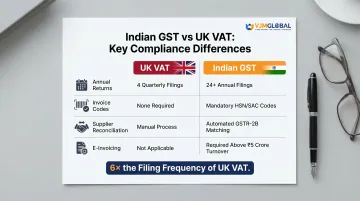
UK finance directors with decades of VAT experience consistently underestimate the compliance load — six times the filing frequency alone is enough to disrupt any reporting calendar built around UK norms.
Conclusion
GST registration in India costs ₹0 from the government, but UK businesses invest ₹50,000–₹5,00,000+ annually once you account for professional fees, compliance tools, and ongoing return filing. Costs vary based on entity type (NRTP vs. subsidiary), operational scale (single-state vs. multi-state), and transaction complexity.
Engage qualified professionals with foreign company experience from the outset. Errors in NRTP registration, HSN code selection, or document submission cause 30–90 day delays and penalties that far exceed any savings made on professional fees.
UK businesses planning India market entry can reach out to VJM Global for a detailed cost assessment and full-service GST registration support tailored to their specific entry structure, whether temporary NRTP registration or permanent subsidiary setup.
Frequently Asked Questions
How much does a CA charge for GST registration in India?
Professional CA fees range from ₹1,499–5,000 for standard Indian proprietorships to ₹5,000–15,000 for foreign companies registering as NRTPs. Foreign company fees fall at the higher end due to apostille documentation, authorised signatory requirements, and advance deposit calculations.
What is the GST rate on CA fees?
Chartered accountant and professional services attract 18% GST under SAC 9982 (financial auditing services) and SAC 9983 (other professional services). This GST is charged on top of the base professional fee quoted. Source: CBIC GST Rate Schedule.
What is the GST registration turnover threshold in India?
Standard thresholds: ₹40 lakh for goods suppliers, ₹20 lakh for service providers in most states. Special category states (Manipur, Mizoram, Nagaland, Tripura) have lower ₹10 lakh thresholds. However, NRTPs must register regardless of turnover per Section 24(v) CGST Act.
Do UK businesses need to register for GST if they have an Indian subsidiary?
Yes. Once a UK company incorporates an Indian subsidiary (Private Limited Company or LLP), the Indian entity must register for GST independently once it meets turnover thresholds or conducts interstate/e-commerce supply. The UK parent company's VAT registration does not affect this requirement.
How long does GST registration take in India for foreign companies?
Standard registration with complete documents takes 3–7 working days. NRTP registrations or cases requiring physical verification may extend to 30 days, so UK businesses should apply at least 5 days before commencing operations and build buffer time into their India launch timeline.
What is a Non-Resident Taxable Person (NRTP) and does it apply to UK businesses?
An NRTP is a foreign business occasionally supplying goods or services in India without a fixed place of business. Registration lasts 90 days (extendable once to 180 days) and requires an advance deposit equal to estimated GST liability. UK businesses running temporary projects, exhibitions, or events typically fall under this category.