Here's the real problem: most rejected or delayed applications don't fail because of a flawed business model. They fail because of paperwork. A blurred photo, a mismatched address, an Aadhaar authentication that didn't go through, any of these can trigger a clarification notice or an outright rejection.
This guide breaks down exactly what documents you need, organised by business structure: proprietorship, partnership, LLP, private limited company, or foreign entity.
Key Takeaways
- GST document requirements differ for proprietorships, partnerships, LLPs, and companies.
- PAN and Aadhaar details of the promoter or signatory are central to verification.
- Applying more than 30 days after your GST liability triggers makes you non-compliant.
- Foreign companies, NRIs, and OCIs face extra documentation, including notarised certificates and RBI/FEMA filings.
- A professional review before submission catches errors that most often cause rejection.
Who Needs GST Registration in India in 2024
Not every business needs to register immediately. It depends on your turnover, your supply type, and sometimes which state you operate from.
Turnover Thresholds That Trigger Registration
| Business type | Threshold | Special category states |
|---|---|---|
| Services / mixed supplies | Above ₹20 lakh | Above ₹10 lakh (Manipur, Mizoram, Nagaland, Tripura) |
| Exclusive goods suppliers (eligible states) | Above ₹40 lakh | Above ₹20 lakh (Arunachal Pradesh, Meghalaya, Sikkim, Uttarakhand, Puducherry, Telangana) |
The ₹40 lakh limit isn't automatic. It doesn't apply if you're already covered under Section 22's compulsory registration provisions, or if you deal in notified goods like tobacco or pan masala.
Compulsory Registration, Regardless of Turnover
Some businesses must register the moment they start operating:
- Inter-state suppliers of goods or services
- E-commerce operators and many sellers operating through them
- Casual taxable persons and non-resident taxable persons
- Businesses liable to pay tax under reverse charge
- TDS/TCS deductors and Input Service Distributors
The 30-day rule: once you become liable, you have 30 days to apply. Casual and non-resident taxable persons must apply at least five days before starting business.
Should You Register Voluntarily?
Plenty of businesses under the threshold register anyway. Voluntary registration lets you claim Input Tax Credit on purchases and makes you more credible to B2B clients who often prefer GST-registered vendors.
Foreign Companies, NRIs, and OCIs
If you're setting up a branch office, subsidiary, or LLP in India, GST registration kicks in the moment you start supplying taxable goods or services here. The same rule applies if you're an NRI or OCI running a sole proprietorship or partnership rather than a registered entity.
Non-resident promoters must navigate RBI and FEMA rules alongside GST compliance, so specialised guidance early on prevents costly delays.
Documents Required for GST Registration – General Checklist
Regardless of your business structure, a few document categories show up in every application. Get these right, and you've cleared most of the hurdle.
PAN card of the business entity or proprietor Your PAN is the primary identifier the GST system links your GSTIN to. Companies and LLPs use the entity's PAN; proprietors use their personal PAN, since a proprietorship has no separate legal existence.
Photograph of promoters, partners, or directors A recent passport-style photograph (JPG format, under 100 KB) is required for every stakeholder and the authorised signatory.
Proof of Business Address
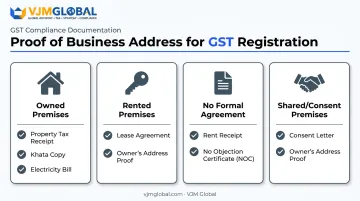
Accepted documents depend on how you occupy the premises:
- Owned premises: latest property tax receipt, municipal khata copy, or electricity bill
- Rented premises: valid rent or lease agreement plus the owner's proof of ownership
- No formal agreement: a rent receipt along with a No Objection Certificate (NOC) from the owner
- Shared or consent-based premises: a consent letter plus the consenter's ownership proof
Bank Account Proof
A cancelled cheque, the latest bank statement, or the first page of your passbook showing the account number, IFSC code, and business name works here. Bank details can actually be added after registration. More on that shortly.
Digital Signature Certificate (DSC)
Companies and LLPs must authenticate their application using a DSC. Proprietors and partnerships have it easier: they can typically use Aadhaar OTP-based e-signature instead of arranging a physical certificate.
Proof of Business Constitution
Finally, you'll need documentation proving your legal structure, a partnership deed, certificate of incorporation, or similar. This is where the paperwork diverges sharply by entity type, which is exactly what comes next.
Documents Required Based on Business Constitution
"Constitution of business" is simply the legal structure under which you operate. GST uses this classification to decide exactly which documents it wants to see.
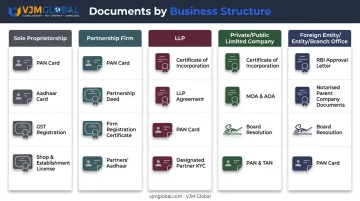
Sole Proprietorship
A proprietorship has no separate legal identity from its owner. The proprietor's own PAN and Aadhaar double up as the business's identity proof. Alongside these, you'll need:
- Any one registration proving the business exists, such as a Shop & Establishment certificate, MSME/Udyam registration, or trade licence
- Address proof of the business premises
- Bank account proof in the proprietor's name
Partnership Firm and LLP
Partnerships and LLPs need a slightly heavier file:
- Partnership deed (for firms) or LLP Agreement plus Certificate of Incorporation from the MCA (for LLPs)
- PAN of the firm or LLP itself
- KYC of all partners: PAN, Aadhaar, and photograph
LLPs carry one extra requirement: a Board or Partner resolution authorising a specific person as the GST portal signatory.
Private Limited, Public Limited, and One Person Companies
Companies face the most document-heavy process, since they're the most formally structured entity type:
- Certificate of Incorporation
- Memorandum & Articles of Association (MOA/AOA)
- Company PAN
- Board Resolution appointing an authorised signatory
Every director also submits individual KYC, PAN, Aadhaar, DIN, and a photograph.
Foreign Companies, NRIs, and Branch/Liaison Offices
This is where documentation gets genuinely complex. On top of everything above, foreign entities typically need:
- Certificate of Incorporation from the country of origin, notarised or apostilled
- PAN of the Indian entity once allotted
- RBI/FEMA approval documents where a branch or liaison office is involved
Our team at VJM Global works with foreign promoters, NRIs, and OCIs regularly. One pattern shows up often: RBI/FEMA paperwork tends to eat up more time than the GST filing itself. This includes routing applications through an AD Category 1 bank or securing a Letter of Comfort when a subsidiary applies independently.
Getting local guidance before your India entity is fully incorporated can save weeks down the line.
Additional Documents: Multiple Business Locations, Authorized Signatory & Bank Details
Running more than one location, or delegating GST compliance to a team member? A few more documents come into play, covering additional locations, your authorised signatory, and bank details.
Multiple places of business: If you operate from more than one location, a branch, warehouse, or additional office, you'll need separate address proof for each one listed in your application, following the same occupancy rules covered earlier.
Authorising a signatory: Someone needs to operate your GST portal login, file returns, and respond to notices. That person needs a Letter of Authorisation, or for companies and LLPs, a Board Resolution, naming them as the authorised signatory, usually alongside an acceptance letter from the signatory themselves.
Bank details: Here's some good news: you have more time than you think. You no longer need finalised bank account details on day one.
Under Rule 10A of the CGST Rules, you can furnish bank account information within 30 days of registration, or before filing your first outward supply statement, whichever comes first. This has removed a genuine bottleneck for businesses still finalising banking arrangements when they file.
Common Reasons for GST Application Rejection & Tips for Smooth Approval
Documentation inconsistencies cause most GST application rejections. Watch for these common triggers:
- Name or address mismatches across PAN, Aadhaar, and address proof documents
- Blurred, expired, or partially visible scanned documents
- Incorrect HSN/SAC code selection for your goods or services
Aadhaar Authentication Issues
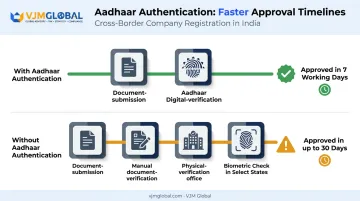
Aadhaar authentication now shapes how fast your application moves. Under Rule 9 of the CGST Rules, applications with successful Aadhaar authentication are typically approved within 7 working days. Skip or fail authentication, and the window can stretch to 30 days, plus a possible physical verification visit. Applicants in select states are now also being asked for biometric authentication at a facilitation centre.
Why a Professional Review Helps
A second pair of trained eyes catches what a founder juggling ten other things might miss. VJM Global's Chartered Accountants and business-setup specialists review documentation for Indian and foreign-owned businesses before it reaches the GST portal. This step catches mismatches and missing signatures that typically trigger a clarification notice.
For clients building an India entity from scratch, that review usually happens alongside broader FEMA and incorporation compliance rather than as a separate, last-minute check.
Frequently Asked Questions
What is the meaning of constitution of the business?
"Constitution" refers to your business's legal structure: sole proprietorship, partnership, LLP, or company. GST uses this classification to determine exactly which documents your application needs.
What are the details required for GST registration of a company?
A company needs its Certificate of Incorporation, PAN, MOA/AOA, and a Board Resolution appointing a signatory, plus KYC (PAN, Aadhaar, DIN, photo) for every director, along with address and bank proof.
How long does GST registration take in India?
With successful Aadhaar authentication and complete documents, approval typically takes around 7 working days. If authentication fails or physical verification is needed, expect closer to 30 days.
Is Aadhaar authentication mandatory for GST registration in 2024?
It isn't strictly mandatory, but skipping it moves your application to a slower, verification-heavy track that can include a physical site visit and, in some states, biometric checks.
What are the fees for GST registration?
There's no fee for filing directly on the official GST portal. If you engage a professional advisor, like VJM Global, for document review and filing support, their service fees apply separately.
Can NRIs or foreign companies register for GST in India?
Yes, once they establish a taxable presence, such as a branch office, subsidiary, or LLP, supplying goods or services in India. Additional documents, such as notarised incorporation certificates from the home country, are typically required.