Introduction
Planning a wedding or a corporate conference is the easy part. Registering the business behind it is where most event entrepreneurs get stuck.
Setting up an event management company in India means choosing a legal structure and completing incorporation through the Ministry of Corporate Affairs (MCA). You'll also need GST registration and event-specific licences before you can legally invoice a single client.
This guide serves two audiences: Indian entrepreneurs building wedding-planning or corporate-event businesses, and NRIs, OCIs, and foreign investors eyeing India's booming weddings, corporate events, and MICE (Meetings, Incentives, Conferences, Exhibitions) sector.
We'll walk through business structures, the step-by-step registration process, licensing requirements, GST rules, costs, and the compliance calendar you'll need to follow once you're operational.
Key Takeaways
- Pvt Ltd companies win corporate contracts and foreign investment more easily than proprietorships
- Incorporation runs through SPICe+ on the MCA portal and wraps up within days
- GST registration kicks in above ₹20 lakh turnover, using SAC 998596 at 18%
- Event-day approvals (police, fire, noise, FSSAI) vary by venue and event scale, not one blanket licence
- NRIs and foreign nationals enter via an Indian subsidiary or Pvt Ltd company under FEMA norms
Why Register an Event Management Company in India
India's MICE and events industry isn't a side hustle anymore. The market generated ₹4,16,217 crore (roughly US$49.4 billion) in 2024, and industry estimates project it will nearly double to ₹8,73,559 crore by 2030, growing at a IBEF's projected 13% CAGR. That's the MICE segment specifically, but weddings and corporate events are riding the same growth curve.
Here's what registration actually buys you:
- Legal separation of assets: A registered entity shields your personal savings and property from business liabilities if a stage collapses, a vendor sues, or a client cancels last minute.
- Access to corporate clients: Most corporates and premium venues only sign contracts with GST-registered, formally incorporated entities that can issue valid tax invoices.
- MSME/Udyam benefits open up priority lending, government tender eligibility, and scheme-based subsidies once you're formally registered.
- Institutional credibility matters too — banks, insurers, and venue partners take a registered company more seriously than an unregistered freelancer.
These advantages apply whether you're based in India or abroad, though the entry route differs slightly for international founders. For foreign nationals, NRIs, and OCIs, incorporating an Indian subsidiary or Pvt Ltd company is the standard route to legally operate, repatriate profits, and tap into India's event market under current FDI norms.
Staying unregistered isn't a viable long-term strategy either. You're limited to small personal events, you have no legal recourse when a client refuses to pay, and your personal liability exposure is unlimited. Once you're handling weddings with 500+ guests or corporate conferences with six-figure budgets, that risk profile stops making sense.
Choosing the Right Business Structure for Your Event Management Company
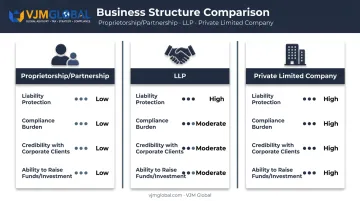
Your choice of structure determines your liability exposure, your compliance workload, and whether you can eventually raise funds or bid for large corporate contracts. Here's how the main options compare.
Sole Proprietorship & Partnership Firm
Suited to solo wedding planners or small two-to-three-person teams running a handful of events a year. Compliance is minimal — no MCA incorporation, no annual ROC filing.
The catch: unlimited personal liability. As your event size and client base grow, so does your exposure. A single dispute over a cancelled corporate gala could put your personal assets on the line.
Limited Liability Partnership (LLP)
A solid middle ground for two-plus partners running multiple events simultaneously. You get:
- Limited liability protection (partners aren't personally liable for the firm's debts, barring their own wrongful acts)
- Flexible profit-sharing arrangements between partners
- Moderate compliance — Form 11 and Form 8 filed annually, rather than full company-level reporting
Private Limited Company
This is the structure most event companies graduate to once they start targeting corporate clients, franchise expansion, or outside investment. It offers:
- Stronger liability protection for shareholders
- Higher credibility with venues, hotels, and corporate procurement teams
- The ability to raise equity funding and onboard investors formally
- Perpetual succession, so the business continues even as ownership or shareholding changes
If you're planning to bid for corporate conference contracts or build a multi-city events brand, Pvt Ltd is generally the better starting point rather than something to convert into later.
Indian Subsidiary for Foreign Founders, NRIs & OCIs
Overseas entrepreneurs typically incorporate a wholly owned subsidiary or Pvt Ltd company with foreign direct investment, mostly under the automatic route that doesn't require prior government approval. VJM Global regularly guides foreign founders, NRIs, and OCIs through this entity selection and FDI compliance process.
One important nuance: One Person Company (OPC) structures aren't available to foreign nationals. Since April 2021, an OPC's member must be an Indian citizen, whether resident in India or abroad. An NRI who retains Indian citizenship may qualify, but a foreign passport holder or an OCI who isn't an Indian citizen cannot.
Step-by-Step Registration Process for an Event Management Company in India
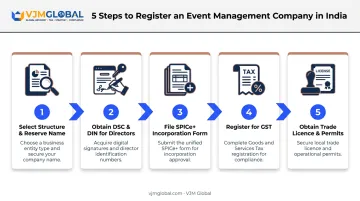
Registration moves in a sequence: pick your structure first, then work through incorporation, tax registration, and finally licensing. Here's the full path.
Step 1: Select Business Structure & Reserve Company Name
Once you've settled on Proprietorship, LLP, or Pvt Ltd, reserve a unique company name through SPICe+ Part A (or the RUN service for existing companies changing names) on the MCA portal. Names must comply with Companies Act naming rules: no identical or deceptively similar names to existing registered entities. A new-company name reservation stays valid for 20 days.
Step 2: Obtain DSC and DIN for Directors
Every director needs:
- A Digital Signature Certificate (DSC) from a licensed certifying authority, used to sign electronic filings
- A Director Identification Number (DIN), allotted through the incorporation form itself for up to three new directors
Foreign directors face an extra step: documents must be notarised in their home country, and apostilled if that country is party to the Hague Apostille Convention. Documents from non-Hague countries need authentication by the relevant Indian consular office instead.
Step 3: File SPICe+ Incorporation Form
SPICe+ Part B bundles several outcomes into one filing: the Certificate of Incorporation, PAN, and TAN. A linked AGILE-PRO-S form handles GSTIN application, EPFO, and ESIC registration alongside it.
When filling this out, select NIC code 82300: "Organisation of conventions and trade shows" if it accurately describes your core activity. If catering or other services are bundled into your business, those need separate classification codes.
Step 4: Register for GST
GST registration becomes mandatory once your aggregate turnover crosses ₹20 lakh (or ₹10 lakh in specified special-category states). It's also required if you're serving corporate clients who expect a valid GST invoice, regardless of turnover. Event management services fall under SAC 998596, taxed at 18% GST.
Step 5: Obtain Trade Licence, Shop & Establishment and Sector-Specific Permits
Depending on your municipality and activities, you may need:
- A municipal trade licence (requirements vary by city; Delhi's MCD General Trade/Storage Licence is one example)
- Shop & Establishment registration if you're hiring staff
- FSSAI registration if you prepare or supply food directly rather than outsourcing catering
- Music/copyright licensing through PPL India and/or IPRS for commercial use of recorded or performed music
Given the paperwork and cross-checks involved at each stage, many international founders bring in a firm like VJM Global to manage incorporation, tax registration, and licensing as one coordinated process.
Licenses, Permits & GST Compliance for Event Companies
Beyond incorporation-linked registrations, event companies deal with a recurring set of event-day approvals, known as NOCs (No Objection Certificates), that depend entirely on venue and scale.
Common event-day NOCs include:
- Police permission for large public gatherings
- Fire safety NOC for indoor venues, temporary structures, and large-occupancy spaces
- Noise pollution NOC for amplified music: general restrictions run from 10 pm to 6 am, with state-authorised exemptions up to midnight for limited occasions per year
- Health department clearance for food stalls at outdoor or public events
GST on Bundled vs. Unbundled Services
This trips up a lot of event businesses at invoicing time. Here's the distinction:
- A naturally bundled composite supply: commonly 5% without input tax credit for standard restaurant/catering services, though specified-premises supplies can run at 18%
Get this wrong on an invoice and you either overcharge clients or under-collect tax you'll owe anyway. It's worth structuring contracts with this distinction in mind from day one.
MSME/Udyam Registration
Udyam registration is free, online, and based on self-declaration through Aadhaar and PAN. Every event company should register regardless of size: it unlocks priority-sector lending eligibility, access to government tenders (procurement policy targets 25% annual sourcing from MSEs), and scheme-based subsidies that unregistered businesses can't access.
Cost of Registration and Ongoing Compliance Requirements
Government fees for registration are lower than most founders expect: the bigger cost driver is professional and licensing fees layered on top.
| Structure | MCA/Government Fee | Notable Add-on Costs |
|---|---|---|
| Proprietorship | None (no MCA filing) | Udyam and GST filing are free; local trade and food-licence fees may apply |
| LLP | Variable, based on contribution amount | Stamp duty varies by state; DSC vendor charges apply |
| Private Limited | Zero MCA incorporation fee for authorised capital up to ₹15 lakh | Name reservation, stamp duty, and DSC charges still apply |
Municipal trade licence fees are a good example of how location changes costs. Delhi's MCD schedule, for instance, charges roughly ₹3,968 to ₹9,919 depending on premises size, and other cities set their own rates entirely.
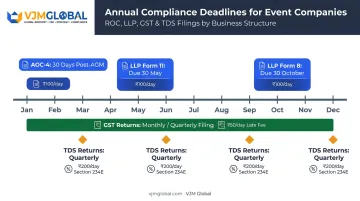
Ongoing compliance obligations differ sharply by structure:
- Pvt Ltd/OPC companies file AOC-4 (financial statements) and MGT-7/MGT-7A (annual return) within 30 and 60 days of the AGM, respectively. Missing either deadline costs ₹100 per day, uncapped
- LLPs file Form 11 (annually by 30 May) and Form 8 (by 30 October)
- GST returns (GSTR-1, GSTR-3B) are due monthly or quarterly depending on your filing scheme, with late fees running ₹20-50 per day depending on whether the return is nil or not
- TDS returns are quarterly, with a ₹200/day fee under Section 234E for late filing, capped at the TDS amount itself
For founders bringing in foreign capital, there's an additional layer: Form FC-GPR must be filed within 30 days of issuing shares to a non-resident investor, and an annual FLA return is due by 15 July each year for entities with outstanding FDI on their books.
Between ROC filings, GST returns, TDS deadlines, and FEMA reporting for foreign-invested entities, the paperwork load adds up fast, and that's before you've run a single event.
VJM Global's Chartered Accountants and business-setup team handle incorporation, GST registration, and ongoing compliance filings for both Indian entrepreneurs and foreign founders, NRIs, and OCIs entering India's events market. That leaves you free to focus on vendor contracts and venue walkthroughs instead of ROC deadlines.
Frequently Asked Questions
How much does it cost to register an event company in India?
Government fees are minimal, often near-zero for proprietorships and Pvt Ltd companies with authorised capital under ₹15 lakh. Professional fees for DSC, filing assistance, and compliance support vary by provider and structure, so request a tailored quote based on your setup.
What are the total ongoing costs of running an event management company in India?
Registration itself is a one-time cost of a few thousand rupees to a few tens of thousands depending on structure and professional fees. Ongoing operational costs (equipment, insurance, staff, and working capital) run considerably higher and depend entirely on your event scale.
Is registration of an event company mandatory in India?
Yes, if you're billing clients, signing contracts, or seeking corporate work. Formal registration isn't optional at that stage, though very small, purely personal-event proprietorships face lighter obligations than incorporated companies.
Which business structure is best for an event management company?
Solo planners often start with a Proprietorship or LLP for lower compliance. Companies targeting corporate clients, franchise growth, or outside investment should register as a Private Limited Company for stronger credibility and liability protection.
What GST rate applies to event management services in India?
Event, exhibition, and convention organisation falls under SAC 998596, taxed at 18% GST. Bundled catering or other components sold separately can attract different rates depending on how the contract is structured.
Can NRIs or foreign nationals register an event management company in India?
Yes — NRIs, OCIs, and foreign nationals can set up an Indian subsidiary or Private Limited company, subject to FEMA and RBI norms. One exception: OPC registration isn't available to foreign nationals or OCIs who aren't Indian citizens.