
Total FDI inflows hit USD 81.04 billion in FY2024-25, up 14% year on year, according to a Press Information Bureau release on FDI performance. Foreign enterprises are showing up in real numbers, and they need a compliant, functioning legal entity to operate.
Here's the catch: "enterprise company" registration isn't a single form or a single path. The right structure depends on your ownership mix, funding plans, and industry. VJM Global has spent years guiding US, UK, and Australian businesses through exactly this decision. This article walks through the eligible structures, the step-by-step SPICe+ process, required documents, cost and timeline factors, and the mistakes that trip up first-time filers.
Key Takeaways
- Registration creates a separate legal entity with limited liability under the Companies Act
- Private Limited Company suits most funded enterprises, while foreign parents often use subsidiaries or branches
- SPICe+ combines name approval, incorporation, PAN, and TAN into one MCA filing
- Foreign nationals, NRIs, and OCIs can hold up to 100% equity under India's automatic FDI route
- Experienced consultants reduce document errors and prevent avoidable Registrar of Companies (ROC) rejections
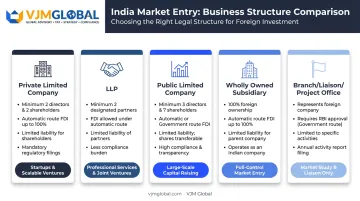
Types of Business Structures Suitable for Enterprise Registration in India
Your structure choice shapes your liability protection, your ability to raise foreign capital, and how heavy your ongoing compliance burden becomes. Get this wrong at the start, and you'll be restructuring later at real cost.
Private Limited Company
This is the default choice for funded startups and mid-size enterprises. Requirements are minimal:
- Minimum 2 directors and 2 shareholders (can be the same people)
- At least one director must be an Indian resident (someone who spent 182+ days in India in the previous financial year)
- No minimum paid-up capital required under current rules
Investors prefer this structure because it supports equity funding rounds and employee stock options, plus clean exit mechanisms through share transfers.
Limited Liability Partnership (LLP)
Consulting firms and IT service providers often pick an LLP instead. It combines partnership-style flexibility with limited liability protection, and the compliance load is noticeably lighter than a private limited company's. Foreign investment in an LLP is permitted under the automatic route in sectors where 100% FDI is allowed with no performance-linked conditions attached.
Public Limited Company
This structure only makes sense once you're planning to raise capital from the public or pursue an IPO. It requires a minimum of three directors, permits unlimited shareholders, and brings added governance obligations under both the Companies Act and SEBI regulations. Most enterprises entering India for the first time won't need this immediately.
Wholly Owned Subsidiary
For US, UK, and Australian parent companies wanting full operational control, a wholly owned subsidiary (structured as a private limited company) is the standard route. It requires:
- FDI compliance under the applicable route (automatic or government)
- At least one Indian resident director
- Full incorporation through SPICe+, same as any domestic company
Under India's FDI policy, caps vary meaningfully by sector, as outlined in the Consolidated FDI Policy Circular from DPIIT:
| Sector | FDI Cap | Route |
|---|---|---|
| Manufacturing | 100% | Automatic |
| Greenfield pharmaceuticals | 100% | Automatic |
| Brownfield pharmaceuticals | 100% | Automatic to 74%, government route beyond |
| Defence | 100% | Automatic to 74%, government route beyond |
| Private security agencies | 74% | Automatic to 49%, government route to 74% |
Branch Office, Liaison Office, or Project Office
These routes suit foreign enterprises that want a representative presence without full incorporation. All three require prior RBI approval, filed via Form FNC through an Authorised Dealer bank, not through SPICe+.
- Liaison Office: communication and market research only, no commercial activity
- Branch Office: limited commercial functions on behalf of the parent
- Project Office: set up for a specific, contracted project in India
RBI eligibility isn't trivial either. A liaison office generally needs a three-year profitable track record and minimum net worth of USD 50,000, while a branch office needs five years of profitability and USD 100,000 in net worth. Applicants who fall short can submit a Letter of Comfort from the parent company instead.
Step-by-Step Process to Register an Enterprise Company in India
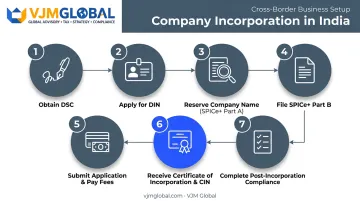
The process is standardized under the Companies Act, 2013 through the integrated SPICe+ form on the MCA portal. Working with an experienced business-setup team, such as VJM Global, helps foreign enterprises move through each stage without the back-and-forth that causes delays.
1. Obtain Digital Signature Certificates (DSC) Every proposed director and subscriber needs a Digital Signature Certificate to digitally sign MCA filings. This has to happen before anything else can proceed, since e-forms won't submit without it.
2. Apply for Director Identification Number (DIN) First-time directors get their DIN allotted directly through SPICe+ itself, no separate application needed. Once issued, a DIN is valid for that person's lifetime.
3. Reserve the Company Name (SPICe+ Part A) Submit two proposed names that comply with MCA naming rules. The Registrar checks each name against existing companies, LLPs, and trademarks. Common rejection reasons include:
- Names identical or too similar to an already-registered entity
- Prohibited terms under the Emblems and Names Act, 1950
- Missing required suffixes (for example, a public company name must end in "Limited")
4. File SPICe+ Part B with Incorporation Details This is the substantial filing. It covers registered office address, capital structure, and director/shareholder details, along with linked forms:
- e-MOA and e-AOA (memorandum and articles of association)
- INC-9 (director/subscriber declaration)
- AGILE-PRO-S (for PAN, TAN, GST, EPFO, ESIC, and bank account setup)
5. Submit Application and Pay Government Fees Once digitally signed and submitted, you'll receive a Service Request Number (SRN) for tracking. Fees vary by authorized capital — MCA charges zero incorporation fee for companies with authorized capital up to ₹15 lakh. Above that threshold, fees scale according to the MCA fee calculator.
6. Receive Certificate of Incorporation (COI) and CIN The ROC verifies every document before issuing the Certificate of Incorporation, which includes your Company Identification Number (CIN). PAN and TAN are usually auto-allotted alongside it.
7. Complete Post-Incorporation Compliance Incorporation isn't the finish line. You'll need to:
- Appoint your first auditor within 30 days of registration
- File Form INC-20A (commencement declaration) within 180 days
- Open a current bank account
- Register for GST, IEC, or MSME status where applicable
Documents and Eligibility Requirements for Enterprise Registration
Document requirements diverge sharply between Indian and foreign directors or shareholders, and this is where most delays actually originate.
Who Is Eligible to Register a Private Limited Company?
The baseline is straightforward:
- At least 2 directors and 2 shareholders
- One Indian resident director, minimum
- No minimum paid-up capital, following the Companies (Amendment) Act, 2015, which removed the earlier statutory threshold
Foreign nationals, NRIs, and OCIs can hold up to 100% equity in most sectors under the automatic FDI route. Sector-specific exceptions apply, particularly in defence, insurance, and private security, where caps and government-route approvals kick in above certain thresholds.
Documents Checklist for Directors, Shareholders, and Registered Office
For Indian directors and shareholders:
- PAN card
- Aadhaar or another government-issued ID
- Address proof (bank statement, utility bill, not older than 2-3 months)
For foreign directors and shareholders:
- Passport, notarised by a foreign authority or signed by the Indian Embassy in that country
- Address proof (bank statement, driving licence, or residence card)
- Notarised English translation for any document in another language
For the registered office:
- Rental agreement or ownership proof
- No Objection Certificate (NOC) from the property owner
- A recent utility bill
One recurring issue worth flagging: the ROC rejects outdated utility bills and address mismatches between the proof and the application form outright. Getting this right the first time saves weeks.
Cost, Timeline, and Compliance Factors That Affect Enterprise Registration
Outcomes here vary based on your chosen structure, authorised capital, and the stamp duty rules in your specific state — India doesn't apply a single flat stamp duty nationwide.
On cost: MCA's incorporation fee is zero for companies (and LLPs with no share capital, up to 20 members) with authorised capital up to ₹15 lakh. Beyond that threshold, costs rise in two ways:
- Government and professional fees increase together as authorised capital grows and filing complexity rises
- RBI-approval structures (branch or liaison offices) and public companies cost more due to added documentation and compliance requirements
On timeline: Document readiness drives the timeline more than anything else. SPICe+ was built to bundle 11 business-starting services together, and MCA has stated these can be delivered rapidly when filings are complete and error-free. In practice, delays come from:
- Incomplete or improperly notarized foreign director documents
- DSC or DIN processing hiccups
- ROC review backlogs during peak filing periods
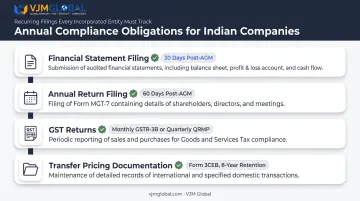
On ongoing compliance: Incorporation marks the start of an ongoing compliance obligation. Enterprises need to stay on top of:
- Financial statement filing within 30 days of the AGM
- Annual return filing within 60 days of the AGM
- GST returns (monthly GSTR-3B, or quarterly under the QRMP scheme for turnover under ₹5 crore)
- Transfer pricing documentation for international transactions with the foreign parent, with records retained for 8 years and reporting via Form 3CEB
VJM Global's team of Chartered Accountants handles this full compliance calendar for foreign-owned entities long after incorporation, covering ROC filings, statutory audits, GST, and transfer pricing benchmarking together rather than piecemeal.
Common Mistakes to Avoid When Registering an Enterprise Company in India
Most registration headaches trace back to a handful of avoidable errors:
- Picking a structure without thinking ahead. Choosing a private limited company or LLP without weighing funding needs, liability exposure, or tax treatment often forces costly restructuring later.
- Submitting weak foreign documentation. Unsigned, incomplete, or non-notarized passports and address proofs for foreign directors are a leading cause of MCA rejections.
- Ignoring state-specific stamp duty and deadlines. Missing INC-20A filing windows or overlooking state stamp duty rules leads to preventable penalties.
VJM Global catches these issues before they reach the Registrar, not after. That approach comes from supporting 500+ American, 250+ UK, and 250+ Australian businesses through India entry, with a 95% client retention rate.
Frequently Asked Questions
How to register an enterprise in India?
Choose your business structure, obtain DSC and DIN for directors, reserve a name, and file SPICe+ with linked forms. The Registrar of Companies (ROC) then issues your Certificate of Incorporation once documents clear verification.
Who is eligible for Pvt Ltd?
You need at least 2 directors and 2 shareholders, with one Indian resident director among them. There's no minimum paid-up capital requirement under current company law.
Can a foreign company fully own an Indian subsidiary?
Yes, up to 100% FDI is permitted in most sectors under the automatic route. Some sectors, like defence and insurance, carry lower caps or require government-route approval.
How long does enterprise company registration take in India?
There's no fixed official average, since timelines depend heavily on document readiness and ROC review load. Complete, error-free filings move through SPICe+ considerably faster than those needing corrections.
What is the minimum capital required to register a private limited company in India?
No statutory minimum paid-up capital requirement exists. This threshold was removed under the Companies (Amendment) Act, 2015, though subscribers must still pay for shares they've agreed to take.
Do foreign directors need to be physically present in India for registration?
No. Foreign directors can complete registration remotely using notarized or apostilled documents. However, the company still needs at least one director who's a resident of India.