Foreign investors looking at Wales usually hit the same wall, though. UK company law is straightforward enough on paper, but Wales-specific funding, visa and sponsor licence rules, and ongoing tax compliance can feel like three separate puzzles. Add in the fact that many investors are also weighing expansion into other fast-growing markets, and the picture gets more complex fast.
This guide walks through why Wales is worth a serious look, how to pick the right business structure, the step-by-step registration process, where the funding actually comes from, and what compliance looks like once you're trading.
Key Takeaways
- Wales attracted 75 foreign investment projects and 1,617 new jobs in 2025-26, the UK's only growth nation
- Two AI Growth Zones in Anglesey and South Wales are drawing major infrastructure investment and thousands of jobs
- The private limited company stays the default choice, making up over 95% of UK-registered corporate bodies
- Registration runs through Companies House and HMRC; a sponsor licence applies if hiring overseas staff
- Business Wales and the Development Bank of Wales provide funding unavailable elsewhere in the UK
Why Wales Is Attracting Foreign Investors
A Genuine FDI Rebound Backed by Data
Wales recorded 75 inward investment projects in 2025-26, up from 65 the year before, alongside 1,617 new jobs. That's roughly a 15% jump in project count year-on-year, and Wales was the only part of the UK to increase foreign investment during that period. Most other UK regions saw flat or declining figures over the same stretch.
That matters for two reasons:
- It signals policy stability at a time when many investors are wary of shifting economic priorities
- It suggests Wales is winning projects on merit rather than riding a national wave
AI Growth Zones are reshaping the map
In November 2025, the UK government designated two AI Growth Zones in Wales: one covering Anglesey and Trawsfynydd in North Wales, the other running along the M4 corridor from Newport to Bridgend in South Wales.
The North Wales zone is projected to create around 3,450 jobs, with a potential future link to a small modular reactor at Wylfa for power supply. The South Wales zone, which includes the former Ford Bridgend site, has been associated with up to £10 billion in planned investment and at least 5,000 jobs.
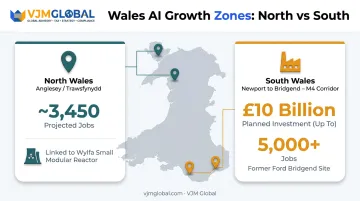
Worth flagging: these are announced targets, not completed investment figures. Still, faster access to power and planning permission for data centre and AI infrastructure projects is a real, practical advantage over more congested regions.
A £546.5 million Local Growth Fund replaces old EU money
The Welsh Government's Local Growth Fund allocates £546.5 million across 2026-27 to 2028-29, filling the gap left by former EU structural funding. Priority sectors include:
- Advanced manufacturing
- Clean and low-carbon energy
- Digital technologies and fintech
- Creative industries
- Life sciences and financial services
Cost and space advantages over London
Cardiff's prime office rent sat at roughly £30 per square foot in late 2025, compared with £182.50 per square foot in London's West End Core during the same year. These are different submarkets, so it's not an apples-to-apples comparison, but the gap is directional and significant for anyone budgeting an office footprint.
Industrial space is tighter than it was — large-unit take-up fell 37% in 2025 versus 2024, partly due to limited Grade A stock. Even so, Wales remains far less congested than the Southeast, and it's increasingly framed as the go-to region for manufacturing, data centres and energy projects.
A workforce pipeline built around specific sectors
Cardiff University and Swansea University anchor the compound-semiconductor cluster in South Wales, feeding talent directly into industry. FinTech Wales runs bootcamps and career-transfer programmes aimed at building a fintech-ready workforce.
The Welsh Government has also taken a proactive stance across advanced manufacturing, renewable energy, digital technology and life sciences, which shows up in how funding and skills programmes are targeted.
Choosing the Right Business Structure for Your Welsh Venture
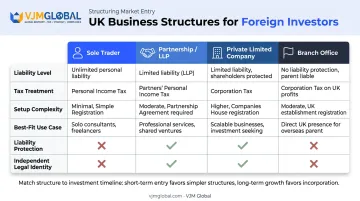
Wales operates under the same Companies Act 2006 framework as the rest of Great Britain. There's no separate Welsh company law, so your structure options are identical whether you're setting up in Cardiff or Croydon.
Sole Trader
Simple and cheap to set up, but you carry unlimited personal liability. Best suited to solo, low-risk ventures such as consultants or freelance operators who don't need to raise external capital.
Private Limited Company (Ltd)
This is the default choice for most foreign investors, and for good reason. Private limited companies make up over 95% of corporate bodies currently on the UK register, according to Companies House data. Key requirements:
- At least one director (no UK residency requirement)
- A registered UK office address
- Shareholder details on file with Companies House
- Liability limited to the company's assets, protecting personal wealth
Partnerships
General partnerships, limited partnerships and limited liability partnerships (LLPs) all exist as options. Profits are taxed at the partner level rather than through corporation tax, which can suit joint ventures where multiple parties want direct control over their share of the business.
Branch Office
Overseas companies wanting a UK presence without full incorporation can register a UK establishment (branch) instead. A branch has no independent legal identity; it operates purely as an extension of the parent company. That means:
- Registration via form OS IN01 within one month of opening, at a cost of £124
- The parent company's accounts (often with certified English translation) may require filing
- Fewer liability protections than a subsidiary, since the parent remains fully exposed
Decision tip: match your structure to liability tolerance, tax efficiency goals and how long-term your Welsh investment is meant to be. A branch suits a short-term representative presence; a limited company suits anyone planning to hire, scale or raise investment locally.
Step-by-Step Guide to Registering Your Business in Wales
Business Wales offers free advisory support throughout this entire process, and it's worth using from day one rather than after problems arise.
Build a Comprehensive Business Plan
Before you register anything, map out the market. This means researching Welsh and UK competitors directly, not just assuming your home-market positioning will translate. Pair that with a financial forecast covering at least 12-18 months of cash flow — lenders and grant bodies will expect to see this.
Register with Companies House and HMRC
You'll need:
- A registered office address in Wales or the UK
- Director and shareholder details
- A Memorandum and Articles of Association
Digital incorporation costs £100 from February 2026 and typically completes within 24 hours. Once incorporated, register with HMRC for:
- Corporation tax (within 3 months of starting to trade)
- VAT, if turnover is expected to exceed the threshold
- PAYE, if you're hiring staff (no more than 2 months before the first payday)
Secure the Right Visa and Sponsor Licence
Foreign nationals running day-to-day operations need an appropriate UK visa route: company incorporation alone doesn't grant you the right to work in the UK. If you plan to hire workers from outside the UK, you'll generally need a sponsor licence, which involves checks on your organisation's suitability, your compliance systems, and who manages sponsorship internally. This area shifts often, so working with an immigration adviser rather than going it alone is the safer route.
Open a UK Business Bank Account
Banks typically ask for:
- Proof of identity
- Proof of your Wales/UK address
- Certificate of Incorporation and company registration number
Processing times vary by bank, and requirements aren't identical across providers. If you're running cross-border operations, prioritise a bank with strong international transfer support and multi-currency accounts, since this will save you friction later.
Funding, Grants and Government Support for Investors
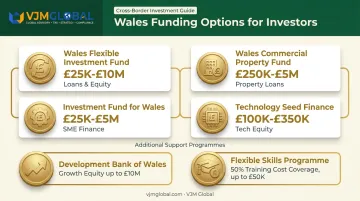
Wales offers funding routes that simply don't exist in the same form elsewhere in the UK. Business Wales runs a free Finance Locator tool that searches available funding and can set up alerts as new schemes open.
| Programme | Funding Range | Purpose |
|---|---|---|
| Wales Flexible Investment Fund | £25K–£10M | Loans, mezzanine finance, equity |
| Wales Commercial Property Fund | £250K–£5M | Loans for new office/industrial development |
| Investment Fund for Wales | £25K–£5M (across products) | Commercial finance for SMEs |
| Technology seed finance | £100K–£350K | Equity for Wales-based tech start-ups |
The Development Bank of Wales also offers growth equity of up to £10M for ambitious businesses. The Flexible Skills Programme covers 50% of accredited training costs (up to £50K per application), targeting advanced manufacturing, digital and tourism sectors.
If you're relocating into a town centre, check local Transforming Towns scheme terms directly. Awards are delivered through local authorities, so amounts vary by area rather than following one fixed national grant range.
Tax, Compliance and Scaling Beyond Wales
The core numbers you need to know
- VAT: Registration is mandatory above £90,000 in taxable turnover; the standard rate is 20%
- Corporation tax: 19% on profits up to £50,000, 25% above £250,000, with marginal relief applying between the two thresholds
- Confirmation statement: Due at least once every 12 months, filed within 14 days of the review period, with a £50 digital filing fee
- Annual accounts: First accounts due 21 months after incorporation; later accounts due 9 months after the financial year-end
- Audit exemption: Available if you meet two of three criteria — turnover under £15M, assets under £7.5M, and 50 or fewer employees
Missing these deadlines is one of the most common (and avoidable) ways foreign-owned companies rack up penalties in their first two years of trading.
When your ambitions extend beyond Wales
Many investors setting up in Wales aren't stopping there. A growing number of multinational entities entering the UK are also eyeing India, drawn by its scale and growth trajectory.
Running compliance across two or more jurisdictions is a different challenge from managing a single-country operation. Dual tax residency questions, transfer pricing between related entities, and DTAA (Double Taxation Avoidance Agreement) claims all need proper handling.
VJM Global has over 30 years of experience supporting foreign companies with India market entry, accounting outsourcing, and tax compliance. The firm works with UK-based investors who want one point of contact managing operations across borders, rather than juggling separate advisors in each country.
For a Wales-based company weighing a parallel move into India, that kind of cross-jurisdictional support can mean the difference between clean compliance and a costly scramble later.
Frequently Asked Questions
Can a foreigner set up a company in the UK?
Yes. There's no residency requirement to register a UK company. You'll need a UK registered office address and compliant incorporation documents, but directors and shareholders can live anywhere.
Do I need to live in Wales to register a business there?
No. Physical residency isn't mandatory, but you do need a registered Welsh or UK office address for official correspondence with Companies House and HMRC.
Is setting up a business in Wales different from the rest of the UK?
Company law is identical UK-wide under the Companies Act 2006. The real difference is funding: Wales offers distinct grants, investment zones, and schemes like the Development Bank of Wales.
How much does it cost and how long does it take to register a company in Wales?
Digital incorporation through Companies House costs £100 (from February 2026) and usually completes within 24 hours. Paper applications take considerably longer.
What government support is available to foreign investors in Wales?
Business Wales offers free advisory services and a Finance Locator tool. The Development Bank of Wales and Investment Fund for Wales add loans, equity, and grants like the Flexible Skills Programme.
Do I need a UK sponsor licence to hire overseas staff for my Wales-based business?
Generally yes, if you're recruiting workers from outside the UK who don't already hold settled status. Sponsor licence applications involve compliance checks, so working with an immigration adviser is strongly recommended.