Unlike the relocation headaches Brexit created for UK-EU founders, there's no equivalent upheaval here. But Dutch entrepreneurs eyeing Australia still hit two questions most generic guides skip over: the director residency requirement and what ASIC actually expects during registration.
This guide walks through structures, costs, registration steps, banking, visas, and ongoing compliance, built specifically for Dutch founders who want Australian market access without necessarily relocating.
Key Takeaways
- You can register an Australian company without moving there, but at least one director must live in Australia
- A Pty Ltd suits most new entrants; foreign company registration keeps your Dutch parent as the main vehicle
- Budget beyond the ASIC fee for a resident director, registered office, and ongoing accounting
- Incorporation does not grant visa or residency rights; those require separate applications
Why Start a Business in Australia from the Netherlands
Australia offers Dutch founders something rare: a stable, AAA-rated economy with a common-law legal system that's straightforward for European businesses to navigate. Both S&P and Fitch reaffirmed Australia's AAA rating in late 2025, underscoring the kind of economic stability that matters when you're setting up shop from 15,000 kilometres away.
The trade relationship backs this up. Austrade's 2023 report puts Dutch investment stock in Australia at A$57 billion, equal to 2.3% of Australian GDP, with average annual investment growth of 5.6% over the preceding decade, making the Netherlands Australia's ninth-largest investor.
A few reasons this matters for your business:
- Tax treaty protection: The Australia-Netherlands tax treaty, in force since 1976 and updated through the Multilateral Instrument, helps manage double taxation on profits and dividends between the two jurisdictions
- Local credibility: An Australian entity opens doors with local clients, banks, and government tenders that a Dutch-registered company simply can't access as easily
- Competitive tax rates: Per the ATO's company tax rate guidance, companies pay 25% as a base-rate entity (broadly, turnover under A$50 million with mostly active income), or 30% otherwise. R&D incentives are also available for scaling businesses
None of this requires giving up your Dutch operations. Most founders run both side by side.
Business Structures Available to Dutch Entrepreneurs
Dutch founders usually choose between a local proprietary company and a registered foreign company. Other structures exist, but they rarely suit a first Australian market entry.
Private Limited Company (Pty Ltd)
This is the default choice for most foreign founders entering Australia. A Pty Ltd needs at least one director, and ASIC requires that at least one director normally live in Australia. There's no cap on foreign shareholding stated in ASIC's published rules, though sector-specific approvals may still apply depending on your industry and activities.
A proprietary company can't have more than 50 non-employee shareholders and can't offer shares to the public, which is fine for almost every first-time market entrant.
Registered Foreign Company (Branch/ARBN)
Rather than incorporating a new subsidiary, some Dutch companies register their existing entity as a foreign company in Australia and receive an Australian Registered Body Number (ARBN). This route requires:
- Certified incorporation and constitution documents from the Netherlands
- A local agent based in Australia, authorised to accept legal notices
- A registered Australian office and ongoing ASIC reporting
This suits founders who'd rather keep the Dutch entity as the primary legal vehicle, with Australia treated as an extension rather than a standalone business.
Public Company and Trust Structures
These fit larger capital raises or specific asset-planning needs, but the compliance load is heavier: more directors, more disclosure, more reporting. Most first-time entrants skip these entirely.
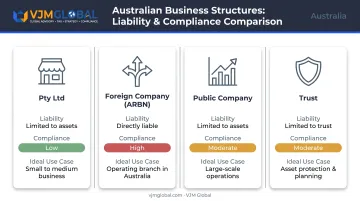
| Structure | Liability | Compliance Load | Best For |
|---|---|---|---|
| Pty Ltd | Limited | Moderate | Most Dutch founders entering Australia |
| Foreign company (ARBN) | Depends on parent entity | Moderate-high | Founders keeping the Dutch company as primary vehicle |
| Public company | Limited | High | Large capital raises |
| Trust | Varies by structure | High | Asset-planning, not typical first entry |
Sole trader and informal partnerships aren't practical here. Both rely on Australian residency-linked governance that non-resident Dutch founders simply can't satisfy.
Step-by-Step Process to Register a Company in Australia from the Netherlands
The path runs from choosing a structure through to ASIC registration, tax numbers, licensing, and banking. Get your paperwork right upfront and ASIC processing moves fast.
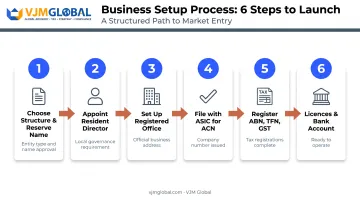
Step 1 – Choose Structure and Reserve Company Name
Decide between Pty Ltd and foreign company registration, then run your proposed name through ASIC's online search tool before filing anything.
Step 2 – Appoint a Resident Director or Local Agent
This is the requirement that trips up most Dutch founders. A Pty Ltd needs at least one director ordinarily resident in Australia; a foreign company registration needs an Australian-resident local agent.
Most non-relocating founders meet this through a professional resident director service. Indicative provider quotes start around AUD 3,500 to 7,250 per year, though terms vary widely, so get a written quote before committing.
Step 3 – Set Up a Registered Office Address
ASIC and the ATO need somewhere to send correspondence, and a PO Box won't cut it. This has to be a physical Australian address.
Step 4 – File with ASIC and Receive ACN
Lodge Form 201 through ASIC Connect. The current fee is AUD 636 for a proprietary company. ASIC targets registering complete online applications within one business day, and complete paper applications within two business days, in 90% of cases (a service target, not a guarantee).
Step 5 – Register for ABN, TFN and GST
Once you have your ACN, you can apply for an ABN and TFN through the Australian Business Register — often on the same application. GST registration becomes mandatory once your turnover hits $75,000, and you have 21 days to register once that threshold is crossed.
Step 6 – Apply for Licences and Open a Business Bank Account
Some industries need specific licences before trading. Expect extra scrutiny from Australian banks during KYC checks, since non-resident-owned companies typically face more documentation requests than local businesses. Build this timeline in early — it's often the slowest step in the whole process.
Costs, Visas and Ongoing Compliance
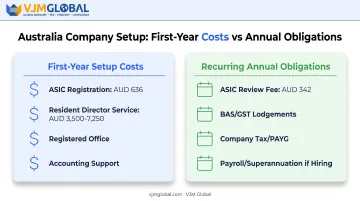
First-Year Cost Breakdown
- ASIC registration: AUD 636 (Pty Ltd via Form 201)
- Resident director service: roughly AUD 3,500–7,250/year (indicative, provider-dependent)
- Registered office: separate ongoing cost, varies by provider
- Accounting and compliance support: quoted per scope
Recurring Obligations
These don't stop after year one:
- Annual ASIC review fee: AUD 342 for a standard proprietary company
- BAS and GST lodgements: ongoing, regardless of trading volume
- Company tax and PAYG: income tax returns and PAYG instalments
- If you hire staff: Single Touch Payroll and superannuation
Company Registration Doesn't Equal a Visa
This trips people up constantly. Registering a company grants no residency or work rights whatsoever.
If you plan to relocate, you need a separate visa pathway: skilled visas (subclasses 189, 190, 491), the National Innovation visa (858), or another route entirely. The former Business Innovation and Investment Program closed to new applications on 31 July 2024, so don't plan around it.
Common Mistakes to Avoid
- Leaving the resident director requirement until the last minute, which stalls registration
- Using a home address as the registered office (not compliant)
- Underestimating ongoing compliance costs beyond the initial setup fee
VJM Global supports businesses entering Australia with entity formation, ASIC-related compliance, and tax coordination across Netherlands–Australia operations. The firm has served 250+ Australian businesses and works with Netherlands-based clients on cross-border setups. For founders juggling Dutch VAT filings alongside Australian BAS reporting, one advisory point of contact cuts the back-and-forth between separate accountants in each country.
Conclusion
Registering a company in Australia from the Netherlands is entirely achievable without relocating — provided you plan for director residency and ASIC compliance from day one, not as an afterthought. Structure choice, documentation quality, and banking timelines matter more than how fast you can file.
Getting the ACN issued is just the start. Long-term success in the Australian market depends on staying on top of annual ASIC reviews and ongoing tax obligations, not just clearing the initial incorporation hurdle.
Frequently Asked Questions
What are the steps involved in starting a business in Australia?
The core path is: choose a structure, appoint a resident director, register with ASIC for an ACN, obtain an ABN and GST if required, then open a business bank account.
Can I get permanent residency (PR) if I buy a business in Australia?
No. Business ownership alone doesn't grant permanent residency. You'd need a separate business or investment visa pathway, each with its own eligibility criteria.
Is it difficult to start a business in Australia?
ASIC registration itself is fast and generally foreign-founder-friendly. The real complexity comes from meeting the resident director requirement and clearing bank KYC checks as a non-resident-owned entity.
What's the easiest business to start in Australia?
Low-capital, service-based or e-commerce models tend to have the simplest setup and lowest ongoing overhead for foreign founders, since they avoid heavy licensing and physical premises requirements.
Do I need a local director to register a company in Australia from the Netherlands?
Yes. At least one director must be ordinarily resident in Australia. Most non-relocating founders meet this through a professional resident director service.
How long does it take to register a company in Australia from the Netherlands?
ASIC approval can take anywhere from minutes to a few days for complete applications. Add another one to two weeks for ABN registration, banking, and any licensing requirements.