Introduction: What Is a Private Limited Company in Australia?
If you're starting a business in Australia — or entering the market from overseas — you'll quickly encounter the term "Pty Ltd." It's everywhere: on invoices, company signage, legal contracts, and ABN registrations.
Pty Ltd stands for Proprietary Limited, and it's the most common company structure used by businesses in Australia. Governed by the Corporations Act 2001, a Pty Ltd is a separate legal entity with liability limited to shareholders' unpaid share amounts, so personal assets stay protected.
Business owners and foreign entrepreneurs alike often find the details murky — what registration actually involves, how Pty Ltd differs from other structures, and what ongoing obligations apply once you're incorporated. This guide answers those questions directly.
Key Takeaways:
- A Pty Ltd is a private company: capped at 50 non-employee shareholders, with no public share trading
- Shareholders' personal assets are protected; liability is limited to unpaid share amounts
- Small proprietary companies face significantly lighter compliance burdens than large ones
- Registration takes roughly 15 minutes online via the Business Registration Service
- At least one director must ordinarily reside in Australia
What Is a Private Limited Company (Pty Ltd) in Australia?
A proprietary limited company is a legal entity entirely separate from the people who own or run it. Under the Corporations Act 2001, a Pty Ltd can own property, open bank accounts, sign contracts, and sue or be sued — all in its own name, independent of its shareholders or directors.
Limited Liability: What It Actually Means
The "limited" in Pty Ltd refers specifically to liability. According to ASIC, in a company limited by shares, members' liability is limited to the unpaid amount on their shares. If a shareholder has fully paid for their shares, their personal exposure to company debts is nil.
This distinguishes a Pty Ltd sharply from sole traders and partnerships, where personal assets — your home, savings, car — are entirely exposed to business liabilities.
Name Requirements and Shareholder Cap
Any proprietary limited company must follow specific structural rules set by the Corporations Act:
- Must include "Proprietary" or "Pty" and "Limited" or "Ltd" in its registered name
- Non-employee shareholders capped at 50
- Cannot offer shares to the general public
- Cannot list on the ASX — that's the domain of public companies (Ltd)
The naming requirement signals legal status to anyone dealing with the business — it's not optional.
Perpetual Succession
Because a Pty Ltd exists as its own legal entity, it has perpetual succession. Directors retire, shareholders sell their stakes, founders move on — the company continues uninterrupted. This means business relationships, contracts, and IP ownership survive ownership changes without legal disruption.
Most small and medium businesses register as limited by shares — the most common variant — rather than the unlimited liability alternative. It offers the clearest protection and the simplest structure to manage.
Key Features and Advantages of a Pty Ltd Company
Limited Liability and Separate Legal Identity
The core appeal is straightforward: personal assets stay separate from business obligations. As business.gov.au explains, unlike a sole trader or partnership where members bear direct liability for debts, a company member is not liable in that capacity for company obligations.
This separation also gives the business operational clarity. The company, not the individuals behind it, independently:
- Holds property and assets
- Employs staff and enters contracts
- Carries legal responsibility for its obligations
Tax Rates for Pty Ltd Companies
Company income is taxed separately from personal income, which creates planning opportunities. According to the ATO, the current rates are:
| Company Type | Tax Rate |
|---|---|
| Standard company tax rate | 30% |
| Base rate entity (from 2021–22 onward) | 25% |
A company qualifies as a base rate entity if its aggregated turnover is under $50 million and no more than 80% of assessable income is base rate entity passive income. For most small and medium Pty Ltd companies, the 25% rate applies — lower than the top personal income tax rate.
Control, Privacy, and Fundraising
- Keeps financial statements private — small proprietary companies are not required to lodge them publicly with ASIC
- Retains ownership within a defined group, since shares aren't freely traded on public markets
- Raise capital through private placements, shareholder loans, or venture capital without going public
- Builds credibility with banks, suppliers, and investors who view an incorporated structure more favourably than an unregistered sole trader
For foreign entrepreneurs entering Australia, these advantages compound quickly — credibility alone often determines whether a commercial bank account opens smoothly or supplier negotiations stall.
Small vs. Large Proprietary Companies: What's the Difference?
ASIC classifies every proprietary company as either "small" or "large" — and the classification determines your reporting obligations significantly.
The Three Thresholds
ASIC states that for financial years starting on or after 1 July 2019, a company is large if it meets at least two of the following:
- Consolidated revenue of $50 million or more
- Gross consolidated assets of $25 million or more
- 100 or more employees at financial year end
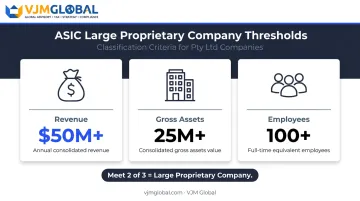
Companies that don't meet at least two thresholds are classified as small proprietary companies.
What This Means in Practice
| Obligation | Small Pty Ltd | Large Pty Ltd |
|---|---|---|
| Prepare annual financial report | Generally exempt | Required |
| Lodge financial report with ASIC | Generally exempt | Required |
| Audited financial statements | Generally exempt | Required (unless ASIC grants relief) |
| Directors' report | Generally exempt | Required |
That said, small proprietary companies aren't always off the hook. Reporting obligations can still apply if:
- ASIC issues a direction requiring it
- Shareholders request it under section 293 of the Corporations Act
- The company is controlled by a foreign entity
For startups and most SMEs, staying below those thresholds means dramatically lower compliance costs — which is why the Pty Ltd structure suits early-stage and growing businesses so well.
How to Register a Pty Ltd Company in Australia
Registration is straightforward for most scenarios. According to business.gov.au, the process takes around 15 minutes online and confirmation typically arrives within two business days.
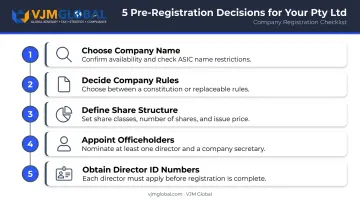
Before You Register: Key Decisions
- Choose a company name — must comply with ASIC's naming rules; check availability via ASIC's name search. You can reserve a name for up to two months using Form 410
- Decide on company rules — adopt the Corporations Act's replaceable rules, a custom constitution, or both
- Define the share structure — determine share classes, issue shares to initial members, and collect written consent from each shareholder confirming their allocation
- Appoint officeholders — at least one director who ordinarily resides in Australia is mandatory under Corporations Act s201A
- Obtain Director ID numbers — all proposed directors must apply for a Director Identification Number (DIN) from the Australian Business Registry Services (ABRS) before the company is registered
The Registration Process
Submit your application via register.business.gov.au. On approval, you receive:
- An Australian Company Number (ACN)
- A Certificate of Registration
The current ASIC registration fee for a proprietary company with share capital is $636.
When Online Registration Doesn't Apply
Not every registration can be completed through the Business Registration Service. Two common exceptions apply:
- Address suppression: If an officeholder wants to keep their residential address off the public register, they must contact ASIC directly for a paper registration form
- Complex structures: Foreign companies and multi-layered corporate arrangements typically require a professional advisor rather than self-registration
For foreign-owned entities in particular, cross-border considerations — such as overseas directors, foreign shareholding, and FEMA compliance — add layers that standard online registration doesn't account for. VJM Global has supported 250+ Australian businesses through setup and compliance, including foreign-owned companies navigating these cross-border requirements.
Ongoing Compliance and Obligations for a Pty Ltd Company
Registration is the beginning, not the end. A Pty Ltd carries ongoing statutory obligations that directors must manage consistently.
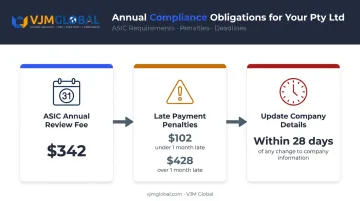
Core Annual Obligations
- ASIC annual review fee: Currently $342 per year for most proprietary companies. ASIC sends an annual statement and invoice; directors must pass a solvency resolution within two months of the review date
- Late payment penalties: $102 if paid up to one month late; $428 if more than one month late — costs that add up quickly if overlooked
- Update company details: Changes to directors, addresses, or shareholders must be notified to ASIC within 28 days; late updates attract penalties
Internal Record-Keeping
The Corporations Act mandates several internal records regardless of company size:
- Member register (s168) — current shareholder details
- Minute books (s251A) — meeting resolutions recorded within one month
- Financial records (s286) — accurate records explaining transactions and financial position
Small proprietary companies don't need to hold AGMs or lodge audited accounts with ASIC. That said, failure to maintain proper internal records still attracts ASIC penalties.
When to Consider Outsourced Support
For foreign-owned Pty Ltd companies, keeping on top of these obligations from overseas creates significant compliance challenges — missed deadlines and penalties are common when no local support structure is in place.
VJM Global works with foreign-owned Australian entities to manage day-to-day compliance remotely, covering:
- Bookkeeping and financial records maintenance
- GST and BAS compliance filings
- Payroll processing, including PAYG and TFN Declarations
- Year-end financial reporting
This allows the overseas parent company to maintain a compliant Australian entity without dedicating internal resources to unfamiliar local requirements.
Pty Ltd vs. Other Business Structures in Australia
Pty Ltd vs. Sole Trader or Partnership
| Factor | Pty Ltd | Sole Trader / Partnership |
|---|---|---|
| Personal liability | Limited to unpaid shares | Unlimited — personal assets exposed |
| Separate legal entity | Yes | No |
| Perpetual succession | Yes | No |
| Setup complexity | Moderate | Low |
| Credibility with lenders | Higher | Lower |
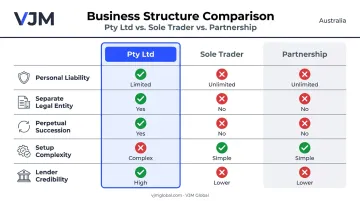
Business.gov.au confirms that sole traders are legally responsible for all business debts and losses. That unlimited exposure is precisely what makes the Pty Ltd structure worth the extra setup effort for any business with real growth plans.
Pty Ltd vs. Public Company (Ltd)
A public company (Ltd) can offer shares to the general public and list on the ASX — but it carries far heavier obligations:
- Minimum three directors, with at least two ordinarily residing in Australia
- Must hold AGMs annually
- Must prepare audited financial reports and lodge them with ASIC
- No cap on the number of shareholders
A Pty Ltd suits businesses that want control, privacy, and lower compliance costs. Public companies are the right fit when raising capital from retail investors is the priority — but that access comes with significant governance overhead.
Other Structures Worth Knowing
- Trusts: Used for asset protection and tax planning, particularly in family business and property contexts — but they're not separate legal entities and carry different governance requirements
- No Liability (NL) companies: A niche structure for the mining sector; members are not liable for calls on partly paid shares
For most startups, SMEs, and foreign businesses entering Australia, the Pty Ltd remains the most practical and widely adopted structure.
ASIC's own data reflects this clearly: 3.6 million companies were registered in Australia as of 2024–25, with 333,188 new registrations in that year alone.
Frequently Asked Questions
What is the difference between a Pty Ltd and a Ltd company?
A Pty Ltd (proprietary limited) is a private company that cannot offer shares to the general public and is capped at 50 non-employee shareholders. A Ltd (limited) company is a public company that can list on the ASX, has no shareholder cap, and faces significantly higher reporting and compliance obligations.
What does it mean if you are a private limited company?
It means your business is a separate legal entity from its owners — shareholders' liability is limited to the unpaid amount on their shares, and the company cannot raise capital from the general public. It can independently enter contracts, hold assets, and sue or be sued in its own name.
Can a Pty Ltd be a small business?
Yes — most small businesses in Australia operate as proprietary limited companies. ASIC classifies a Pty Ltd as a "small proprietary company" if it meets fewer than two of the three size thresholds (revenue, assets, employees), which significantly reduces its financial reporting obligations.
How many shareholders can a Pty Ltd company have in Australia?
A Pty Ltd can have no more than 50 non-employee shareholders. There is no minimum above one — a company can be registered with a single shareholder who also serves as the sole director.
What are the ongoing compliance obligations for a Pty Ltd in Australia?
Core ongoing obligations include:
- Maintaining company records and keeping ASIC details current
- Paying the AUD $342 annual review fee
- Displaying the company name and ACN on official documents
Large proprietary companies must also lodge audited financial reports with ASIC. Small proprietary companies are generally exempt.
Can a foreign company or individual register a Pty Ltd in Australia?
Yes, but at least one director must ordinarily reside in Australia. Foreign companies already conducting business there may also need to register separately as a foreign company with ASIC, alongside any Pty Ltd structure they establish.