
Introduction
UK investment into India is gaining serious momentum. Bilateral trade between the two nations reached £47.4 billion, with UK FDI stock in India standing at £19.1 billion. According to India's Department for Promotion of Industry and Internal Trade (DPIIT), cumulative FDI from the UK has hit USD 34.81 billion, making the UK one of India's top European investors. India's economy is growing at 6.5% annually — one of the fastest rates among major economies — and the signing of the Comprehensive Economic Partnership Agreement (CEPA) in July 2025 has opened new doors for UK businesses looking east.
Whether you're an established UK enterprise or a first-time investor, the challenge is the same: India's legal setup process is complex and easy to get wrong without local knowledge. Missing a single filing deadline or submitting incorrectly apostilled documents can delay incorporation by weeks — or trigger penalties that compound daily.
This article is a practical, sequenced checklist covering every legal requirement UK investors must fulfill before and after setting up a business in India.
Key Takeaways
- A Private Limited Company is the go-to structure for UK investors — it supports 100% foreign ownership in most sectors
- Setup runs in three phases: pre-incorporation, incorporation, and post-incorporation registrations, in that order
- Tax obligations start immediately: corporate income tax, GST registration, and FEMA reporting to the Reserve Bank of India
- UK-issued documents (passport, address proof) must be apostilled before Indian authorities will accept them
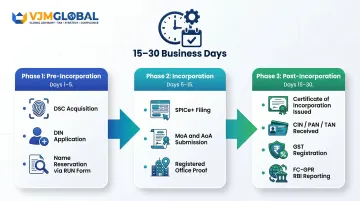
- Expect 15–30 days from start to Certificate of Incorporation when documents are in order
Why India Is on Every UK Investor's Radar Right Now
India is now the world's 4th largest economy and forecasts from the IMF project growth will hold at 6.5% through 2026. This positions India as one of the fastest-growing major economies globally, particularly attractive post-Brexit as UK firms seek new export and expansion markets.
Key pull factors for UK investors:
- India's ~125–130 million English speakers give UK firms immediate access to one of the world's largest English-speaking talent pools
- A legal system rooted in British common law makes India's regulatory framework far more familiar to UK entities than civil law jurisdictions
- The World Bank's B-READY scores show measurable progress in business entry, market competition, and regulatory quality
Several sectors — technology, financial services, manufacturing, and retail — now permit 100% foreign direct investment under the automatic route. This means UK investors do not need prior government approval; they can proceed directly with incorporation once they verify their sector's FDI policy. Automatic route investments are faster, simpler, and carry fewer bureaucratic hurdles than government-approval routes.
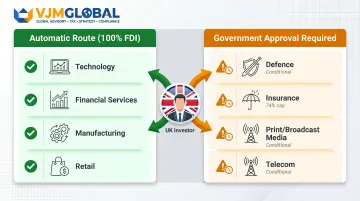
The UK-India CEPA signed in July 2025 further strengthens this bilateral framework, reducing tariffs and streamlining investment procedures for UK businesses entering India.
Choosing the Right Business Structure as a UK Investor
Your choice of business structure shapes everything that follows — tax treatment, liability exposure, fundraising options, FDI eligibility, and day-to-day compliance burden. Getting this right before incorporation saves significant time and cost later.
Private Limited Company (Pvt. Ltd.)
This is the default choice for UK investors. A Private Limited Company permits 100% foreign ownership under the automatic FDI route in most sectors, provides limited liability, operates as a separate legal entity, and is required for equity fundraising.
Requirements:
- Minimum 2 directors (at least one must be India-resident)
- Minimum 2 shareholders
- Registered office address in India
- Compliance with the Companies Act, 2013
UK investors favour this structure because it supports growth and future equity raises, protects personal assets, and meets venture capital or private equity funding requirements.
Limited Liability Partnership (LLP)
An LLP offers simpler compliance and lower formation costs, making it attractive for professional services firms — consulting, legal, and design practices in particular. There is, however, a critical restriction: foreign investment in LLPs requires RBI approval and does not fall under the automatic FDI route. This adds a step and delays incorporation compared to a Private Limited Company.
Branch Office or Liaison Office
- Branch Office: Can carry out limited commercial activities that mirror the UK parent company's operations (trading, invoicing, contracts). Requires RBI approval via an Authorised Dealer bank and is governed by FEMA Regulation 22(R).
- Liaison Office: Can only represent and communicate on behalf of the UK parent — no revenue generation, no invoicing, no profit activity. Also requires RBI approval.
These structures are typically a first step — once the Indian market proves viable, most UK firms transition to a Private Limited Company for full operational capability.
FDI Restrictions UK Investors Must Verify
While most sectors allow 100% automatic FDI, certain sectors have caps or require government approval:
- Defence: Caps vary by activity
- Insurance: 74% FDI cap
- Media (print, broadcast): Sector-specific caps apply
- Telecom: Up to 100% with conditions
UK investors must verify their sector's FDI policy on the DPIIT FDI portal before committing to a structure.
If your sector involves any of these restrictions, the structure decision becomes more complex. VJM Global has guided 250+ UK businesses through this process — matching structure selection to industry, funding plans, and long-term operational goals.
The Legal Compliance Checklist: Setting Up Your Indian Business
This is a sequenced checklist — steps must be completed in order. Jumping ahead (e.g., trying to open a bank account before incorporation) wastes time and creates rework.
Pre-Incorporation: Documents and Digital Identity
Digital Signature Certificate (DSC)
Every proposed director must obtain a DSC before any MCA filing can begin. For UK-based directors, this requires submitting a notarised and apostilled copy of the passport and address proof.
What is apostille? An apostille is a certification that authenticates the origin of a public document for use in another country. UK investors obtain it from the FCDO-authorised apostille service. This step is commonly overlooked and causes significant delays.
Director Identification Number (DIN)
Each director must have a DIN issued by the Registrar of Companies. This can now be applied for within the SPICe+ incorporation form for up to 3 directors, but UK-based directors must first have their documents authenticated (apostilled).
Company Name Reservation
The proposed name must be checked for availability and reserved through the MCA portal using the RUN (Reserve Unique Name) form.
Rules:
- No similarity to existing trademarks or company names
- No prohibited words (e.g., government, national, bank without approvals)
- 1–2 name options can be submitted
Approval typically takes 1–3 working days. The name reservation is valid for 20 days, within which incorporation must be completed.
Incorporating Your Entity via the MCA Portal
SPICe+ Form Filing
SPICe+ (Simplified Proforma for Incorporating Company Electronically Plus) is the integrated form on the Ministry of Corporate Affairs portal that combines:
- Company incorporation
- DIN allotment
- PAN (Permanent Account Number)
- TAN (Tax Deduction and Collection Account Number)
This must be accompanied by the Memorandum of Association (MoA) and Articles of Association (AoA). Drafting these correctly matters — they define the company's scope, governance, and permissible activities under the Companies Act, 2013. Errors here require formal amendments later, which cost time and money.
Registered Office Address
A physical address in India is mandatory under Section 12 of the Companies Act, 2013. UK investors cannot register without one. This can be a rented space, and requires:
- No Objection Certificate (NOC) from the property owner
- Utility bill (electricity, water) as address proof
Some service providers offer virtual office arrangements for initial registration purposes — a practical option for UK investors who don't yet have a physical presence in India.
Certificate of Incorporation
Once the ROC approves the filing, the Certificate of Incorporation is issued along with the company's CIN (Corporate Identification Number), PAN, and TAN. The company is now legally constituted, and all post-incorporation obligations begin from this point. Typical timeline: 10–15 working days from SPICe+ submission.
Post-Incorporation Registrations
GST Registration
Mandatory once annual turnover crosses ₹20 lakh (₹10 lakh in special category states) or for inter-state supply of goods/services regardless of turnover under Sections 22 and 24 of the CGST Act.
UK investors should note that most B2B operations will require GST registration from day one. The GSTIN (GST Identification Number) is issued after submitting the online application on the GST portal, typically within 3–7 working days.
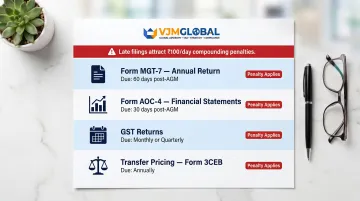
Filing frequency: Monthly or quarterly returns depending on turnover and category.
FEMA and RBI Reporting
UK investors injecting capital into an Indian entity must report the foreign investment to the Reserve Bank of India within 30 days of receiving funds. This filing goes through the entity's Authorised Dealer bank and is required under Section 13 of the Foreign Exchange Management Act. Many UK investors miss this step — non-compliance attracts financial penalties.
The filing is made via Form FC-GPR (Foreign Currency – Gross Provisional Return). Getting this right requires coordinating with the Authorised Dealer bank, which adds a layer of complexity for investors unfamiliar with Indian banking procedures.
Shops and Establishments Act Registration
Required for any business operating from a commercial premises. This is a state-level registration (each state has its own Act) and must be obtained from the local municipal authority. Requirements vary by state, adding complexity for UK investors unfamiliar with India's federal structure.
Sector-Specific Licenses and Permits
| Sector | Required License | Issuing Authority |
|---|---|---|
| Food Businesses | FSSAI Registration/License | Food Safety and Standards Authority of India |
| Import/Export | Import Export Code (IEC) | Directorate General of Foreign Trade (DGFT) |
| Financial Services | RBI License | Reserve Bank of India |
| Manufacturing | Environmental Clearances | Ministry of Environment, Forest and Climate Change (MoEFCC) |
| E-commerce, IT, Consulting | Digital Personal Data Protection Act (DPDPA) 2023 compliance | Ministry of Electronics and IT |
DPIIT Startup India Recognition: UK-incorporated entities setting up Indian subsidiaries that qualify (under ₹200 crore turnover, less than 10 years old, working on innovative products/services) can apply for DPIIT recognition. This unlocks tax exemptions, compliance relaxations, and access to the SIPP (Scheme for Facilitating Startups Intellectual Property Protection) scheme for subsidised IP filing.
UK investors in technology, consulting, and professional services typically have the lightest licensing burden — but the DPDPA 2023 is worth specific attention. It mirrors GDPR in spirit but differs structurally: notably, it does not yet have an independent supervisory body equivalent to the UK's ICO, and enforcement mechanisms are still evolving.
VJM Global supports UK investors across all stages of this checklist — from MoA drafting and SPICe+ filing through to GST registration, FC-GPR reporting, and ongoing compliance management.
Tax and Financial Compliance for UK-Owned Indian Entities
Corporate Income Tax
Indian domestic companies are taxed at a base rate of 22% under Section 115BAA of the Income Tax Act (for companies that do not claim certain deductions/exemptions). Foreign companies are taxed at 35% on India-sourced income.
A properly incorporated Indian entity (Private Limited Company) is taxed as a domestic company, not a foreign company — this is a significant tax advantage for UK investors.
UK-India Double Tax Agreement (DTA)
The UK and India have a bilateral tax treaty that prevents the same income from being taxed twice. For UK investors, key treaty provisions include:
- Dividends: Taxed at 10–15% in India (depending on treaty provisions)
- Royalties and technical fees: Reduced withholding tax rates apply
- Capital gains: Treaty provides clarity on which country has taxing rights
Treaty benefits require a Tax Residency Certificate (TRC) from HMRC. This certificate proves the UK parent company is a tax resident of the UK and eligible for treaty benefits.

Transfer Pricing Compliance
Transfer pricing is one of the highest-risk compliance areas for UK-owned entities. Any transaction between a UK parent and its Indian subsidiary must be priced at arm's length and documented under Sections 92 and 92D of the Income Tax Act.
Core transfer pricing obligations include:
- Arm's length pricing: Required for intra-group services, management fees, loans, and IP licensing
- Annual Transfer Pricing Study: Mandatory documentation prepared by a Chartered Accountant
- Form 3CEB: Must be filed annually; non-compliance attracts significant penalties
VJM Global's Chartered Accountants handle transfer pricing documentation, FEMA filings, and ongoing tax compliance for UK-owned Indian entities — helping clients stay audit-ready.
Ongoing Compliance Obligations You Cannot Ignore
Annual ROC Filings
Every registered Indian company must file annual returns and financial statements with the Registrar of Companies:
- Form MGT-7 (Annual Return): Due within 60 days of the Annual General Meeting (AGM)
- Form AOC-4 (Financial Statements): Due within 30 days of the AGM
Late filings attract daily penalties of ₹100 per day, which compound quickly. VJM Global handles annual ROC filings for UK-owned Indian companies, ensuring deadlines are met across different financial year-ends.
Labour Law Compliance for UK Businesses Hiring in India
Once employees are hired, businesses must comply with:
- Employees' Provident Fund (EPF) Act: Mandatory for entities with 20+ employees
- Employees' State Insurance (ESI) Act: Mandatory for entities with 10+ employees
- Minimum Wages Legislation: Varies by state
- Sexual Harassment of Women at Workplace (POSH) Act: Applies to entities with 10+ employees
Compliance threshold triggers are employee-count based, so UK investors should plan these registrations as part of their hiring roadmap. VJM Global's PEO services cover payroll processing and labour law compliance for UK-owned entities in India.
Intellectual Property Protection
IP protection is another compliance area that catches many UK investors off guard. UK registrations for trademarks, patents, and copyrights offer no protection in India — each must be registered separately under Indian law:
- Trademarks: Registered with the Office of the Controller General of Patents, Designs & Trade Marks
- Patents: Filed through the Indian Patent Office
- Copyrights: Registered with the Copyright Office of India
DPIIT-recognised startups can access the SIPP scheme for subsidised IP filing. For broader IP strategy and registration, UK investors should consult specialist IP legal partners. VJM Global can facilitate these referrals.
Frequently Asked Questions
What are the legal requirements for starting a business in India?
The key steps include choosing a business structure, registering with the MCA, obtaining PAN/TAN and GST registration, and fulfilling sector-specific licenses. Foreign investors (including UK nationals) must also comply with FEMA for capital remittances and RBI reporting.
What are the 4 main types of business structures in India?
The four most common structures are Sole Proprietorship, Partnership Firm, Limited Liability Partnership (LLP), and Private Limited Company. For UK investors, Private Limited Company is generally recommended due to FDI eligibility and liability protection.
Can a UK investor own 100% of an Indian company?
Yes, 100% foreign ownership is permitted in most sectors under the automatic FDI route. However, certain sectors (defence, insurance, media) have ownership caps or require government approval. Verify the applicable FDI policy for your specific sector before incorporation.
How long does it take to register a business in India as a UK investor?
The process from document authentication (apostille) to receiving the Certificate of Incorporation typically takes 15–30 days. Delays in apostille processing or name rejection can push this further.
Do UK investors need to be physically present in India for registration?
Physical presence is not required — the process can be completed remotely with the help of local professionals. However, a registered physical office address in India is mandatory, and at least one India-resident director must be appointed.
What is FEMA and why does it matter for UK investors setting up in India?
FEMA (Foreign Exchange Management Act) governs all cross-border capital flows into and out of India. UK investors must report foreign investments to the RBI within 30 days of fund receipt — failure to comply carries financial penalties under Section 13 of FEMA.