Add the ASEAN-Australia-New Zealand Free Trade Area, rising ecommerce demand, and Australia's reputation as a stable, English-speaking economy just a few hours away by flight, and the appeal makes sense.
The people asking about this range widely: ecommerce sellers wanting an Australian storefront, consultants who studied in Melbourne or Sydney, and established Malaysian SMEs scouting expansion. This guide walks through eligibility, structure, registration, costs, visas, and ongoing compliance, step by step.
Key Takeaways
- Malaysians can own 100% of an Australian Pty Ltd remotely, but one director must reside in Australia
- A Pty Ltd is the default structure for foreign-owned small businesses in Australia
- Setup involves ASIC registration, an ABN/TFN, and GST once turnover passes A$75,000
- Incorporating a company does not grant a visa; relocating still requires a separate application
- Budget for both one-time registration fees and recurring annual compliance costs
Can a Malaysian Citizen Start a Small Business in Australia?
Yes. Malaysians can fully own and register a business across most Australian industries. Foreign ownership itself isn't the obstacle most founders assume it to be. business.gov.au confirms that non-citizens and non-permanent residents can start a business, though running it in person requires a visa.
Structure options available to you:
- Sole trader — simplest structure, but requires an Australian TFN and effectively assumes local residency
- Partnership — similarly impractical without an Australian-based presence
- Company (Pty Ltd) — the standard choice for non-resident founders
- Trust — used occasionally for asset protection, but adds compliance complexity most small businesses don't need
Given that sole trader and partnership structures are built around individuals physically operating in Australia, they're rarely workable for Malaysia-based founders. That leaves the proprietary limited (Pty Ltd) company as the default path.
There's one non-negotiable requirement here: at least one director must ordinarily reside in Australia. This is separate from share ownership entirely, since a Malaysian founder can hold 100% of the shares while a locally resident director fulfills the compliance role.
Being eligible to register the company, though, is not the same as being eligible to live or work there. We'll unpack that distinction later in this guide.
Why Start a Small Business in Australia from Malaysia
This isn't a guaranteed win for every business — it makes sense when there's a genuine market opportunity or trade advantage behind it. For businesses trading regionally or serving Asia-Pacific customers, a few factors stand out.
The economics are solid. Australia's economy was valued at roughly US$1.76 trillion in GDP in 2024, one of the larger economies in the Asia-Pacific region.
The legal framework under the Corporations Act is well-established, and R&D tax incentives (a refundable offset at the corporate tax rate plus an 18.5% premium) support companies running qualifying experimental projects.
Strategic positioning matters too:
- AANZFTA membership gives Malaysian-linked businesses smoother regulatory access between both markets
- Malaysian goods already enter Australia tariff-free under existing trade arrangements
- Proximity to both Southeast Asian and broader Asia-Pacific markets supports regional trading models
Beyond trade mechanics, Australia offers a skilled, English-speaking workforce and a startup ecosystem with periodic government grant programs. Eligibility criteria and funding availability shift regularly, though, so always check current status before building a business case around a specific grant.
What to Know Before You Start: Structures, Directors & Visas
Most Malaysian founders get the paperwork right. What trips them up is underestimating two things: the director-residency rule and the gap between incorporating a company and actually being allowed to live there.
Comparing Your Structure Options
| Structure | Liability | Compliance Level | Suitability for Malaysian Founders |
|---|---|---|---|
| Pty Ltd Company | Limited to company assets | Moderate: annual review, director ID | |
| Partnership | Personal, unlimited | Low, but requires local presence | Impractical without residency |
| Trust | Trustee bears liability | Higher: trust deed, annual returns | Occasionally used, added complexity |
Director Residency & Visa Requirements
ASIC is explicit: at least one director of a proprietary company must ordinarily reside in Australia. This is a hard rule, not a guideline. Most Malaysian founders solve this by engaging a nominee director or a registered agent service that can fulfill the role while the founder retains full ownership and control of strategic decisions. Firms that handle entity formation and registered-agent services across multiple markets, including VJM Global, often supply the nominee director alongside the incorporation paperwork itself.
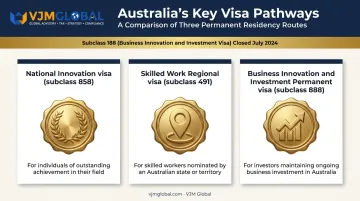
This is the single most common misunderstanding. Registering an ACN with ASIC gives you a legal company. It does not give you the right to live or work in Australia. If you plan to relocate and run the business day-to-day, you'll need a separate visa pathway, such as:
- National Innovation visa (subclass 858): for those with an outstanding record of achievement in an eligible field
- Skilled Work Regional visa (subclass 491): provisional, requiring state/territory nomination
- Business Innovation and Investment (Permanent) visa (subclass 888): for continuing business or investment activity, available to those who already hold a provisional pathway
Note that the Business Innovation and Investment Provisional visa (subclass 188) closed permanently to new applicants in July 2024, so double-check current pathways before planning around older information.
Timeline and Remote Reality
Registration itself typically moves quickly once documents are in order, but the whole process spans one-time setup costs and ongoing annual compliance. Much of this can be handled online from Malaysia. However, banking and document certification are where remote founders tend to hit friction, since some steps still expect an in-person presence or certified paperwork.
How to Start a Small Business in Australia from Malaysia – Step by Step
Here's the practical roadmap. Three mistakes come up again and again:
- Assuming incorporation automatically grants a visa
- Missing the mandatory local director requirement
- Underestimating the ongoing cost of compliance
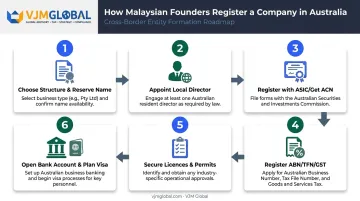
Step 1 – Choose Your Business Structure and Reserve a Name
Decide on a Pty Ltd company for limited liability and credibility with Australian banks and investors. Before filing, use ASIC's name availability tool to check your proposed name isn't already taken, then reserve it if needed.
Step 2 – Appoint a Local Director or Registered Agent
At least one Australia-resident director is mandatory. Founders without an obvious local candidate typically engage a nominee director or a registered agent service. Cross-border firms like VJM Global support this piece specifically so Malaysian founders don't have to independently source and vet a local director.
Step 3 – Register with ASIC and Obtain Your ACN
Submit the required forms and certified documents to ASIC. Before registration finalises, every director, resident or not, must first secure a Director Identification Number (Director ID) through the ABRS. Once approved, ASIC issues your Australian Company Number (ACN), registration certificate, and corporate key.
Step 4 – Register for an ABN, TFN, and GST (If Applicable)
With your ACN in hand, apply for an Australian Business Number (ABN) through the ATO. You'll need this number for invoicing, contracts, and tax purposes. A TFN is issued alongside it automatically. GST registration becomes compulsory once your annual turnover crosses A$75,000, generally due within 21 days of crossing that threshold.
Step 5 – Secure Licences, Permits, and Industry Approvals
Use the Australian Business Licence and Information Service (ABLIS) to identify which state, territory, or industry-specific approvals apply to your business. A common miss: assuming one national licence covers every state. In practice, many approvals (food handling, trades, professional services) are issued at the state or council level, not federally.
Step 6 – Open a Business Bank Account and Plan Your Visa Pathway
Major Australian banks vary in how remote-friendly they are. Some allow single-director companies to start the process online; others require in-person verification once there are multiple signatories or non-resident directors involved. Multi-currency account alternatives can bridge the gap for founders who haven't relocated yet.
If you do plan to move to Australia to run daily operations, remember: that requires its own visa application, entirely separate from incorporating the company.
Cost of Starting & Ongoing Compliance
Budget in two buckets: one-time setup and recurring annual compliance.
One-time setup costs (current ASIC figures):
- Pty Ltd registration with share capital: A$636
- Business name reservation: A$65
- Local director/registered agent onboarding fee (varies by provider)
Recurring annual costs:
- ASIC annual company review fee: A$342
- Business name renewal: A$47 (1 year) or A$108 (3 years)
- Registered agent/nominee director renewal (provider-dependent)
Beyond the statutory fees, budget for ongoing operational costs:
- Accounting and bookkeeping
- GST filing through Business Activity Statements
- Payroll, if you hire staff
- General compliance support
These add up quickly for founders juggling two time zones and two sets of regulations.
This is where firms like VJM Global add practical value. Bundling entity formation with bookkeeping, BAS/GST filing, and payroll compliance means founders aren't managing separate vendors across Malaysia and Australia's business hours.
Conclusion
Starting a small business in Australia from Malaysia is entirely achievable — the fundamentals just need to be right from day one. Get the Pty Ltd structure sorted, secure your resident director, and complete ASIC and ATO registration correctly, and the rest of the process follows logically.
Clarity on visas, costs, and compliance matters more than speed here. Mistakes in these areas are expensive and slow to unwind later. That's why partnering with a cross-border advisory firm like VJM Global can take the paperwork off your plate. The right partner handles Pty Ltd registration, resident director appointments, and ASIC/ATO compliance for Malaysian founders, so you can focus on growing the business.
Frequently Asked Questions
Can a foreigner start a small business in Australia?
Yes, foreigners including Malaysians can fully own an Australian business in most sectors. A Pty Ltd company, however, must have at least one director who ordinarily resides in Australia.
How much does it cost to start a small business in Australia?
Expect around A$636 for company registration plus A$65 for name reservation upfront, with roughly A$342 in annual ASIC review fees. Costs vary by structure, so confirm current figures against ASIC's published rates.
Do I need to live in Australia to own a business there?
No. Ownership doesn't require residency. Running a Pty Ltd, though, requires at least one locally resident director or an appointed local representative to meet ASIC's rules.
What visa do I need if I want to move to Australia to run my business?
Options include the National Innovation visa (subclass 858) and Business Innovation and Investment (Permanent) visa (subclass 888), among others. Incorporating a company alone does not grant residency or work rights.
Can I open an Australian bank account from Malaysia without visiting?
Some major banks require an in-person branch visit, particularly for multi-signatory companies. Others allow single-director companies to start online, and multi-currency platforms offer additional flexibility for pre-relocation founders.
What is the difference between an ABN and ACN?
An ACN is ASIC's 9-digit company identifier. An ABN is an 11-digit number for tax and invoicing, obtained using your ACN after incorporation.