Here's what many Malaysian founders don't realise until they're mid-application, though: registering a Private Limited Company (Pte Ltd) in Singapore isn't quite the same do-it-yourself process a Singapore resident enjoys. As a foreigner, you can't file directly on BizFile+, and you'll need a locally resident director before ACRA approves anything.
This guide covers the exact steps, costs, eligibility rules, and mistakes Malaysian applicants run into when setting up a Pte Ltd from across the border.
TL;DR
- Malaysians are foreigners under Singapore law, so a Corporate Service Provider must file your BizFile+ application
- Pte Ltd allows up to 100% foreign shareholding but requires one Singapore-resident director
- Minimum setup: S$1 capital, one shareholder, one resident director, a local address, and a secretary within 6 months
- Government fees start at S$315, but nominee director and professional fees push all-in costs to S$2,000-5,000+
- No need to fly to Singapore for incorporation, though it helps when opening a bank account
How to Register a Private Limited Company in Singapore from Malaysia
Step 1: Choose Your Business Structure and Reserve a Company Name
Most Malaysian founders expanding into Singapore default to a Private Limited Company, and for good reason. Unlike a sole proprietorship or LLP, a Pte Ltd gives you a separate legal identity, caps your personal liability at your paid-up capital, and carries more weight with banks and investors.
Once you've settled on Pte Ltd, reserve your company name through BizFile+. Your name needs to clear a few checks:
- Not identical to an existing or reserved company name
- Free of trademark conflicts (a quick IPOS database search helps, since ACRA registration doesn't grant trademark rights)
- Clear of restricted words like "bank," "finance," or "school" without regulator sign-off
Flagging a sensitive word triggers a referral to another government agency, which can add 14 to 60 days to your timeline. The name application fee is a flat S$15.
Once approved, your name is reserved for 120 days. That sounds generous, but it moves fast once you're coordinating a resident director and filing agent from Malaysia. Have your incorporation paperwork ready before submitting the name application, not after.
Step 2: Appoint a Local Resident Director
This is the step that trips up most Malaysian applicants, since it's the one requirement Singapore citizens and PRs never face.
ACRA requires every company to have at least one director who is "ordinarily resident." This means a Singapore citizen, permanent resident, or a valid pass holder such as an Employment Pass with a Letter of Consent for a second directorship.
A Malaysian citizen living in Malaysia doesn't meet this bar, and holding an EntrePass doesn't automatically qualify you either. ACRA advises checking directly with the pass issuer.
That leaves two practical routes:
- Relocate a trusted local contact into the role: a family member, partner, or associate who already holds Singapore citizenship or PR status
- Engage a nominee director service: firms like VJM Global arrange nominee directors as part of broader Singapore entity formation support, pairing the compliance appointment with the rest of the incorporation and secretarial workload
A nominee director exists purely to satisfy ACRA's residency rule. In most arrangements, the nominee has no say in day-to-day operations or bank signing authority, leaving the founder in control of strategic and financial decisions. That said, terms vary by provider, so it's worth clarifying the exact scope of authority before signing anything.
One caveat: nominee status doesn't remove liability. ACRA holds all directors, active or not, legally responsible for compliance.
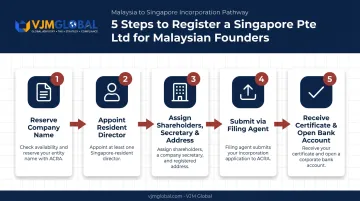
Step 3: Appoint Shareholders, Company Secretary, and Registered Address
With your director sorted, the next layer covers ownership, secretarial compliance, and your legal address.
Shareholders: A Malaysian individual or company can hold up to 100% of the shares in a Singapore Pte Ltd. You need a minimum of one shareholder and can have up to 50; directors and shareholders can be the same person or entirely separate.
Company secretary: Every Pte Ltd must appoint a qualified secretary within six months of incorporation. A sole director cannot double as secretary; ACRA requires a separate appointment.
Registered address: Your company needs a physical Singapore address on file with ACRA, open to the public for at least three hours during normal business hours, every business day. A commercial office works, but so does a virtual office arranged through a corporate service provider, the route most overseas founders take.
Many Malaysian founders bundle the secretary and registered address into the same engagement as their filing agent, since managing three separate vendors for one compliance package rarely makes sense.
Step 4: Submit Documents via a Registered Filing Agent
Here's the rule that surprises most Malaysian applicants: you cannot file your own incorporation application on BizFile+. ACRA requires foreigners who don't meet local-residency criteria to engage a Corporate Service Provider, still commonly called a registered filing agent, to submit the application.
Firms such as VJM Global act in this capacity, filing on behalf of Malaysian and other overseas clients as part of their Singapore entity formation service.
Before filing, your provider will typically collect:
- Passport copies for all directors, shareholders, and the company secretary
- Proof of residential address for each individual involved
- A brief professional profile or background summary
- Signed consent-to-act forms from directors, shareholders, and the secretary
You'll also need a company constitution on file. ACRA offers two options: adopt its standard model constitution, which covers most straightforward setups, or submit a customised version if your governance arrangements need something more specific.
Most first-time Malaysian founders start with the model version and amend it later. Custom drafting adds time upfront without much benefit for a simple two-shareholder company.
Step 5: Receive Certificate of Incorporation and Open a Corporate Bank Account
Once ACRA approves your application, you'll receive an e-Certificate of Incorporation and a Unique Entity Number (UEN) by email. Straightforward applications typically clear soon after the registration fee is paid; complex cases can take up to 15 working days, and cases referred to another agency can stretch to 14-60 days.
Opening a corporate bank account is usually the next hurdle:
- Major local banks: DBS, OCBC, and UOB all support foreign-owned Pte Ltd accounts, though each requires certified passport copies, proof of address, a board resolution, and FATCA/CRS declarations for every director, signatory, and beneficial owner
- Digital or fintech business accounts: several providers support remote onboarding for overseas applicants, which can move faster for simpler ownership structures
Some banks process everything online; others still ask for an in-person visit or video verification. Given how close Malaysia sits to Singapore, whether via the Causeway or a short flight, this rarely derails a launch timeline: it just means budgeting a day trip if your bank insists on face-to-face verification.
Eligibility and Requirements for Malaysian Applicants
Who exactly can set up a Singapore Pte Ltd from Malaysia? The rules are more permissive than most people expect.
Any individual over 18 who hasn't been declared bankrupt or convicted of a relevant offence can register a company, hold shares, or serve as a director. Nationality doesn't factor into eligibility: this applies equally to a Malaysian citizen in Kuala Lumpur as it does to a Singapore PR.
Ownership and compliance are two separate matters. As a shareholder, a Malaysian can own up to 100% of a Singapore Pte Ltd without a local partner. The resident director requirement, however, is a compliance role rather than an ownership stake, and it must be filled by someone meeting Singapore's residency criteria regardless of who holds the majority shares.
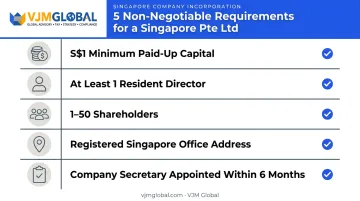
The non-negotiable minimums for any Pte Ltd:
- S$1 minimum paid-up capital
- At least 1 resident director
- Between 1 and 50 shareholders
- A registered Singapore office address
- A company secretary appointed within 6 months
Working through these requirements piecemeal (one vendor for the nominee director, another for the address, a third for filing) adds coordination overhead most first-time founders don't anticipate. Firms with cross-border capability, VJM Global among them, handle nominee director arrangements and filing agent duties within a single engagement, cutting down the back-and-forth between separate providers.
Cost and Timeline Breakdown
Budgeting for a Singapore Pte Ltd involves two layers: what ACRA charges directly, and what you'll pay professional providers for the parts you can't handle as a foreigner.
| Item | Fee |
|---|---|
| Name application | S$15 |
| Company registration | S$300 |
| Total ACRA fees | S$315 |
That S$315 figure covers only ACRA's fees. Malaysian applicants should also budget for professional support:
- Incorporation/filing service: S$100-500, depending on document preparation and coordination
- Company secretary (annual): S$300-1,000, since this is an ongoing compliance role
- Nominee director (annual): S$2,000-5,000, often with a refundable security deposit, given the personal liability the nominee takes on
Add these together and most Malaysian founders land somewhere between S$2,000 and S$5,000 all-in for year one, well above the S$315 ACRA charges alone.
VJM Global bundles these three services (incorporation filing, company secretary, and nominee director support) for Malaysian founders registering in Singapore, so you manage one engagement instead of three separate vendors.
On timeline, ACRA doesn't guarantee a fixed turnaround, but most straightforward applications are approved soon after the registration fee is paid. Complex cases can take up to 15 working days, and referrals to another government agency push that to 14-60 days. Build in that buffer if you're planning around a launch date or contract deadline.
Common Mistakes Malaysian Applicants Should Avoid
Even straightforward incorporations go sideways when founders skip past a few details. Here's what comes up most often:
Assuming self-registration is an option. Many Malaysians try logging into BizFile+ directly, only to find the portal won't accept their application. As a foreigner without Singapore residency status, you need a Corporate Service Provider to file on your behalf—there's no workaround.
Underbudgeting for the nominee director. The S$315 government fee gets quoted everywhere, but the nominee director's annual fee and deposit can dwarf everything else in your first-year budget.
Missing compliance deadlines. Two penalties catch people out:
- Failing to appoint a company secretary within 6 months can mean a fine of up to S$1,000 for the director
- Letting your registered office fall out of compliance carries a fine of up to S$5,000, plus a daily default penalty
Overlooking cross-border tax implications. Under the Singapore-Malaysia tax treaty, director's fees paid to a Malaysian resident sitting on a Singapore company's board can be taxed in Singapore. Malaysia generally allows a foreign tax credit for that Singapore tax, but check the interaction with your Malaysian residency status before assuming a single point of taxation.
A firm handling both the Singapore incorporation and the Malaysia-side tax reporting, such as VJM Global, can flag these issues before they turn into penalties or double taxation.
Private Limited Company vs Other Business Structures in Singapore
If you've been comparing structures, here's the short version: a private limited company caps shareholders at 50 and cannot offer shares to the public.
A public limited company can have unlimited shareholders and raise capital through public offerings. That scale comes with far heavier reporting obligations, which is why it typically suits only large, well-capitalised businesses, not first-time market entrants.
For Malaysian founders, the more relevant comparison is Pte Ltd versus a sole proprietorship or LLP:
- Sole proprietorship: Simplest to set up, but you're personally liable for business debts and it carries less credibility with investors or enterprise clients
- LLP: Limits liability for partners, but lacks the separate legal identity and tax treatment that make a Pte Ltd attractive for growth
- Pte Ltd: Separate legal entity, limited liability, and access to corporate tax exemptions unavailable to sole proprietors
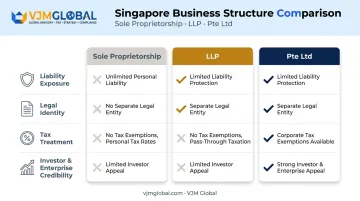
That last point matters more than it sounds. A new Pte Ltd can claim partial exemption on its first S$200,000 of chargeable income under Singapore's start-up tax exemption scheme, provided it meets the shareholder conditions.
That's a concrete reason most Malaysian SMEs and startups entering Singapore default to Pte Ltd, rather than a preference for structure's sake.
Frequently Asked Questions
How much does it cost to register a private limited company in Singapore?
Government fees total S$315: S$15 for name application and S$300 for registration. Factor in a nominee director, secretary, and filing agent fees, and most Malaysian applicants budget S$2,000-5,000 for a fully supported setup.
Who is eligible to register a private limited company in Singapore?
Anyone over 18 who hasn't been declared bankrupt or convicted of a relevant offence can be a shareholder or director, regardless of nationality. Malaysian founders still need at least one Singapore-resident director on the board.
What is the difference between a private limited company and a public limited company in Singapore?
A private limited company caps shareholders at 50 and cannot sell shares to the public. A public limited company can have unlimited shareholders and raise funds publicly, but faces heavier compliance obligations.
Can a Malaysian be the sole director and shareholder of a Singapore company?
A Malaysian can be the sole shareholder, but not the sole director, unless they hold Singapore PR status or an eligible work pass with the right consent. Otherwise, a local nominee director is required alongside them.
Do I need to travel to Singapore to register my company from Malaysia?
No. A registered filing agent handles incorporation remotely on your behalf. A visit may still help when opening your corporate bank account, depending on the bank's verification requirements.
How long does it take to register a Singapore company from Malaysia?
Most straightforward applications are approved soon after the registration fee is paid, often within a few working days. Referred or complex cases can take anywhere from 14 to 60 days.