The franchise route lets you own a piece of India's growth story without reinventing the wheel. You get a system, brand recall, and often training support baked into the deal.
This guide walks through the top franchise sectors worth considering, what they typically cost, the legal groundwork UAE residents need before signing anything, and how to pick the right opportunity for your budget and risk appetite.
TL;DR
- India's franchise sector spans low-to-mid investment options across food, retail, education, and services
- UAE investors need an Indian legal entity plus FDI/FEMA clearance before operating a franchise
- Use indicative costs and a compliance checklist to shortlist viable options before you commit
- Franchise fit hinges on budget, sector interest, and local demand—not brand appeal alone
- Professional guidance simplifies Indian entity formation, FDI/FEMA clearance, and cross-border tax structuring
Franchising as an Entry Route Into India for UAE Investors
Franchising means paying to operate under an established brand's name, systems, and support structure. For UAE-based investors, it's often a lower-risk way to enter India than launching an independent venture, since the operating model, supply chains, and brand trust are already built.
A 2023 FranCast whitepaper estimated India's franchise sector at ₹800 billion, with 4,600 franchisors operating nearly 200,000 outlets and annual growth projected at 30-35%. Treat that as an industry estimate rather than an official census, but it signals a maturing market with room for new entrants.
Here's the catch: UAE investors typically can't sign a franchise agreement directly. You'll need an Indian legal entity—usually a Private Limited Company or LLP—to hold the agreement and operate locally. More on that below. First, let's look at where the opportunity actually is.
Top Franchise Business Ideas to Start in India from UAE
The sectors below were shortlisted on four factors: brand strength, investment accessibility, market demand, and how well they suit remote or NRI ownership.
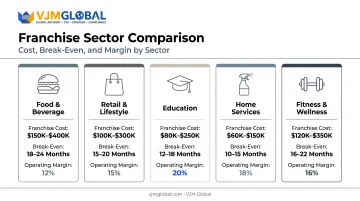
Food & Beverage (QSR, Cafés, Cloud Kitchens)
India's food service market is projected to grow from ₹5.69 trillion to ₹7.76 trillion by 2028, an 8.1% CAGR, with organised formats growing even faster at 13.2%. Quick-service and cloud kitchen formats are capturing most of that organised growth.
Why this fits UAE-based owners:
- Lower operational complexity than full-service restaurants
- Scales easily across cities using standardized systems
- Strong brand recall reduces marketing lift
| Metric | Range |
|---|---|
| Franchise Cost | ₹2 – ₹15 Lakhs |
| Break-even Period | 6 – 14 months |
| Operating Margin | 15% – 30% |
Note: these are directional bands, not guarantees. A brand's actual unit economics depend heavily on rent, food cost, and delivery commissions.
Retail & Lifestyle Franchises
Organised retail in India is forecast to hit US$230 billion by 2030 at a 10% CAGR, according to a Deloitte-RAI report. Rising consumer spending is pushing fashion, accessories, and convenience formats into smaller cities too.
Established supply chains and brand recognition cut setup uncertainty. A local store manager can run day-to-day operations while you oversee remotely from the UAE.
| Metric | Range |
|---|---|
| Franchise Cost | ₹5 – ₹30 Lakhs |
| Break-even Period | 12 – 24 months |
| Operating Margin | 20% – 35% |
One caveat: retail FDI rules vary by format. Single-brand retail permits 100% automatic-route FDI, but multi-brand retail requires government approval. This affects entity structuring, not just brand choice.

Education & Skill Development Centres
Tutoring, coaching, and vocational training franchises sit inside India's broader education market, expected to grow from roughly US$117 billion (about ₹9.7 lakh crore) to US$313 billion by FY30. Coaching-specific franchise data is thinner, but demand signals are strong.
What keeps demand steady:
- Recession-resistant demand (parents rarely cut education spend)
- Several government-backed skilling initiatives support this space
- Multi-branch scalability once one centre proves out
| Metric | Range |
|---|---|
| Franchise Cost | ₹1 – ₹10 Lakhs |
| Break-even Period | 12 – 24 months |
| Operating Margin | 15% – 25% |
Laundry, Cleaning & Home Services
India's online home-services segment is growing at an estimated 18-22% annually, per Redseer research. Organised, tech-enabled laundry and cleaning franchises are capturing a slice of that shift from unorganized local vendors.
Staffing needs stay lean, urban demand keeps rising, and franchisors typically hand over training and operating systems upfront—useful when you are not on the ground full-time.
| Metric | Range |
|---|---|
| Franchise Cost | ₹5 – ₹25 Lakhs |
| Break-even Period | 6 – 16 months |
| Operating Margin | 20% – 35% |
Fitness, Wellness & Beauty Franchises
Deloitte and the Health & Fitness Association project India's fitness market revenue doubling from ₹16,200 crore in 2024 to ₹37,700 crore by 2030, an 11% CAGR in memberships. Rising health consciousness is driving gyms, salons, and wellness studios well beyond metro cities.
Recurring membership revenue builds a steadier cash cycle than one-off retail, and niche formats (yoga studios, boutique fitness) are gaining ground in tier-2 cities.
| Metric | Range |
|---|---|
| Franchise Cost | ₹5 – ₹20 Lakhs |
| Break-even Period | 10 – 18 months |
| Operating Margin | 20% – 35% |

Legal & Compliance Essentials for UAE Investors
Here's where most first-time franchise investors from the UAE hit friction. You can't simply wire money and sign a franchise agreement as an individual. You need an Indian entity, and the compliance stack behind it matters.
Entity setup: Most UAE investors incorporate a Private Limited Company, though an LLP works if the sector permits 100% automatic-route FDI with no performance conditions attached. A Private Limited Company generally offers more flexibility for future fundraising and bank credit, which is why it's the more common default.
Key compliance steps include:
- Incorporation with the Registrar of Companies (ROC) under the Companies Act
- GST registration, reviewed against your business model and transaction types
- Franchise agreement structuring for royalty payments and applicable tax treatment
Repatriation and tax residency: Profits earned in India can be repatriated to the UAE, but the mechanism and tax treatment depend on your entity type and residential status under Indian tax law.
The India-UAE Double Taxation Avoidance Agreement caps source-country tax on qualifying dividends and royalties at 10%, which helps avoid double taxation on the same income. That figure is a treaty ceiling, not an automatic exemption—documentation and beneficial-ownership rules still apply.
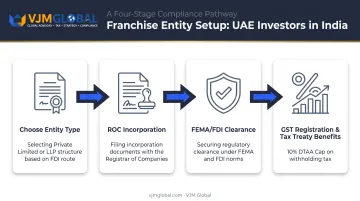
VJM Global works with foreign investors, including UAE-based clients, on entity formation and compliance for Indian market entry. Support covers Private Limited Company and LLP incorporation, FEMA and FDI advisory, and GST registration through ongoing statutory compliance.
How to Choose the Right Franchise as a UAE-Based Investor
Picking a franchise isn't just about which brand looks appealing. Work through these checks before you commit capital:
- Set your budget honestly — Include the franchise fee, fit-out, working capital, and a buffer for a slower ramp-up.
- Decide your involvement level — Remote management via a local team, or part-time presence in India to oversee operations.
- Read the franchise agreement closely — Royalty rates, marketing fund contributions, supply mandates, and the support the franchisor actually delivers.
- Validate local demand — Success in Dubai malls does not guarantee a tier-2 Indian city; test competition and cultural fit first.
- Check territory, term, and exit clauses — Confirm exclusivity, renewal rights, transfer rules, and what you keep if you exit.
Franchisors often advertise low entry costs. The real figure includes royalties, renewal fees, and minimum purchase commitments buried in the agreement—so model full unit economics before you sign.
Conclusion
India's franchise landscape offers UAE-based investors a diversified set of entry points, from quick-service food formats to wellness studios, each with different capital requirements and risk profiles. The commercial upside is real. So is the compliance work that comes with every deal.
Before finalising any franchise, check the brand's track record alongside FDI eligibility, GST obligations, and long-term scalability for the structure you plan to use. A strong brand on the wrong entity setup creates headaches later.
If you're exploring franchise entry into India from the UAE, VJM Global can help with entity formation, GST registration, and FEMA/FDI compliance so the legal groundwork is in place before you launch.
Frequently Asked Questions
Which is the most profitable franchise in India?
F&B, education, and wellness franchises tend to show strong ROI on paper, but actual profitability depends heavily on location, brand strength, and local demand. There's no universal "most profitable" answer.
Can a UAE resident or NRI legally own a franchise business in India?
Yes, this is permitted under FDI rules, typically by incorporating an Indian entity such as a Private Limited Company. Sector-specific conditions and beneficial-ownership rules still apply.
What is the minimum investment needed to start a franchise in India from the UAE?
Low-investment options can start around ₹2-5 lakhs for compact formats, while premium or retail-heavy brands can require ₹20-30 lakhs or more. The franchise fee is rarely the full picture.
Do UAE-based franchise owners need to pay tax in both India and UAE?
The India-UAE DTAA caps source-country tax on qualifying dividends and royalties at 10%, helping avoid double taxation. Exact treatment depends on your residential status and how profits are structured.
What legal structure should a UAE investor use to set up a franchise in India?
A Private Limited Company is commonly preferred for liability protection, easier fundraising, and straightforward compliance. An LLP works only where the sector allows 100% automatic-route FDI.
How long does it take to set up a franchise business entity in India?
Entity incorporation typically takes around 2-4 weeks, covering DSC, DIN, name approval, and ROC registration. This excludes franchisor onboarding and site approval timelines.