Dubai Chamber alone welcomed over 18,000 new Indian-owned member companies in 2025.
Online guides make registration sound like a five-minute form fill. It isn't. Your actual outcome depends on picking the right jurisdiction, getting document attestation right the first time, and knowing exactly what can be done from your desk in Mumbai versus what needs a flight to Dubai.
This guide walks through structure selection, the real remote registration steps, the document checklist Indian applicants specifically need, current costs, and the mistakes that trip up first-time founders.
Key Takeaways
- Free Zones: 100% foreign ownership and setup in about 10 working days—default if you have no UAE storefront
- Mainland LLCs: 100% foreign ownership in most sectors; best for local clients or government contracts
- Run activity selection, name reservation, and filings fully from India; UAE travel is usually only for bank biometrics
- Costs range from about AED 10,000 (lean offshore) to AED 80,000+ (serviced Free Zone office)
- Nail document attestation and post-incorporation tax registration first time to avoid delays most applicants hit
How to Register a Private Limited Company in the UAE from India: Step-by-Step Process
Step 1: Decide Your Business Activity and Jurisdiction
The UAE licenses thousands of distinct business activities, each falling under one of six categories: commercial, professional, industrial, tourism, agricultural, or crafts. Your activity code isn't a formality. It determines everything downstream.
Here's what it decides:
- Which jurisdiction you're legally allowed to use — Mainland, Free Zone, or Offshore aren't interchangeable for every activity
- Whether you need extra regulatory sign-off — financial services need Central Bank or SCA approval, healthcare needs Dubai Health Authority clearance, and several activities need sector-specific regulators
- What office setup is mandatory — some activities require a physical premises; others accept a flexi-desk
Confirm activity-jurisdiction fit before paying a single fee. Switching later often means restarting the name reservation and initial approval steps from scratch, which costs time and money you'll want to avoid.
Step 2: Reserve Your Trade Name and Secure Initial Approval
UAE naming rules are stricter than most Indian founders expect. Your proposed name can't:
- Reference religion or contain offensive language
- Duplicate an existing trademark or resemble a well-known local brand
- Include geographic terms or airport codes without justification
- Contradict your stated business activity
Once your name clears these checks, you apply for initial approval: government confirmation that nobody objects to your proposed activity. This step is completed entirely online.
Free Zones like DMCC have built paperless pipelines: portal-based document upload, digital signing, and electronic licence issuance, all done remotely. Dubai's DED also accepts licence applications online, though not every Mainland activity clears every approval without at least one manual touchpoint.
Step 3: Submit Incorporation Documents and Obtain the Trade Licence
With initial approval secured, you submit your incorporation file. For an individual founder, this typically includes:
- Passport copies for all shareholders, directors, and signatories
- Passport-size photographs matching UAE specifications
- Proof of Indian residential address — a recent utility bill or bank statement usually works
- Drafted Memorandum and Articles of Association (MOA/AOA) outlining ownership and governance
Notarisation and attestation requirements differ by authority. A DMCC filing and a Dubai Mainland filing don't follow identical rules. Confirm requirements with the specific Free Zone or DED office before you submit anything, not after.
You'll also need a registered office address before the licence is issued. Depending on jurisdiction, this can be a physical office, a flexi-desk, or a virtual address, but it's non-negotiable. No address, no licence.
This documentation stage is where coordinating attested paperwork, MOA drafting, and jurisdiction-specific filing requirements gets time-consuming for a founder managing it alongside a day job.
VJM Global's cross-border entity formation team handles this coordination end-to-end for Indian founders expanding into the UAE. The team works directly with the relevant DED or Free Zone authority so the filing doesn't stall on a documentation technicality.
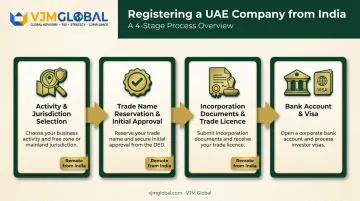
Step 4: Open a Corporate Bank Account and Apply for a Visa (If Relocating)
Your trade licence doesn't automatically give you banking access. UAE banks run their own KYC process, separate from your incorporation, and it can extend your timeline by weeks if you're unprepared.
Banks typically request:
- Trade licence and MOA
- Passport copies of all shareholders
- Proof of business activity and, often, a business plan
- Source of funds documentation
Minimum balance requirements vary significantly by bank. Some digital-first accounts like Wio Business start at zero minimum balance with a monthly fee around AED 99. Traditional packages at banks like Emirates NBD can require average balances of AED 50,000 for premium tiers.
Several banks also require at least one UAE-resident signatory for fully online applications. That matters if every founder is based in India.
A residency visa and Emirates ID are only necessary if you plan to physically relocate. The company itself can be fully registered and operational without either.
Choosing the Right UAE Business Structure: Mainland, Free Zone, or Offshore
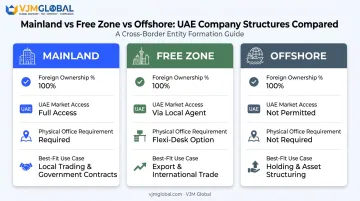
Indian founders usually pick one of three UAE structures: Mainland, Free Zone, or Offshore. The right choice depends on whether you need direct access to the local market, how fast you want to set up, and whether the entity will trade or only hold assets.
| Factor | Mainland | Free Zone | Offshore |
|---|---|---|---|
| Foreign ownership | 100% in most sectors | 100% | 100% |
| UAE market access | Direct | Via distributor | None |
| Physical office | Required | Flexi-desk or office | Not required |
| Best fit | Local trade, retail, gov contracts | E-commerce, IT, consulting, export-import | Holding or group structure |
Mainland Company
Mainland LLCs are licensed through the Department of Economic Development in the relevant emirate. Following recent reforms, they now permit 100% foreign ownership in most sectors, with no local Emirati partner required for the vast majority of activities.
This structure fits Indian entrepreneurs who need to:
- Trade directly with UAE-based clients without a distributor
- Bid on government contracts
- Run a physical retail outlet or service centre anywhere in the UAE
Free Zone Company
Free Zones offer 100% foreign ownership and full profit repatriation, without the local-sponsor complexity Mainland once required. The trade-off: most Free Zone companies can't sell directly into the UAE local market without a distributor.
For an Indian founder running e-commerce, IT services, consulting, or export-import without a UAE storefront, this is usually the faster, cheaper default. DMCC reports setup in about 10 working days once documents are complete.
Offshore Company
Offshore entities can't trade within the UAE at all and don't require a physical office. That makes them a poor choice for an active first business, but a better fit for a holding company or an international trading structure above an operating entity.
Offshore works best as a complement, not a replacement, for a Mainland or Free Zone entity that is actually doing business.
Documents & Eligibility Requirements for Indian Entrepreneurs
The core checklist for Indian applicants is shorter than most founders expect:
- Valid passport with at least six months' validity remaining
- Passport-size photograph meeting UAE specifications
- Proof of Indian residential address (issued within the last three months)
- A brief business plan, required only for regulated activities
You don't need an existing UAE visa or address to start registration. Banks will ask for additional KYC documentation later, but that's a separate track from the incorporation itself.
Salaried professionals should check one thing early: some visa categories require a No Objection Certificate from your current employer. It's a small document that causes real delays if forgotten.
Who Qualifies
Most Indian entrepreneurs meet the requirements without prior UAE ties:
- 100% foreign ownership is available for most mainland and free-zone activities
- One shareholder and one director are typically enough (the same person can fill both roles)
- Minimum capital is nil or low in most free zones; mainland rules depend on the activity
Common Document Errors That Cause Delays
Four mistakes account for most rejections and resubmissions:
- Name spelling inconsistencies across passport, address proof, and application forms
- Near-expiry passports submitted without checking the six-month rule
- Address proof older than the accepted validity window, usually three months
- Missing attestation on documents that the specific authority requires notarised
Coordinating attested paperwork, MOA drafting, and jurisdiction-specific submissions is where founders often benefit from professional support rather than trial and error. A cross-border firm such as VJM Global can manage documentation and filing end-to-end, so a spelling mismatch or missing attestation doesn't cost you three weeks.
Cost of Registering a Private Limited Company in the UAE from India
Setup cost depends far more on jurisdiction than on company size. Quotes are almost always in AED and vary by free zone. Here's a rough breakdown of the core components:
| Cost Component | Typical Range (AED) |
|---|---|
| Trade name reservation | ~620 |
| Free Zone application + registration fee | 1,015 – 9,000 |
| Free Zone annual licence | ~20,285 |
| Flexi-desk office | 16,000 – 19,000 |
| Serviced office (Free Zone) | 35,000 – 140,000 |
| Employment visa (2-year, new) | ~2,970 |
| Offshore incorporation (JAFZA) | ~10,000 |
For a lean Free Zone setup with a flexi-desk, many founders budget roughly AED 40,000–55,000 in the first year for registration, licence, and workspace—before visas. Free Zone packages are usually the most economical route for solo founders or small teams. Mainland setups typically cost more once you factor in physical office requirements and any activity-specific approvals.
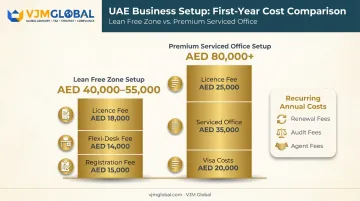
Beyond initial setup, budget for recurring annual costs:
- Licence renewal fees (often close to the initial licence cost)
- Mandatory audit and accounting fees for entities required to maintain audited accounts
- Local agent fees, where applicable to your structure
Common Mistakes Indian Entrepreneurs Make When Registering in the UAE
Four patterns show up repeatedly among first-time Indian applicants:
- Choosing jurisdiction on cost alone. A cheap Free Zone package is worthless if it doesn't permit your intended activity or let you reach your actual target market.
- Underestimating tax obligations. UAE corporate tax applies at 9% above AED 375,000 in taxable income, with 0% below that threshold. VAT registration becomes mandatory once revenue crosses AED 375,000, with voluntary registration available from AED 187,500.
- Treating the trade licence as the finish line. Founders who wait until after licence issuance to think about bank KYC often lose weeks to avoidable delays. Start gathering bank documentation the moment you submit incorporation papers.
- Viewing registration as a one-time event. Corporate tax filing, VAT returns, UBO disclosures, and audit requirements continue every year the company exists. Those obligations are where ongoing support matters most. VJM Global's accounting, tax, and audit compliance services help founders stay current well beyond the incorporation certificate.
Frequently Asked Questions
Can an Indian open a private limited company in the UAE?
Yes. Indian nationals can own up to 100% of a company in most UAE Free Zones and in most Mainland sectors. No UAE citizen partner is required for these activities.
How much does it cost to form a private limited company (LLC) in the UAE?
Cost depends on jurisdiction and visa count. Free Zone setups can start around AED 10,000-15,000 for basic packages, while fuller Free Zone or Mainland packages with office space and multiple visas often run AED 40,000-85,000.
Do I need to travel to the UAE to register my company from India?
Not for most of it. Activity selection, name reservation, document submission, and licence approval can all be completed remotely. Travel is typically only necessary for bank account biometrics or visa processing if you're relocating.
Do I need a local UAE sponsor to own 100% of my company?
No, in most cases. The majority of Free Zones and most Mainland activities no longer require a local sponsor for ownership. A local service agent may still apply to select Mainland activities, but this doesn't affect your ownership percentage.
How long does it take to register a UAE company from India?
Free Zone setups (like DMCC) typically take around 10 working days once documents are complete. Offshore structures often finish in 5-7 working days through a registered agent. Mainland timelines depend on activity-specific approvals.
Can I open a UAE corporate bank account without visiting the UAE?
Some banks allow remote onboarding for Free Zone companies, especially digital-first options. Most still require one in-person visit for biometrics and final KYC, particularly when all signatories are based outside the UAE.