Introduction
Outsourced bookkeeping in Singapore ranges from S$60 to over S$1,200 per month — a gap wide enough to leave most business owners unsure what they should actually be paying. The difference comes down to transaction volume, service scope, business complexity, and whether you're working with a local firm, a cloud-based platform, or an offshore provider.
Focusing only on the headline monthly fee is where most businesses go wrong. Surprise charges for GST filing, year-end statements, or payroll processing can push your real cost well above the quoted price.
Paying for services your business doesn't yet need creates the opposite problem — budget that could go toward growth gets tied up in features you won't use for another two years.
This guide breaks down realistic price ranges for Singapore, the key cost drivers, what's typically included versus excluded, and how to avoid common budgeting mistakes when outsourcing bookkeeping.
Key Takeaways
- Outsourced bookkeeping in Singapore ranges from S$100–S$300/month for startups to S$600–S$1,200+/month for GST-registered, growing businesses
- Transaction volume, GST status, reporting frequency, and add-ons like payroll or tax filing drive the biggest cost differences
- Startups pay the least; businesses with employees, regular invoicing, or multi-currency operations pay substantially more
- Low-cost packages often exclude GST filing and payroll — gaps that lead to penalties down the line
How Much Does Outsourcing Bookkeeping Cost in Singapore?
There is no fixed market rate for outsourced bookkeeping in Singapore. Costs vary based on business size, service scope, and whether you choose a local accounting firm, a cloud-based provider, or an offshore outsourcing partner like VJM Global.
Misreading the pricing structure leads to two predictable problems: underbudgeting (and hitting surprise add-on charges) or overpaying for bundled services you don't need. The three tiers below map directly to transaction volume and service complexity.
Basic Tier (S$100 – S$300/month)
Covers monthly bookkeeping for up to 30–60 transactions, basic bank reconciliation, and year-end financial statement preparation. GST filing is typically charged separately or excluded.
Best suited for:
- Sole proprietors and newly incorporated companies
- Dormant entities or businesses with minimal activity
- Companies with no employees or payroll obligations
- Startups testing market fit before scaling operations
Mid-Tier (S$300 – S$600/month)
Covers monthly bookkeeping for 60–200 transactions, along with:
- Bank reconciliation across multiple accounts
- Quarterly GST filing under IRAS requirements
- Basic payroll processing for small teams (typically under 10 employees)
- Management reports for decision-making
- Annual corporate tax filing (provider-dependent)
Best suited for:
- Active SMEs issuing regular invoices
- GST-registered businesses with quarterly filing obligations
- Companies with a small headcount needing monthly financial visibility
- Service-based businesses with straightforward revenue streams
Comprehensive Tier (S$600 – S$1,200+/month)
This tier handles high-volume, multi-dimensional accounting needs. It typically includes:
- High-volume bookkeeping (200–500+ transactions monthly)
- Full GST compliance and quarterly filing
- Payroll management for larger teams
- Multi-currency transaction reconciliation
- Dedicated accountant support with regular consultation
- Monthly financial statements and management reports
- Corporate tax filing (Form C-S/C)
- Most providers charge XBRL filing and group consolidation separately
Best suited for:
- Growing companies scaling operations quickly
- E-commerce businesses managing multiple sales channels
- Trading companies dealing in foreign currencies
- Businesses requiring weekly or real-time financial visibility
- Companies with complex corporate structures or group entities
As confirmed by industry pricing benchmarks for Singapore accounting services, transaction volume is the primary cost driver — and knowing your monthly count before approaching providers puts you in a stronger position to negotiate scope.
Key Factors That Affect Outsourced Bookkeeping Costs in Singapore
Pricing depends on a combination of technical, operational, and compliance factors. Understanding these helps businesses compare quotes accurately and avoid invoice surprises.
Transaction Volume and Frequency
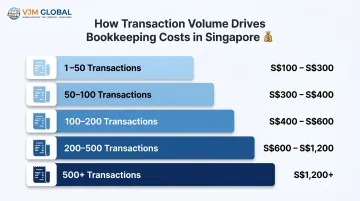
The number of monthly transactions — sales invoices, purchase receipts, expense claims, bank entries — is the single largest cost driver. J Accounting Services uses a straightforward per-transaction model at S$5 per transaction with a S$300/month minimum. This means 60 transactions cost S$300/month, while 150 transactions would run S$750/month.
How costs scale across transaction bands:
| Monthly Transactions | Typical Monthly Fee |
|---|---|
| 1–50 | S$100–S$300 |
| 50–100 | S$300–S$400 |
| 100–200 | S$400–S$600 |
| 200–500 | S$600–S$1,200 |
| 500+ | S$1,200+ |
Reporting frequency compounds costs. Monthly reporting requires ongoing work throughout the year, whereas quarterly or annual-only plans reduce frequency but require clean records submitted at year-end. Weekly reporting typically increases fees by 30–50% above standard monthly rates.
Business Complexity and Structure
Businesses with GST registration, multi-currency transactions, overseas clients, or group structures face higher fees due to additional reconciliation work, reporting requirements, and compliance checks under IRAS and ACRA regulations.
GST registration alone creates substantial cost differences. Sleek's 2026 pricing guide shows GST-registered businesses paying S$400–S$1,000+/month compared to S$60–S$150/month for simple non-GST businesses — roughly 3–7 times higher. This premium reflects not just quarterly GST filing work, but the fact that GST-registered businesses typically have higher transaction volumes and more complex operations.
Industry type also affects pricing:
- F&B, retail, and e-commerce businesses with high daily transaction volumes typically attract premiums
- Trading companies managing multi-currency invoices and foreign exchange reconciliation pay more
- Service-based firms with straightforward billing generally fall into lower pricing tiers
Multi-currency support requires upgraded software (Xero Premium at S$95/month versus Standard at S$70/month) and additional reconciliation work, adding 30–40% to base bookkeeping costs.
Scope of Services Bundled In
Standalone bookkeeping (transaction recording and reconciliation only) costs far less than full-service packages. Each additional service layer increases overall fees:
Market rates for individual add-on services:
| Service | Frequency | Typical Cost Range |
|---|---|---|
| GST Filing | Quarterly | S$150–S$350/quarter |
| Payroll Processing | Per employee/month | S$6–S$20/employee |
| Corporate Tax Filing (Form C-S) | Annual | S$600–S$750 |
| XBRL Filing | Annual | S$330–S$600 |
| Unaudited Financial Statements | Annual | S$250–S$800 |
| ECI Filing | Annual | S$300 |
Some providers advertise low monthly retainers but charge separately for every service. Others bundle core services — bookkeeping, GST filing, and annual filing — into one predictable fee. Before signing, confirm exactly what's included.
Quality of Records and Software Used
Disorganised records — missing receipts, mixed personal and business transactions, delayed submissions — directly inflate fees by increasing the accountant's time commitment. Being organised and submitting documents promptly can reduce costs by 20–30%.
Cloud accounting software plays a dual role. Providers using integrated platforms like Xero, QuickBooks, or Sage may charge setup or subscription fees upfront (S$39–S$95/month for Xero Singapore plans), but typically deliver faster processing times that lower per-transaction costs over time.
Xero was named a leader in the IDC MarketScape 2020 assessment for SaaS small business finance applications and is widely used among Singapore accounting firms.
Breaking Down the Cost: What You're Actually Paying For
The quoted monthly retainer rarely tells the complete story. Businesses should budget for both recurring service costs and periodic or one-time charges.
Ongoing Bookkeeping and Reconciliation (Recurring — Monthly or Quarterly)
This core service covers transaction recording, bank reconciliation, and ledger maintenance. It forms the base fee quoted by most providers and scales directly with transaction volume and reporting frequency.
GST Filing and Compliance Submissions (Recurring — Quarterly)
For GST-registered businesses, quarterly GST returns filed with IRAS are either bundled into packages or charged separately at S$150–S$350/quarter. IRAS imposes strict filing deadlines — returns are due one month after the end of each accounting period, with no extensions granted.
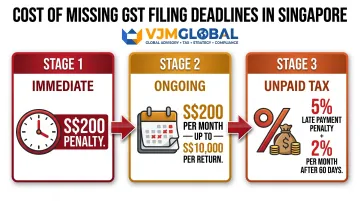
Missing these deadlines costs more than outsourcing ever will. IRAS penalties stack quickly:
- S$200 immediately upon missing the filing deadline
- S$200 per month the return stays outstanding, up to S$10,000 per return
- 5% late payment penalty on tax owed, plus 2% per month if unpaid after 60 days
Year-End Financial Statements and Corporate Tax Filing (Recurring — Annual)
Preparation of unaudited financial statements, tax computation, and Form C-S/C submission to IRAS typically costs S$600–S$2,000/year depending on complexity. This work is usually separate from monthly bookkeeping fees unless explicitly bundled.
Ad-Hoc and One-Time Charges to Watch For (Periodic)
These charges frequently go unbudgeted:
- Catch-up fees for backlogged records (20–50% surcharge on standard rates)
- XBRL filing for companies required to submit in XBRL format (S$330–S$600/year)
- Consolidation fees for group structures with multiple entities
- GST registration setup (S$600 one-time fee per J Accounting Services)
- Personal income tax filings for directors or employees
Because the monthly retainer is only part of the picture, always request a full-scope quote that breaks out recurring fees alongside anticipated annual and one-time charges — that's the only way to compare providers on equal footing.
In-House Bookkeeper vs. Outsourcing in Singapore: Which Costs More?
Fully-Loaded In-House Bookkeeper Cost
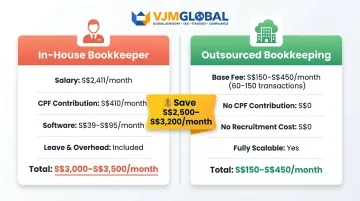
According to Indeed Singapore, the average bookkeeper salary is S$2,411/month. Adding the 17% CPF employer contribution brings the base cost to approximately S$2,821/month.
This excludes:
- Annual leave and sick leave coverage
- Training and professional development
- Accounting software subscriptions (S$39-S$95/month for Xero)
- Office space and IT equipment
- Management overhead and supervision time
Realistic fully-loaded cost: S$3,000-S$3,500/month minimum for an entry-level bookkeeper.
Outsourced Bookkeeping Comparison
A typical SME with 60-150 transactions/month would pay S$150-S$450/month outsourced, — a saving of roughly S$2,500-S$3,200/month versus hiring in-house.
Non-Financial Advantages of Outsourcing
The savings extend beyond the monthly invoice, though. Outsourcing also delivers:
- Access to a team of professionals covering bookkeeping, tax, and compliance expertise
- Reduced risk of single-point-of-failure if an in-house person leaves
- Compliance maintained under ACRA and IRAS frameworks without internal oversight
- Scalability without recruitment costs as transaction volumes grow
Offshore bookkeeping providers like VJM Global handle Singapore-compliant books remotely with qualified accountants — a setup that works especially well for foreign-owned companies and multinationals managing Singapore operations from abroad.
How to Avoid Overpaying for Outsourced Bookkeeping
Focusing Only on the Headline Monthly Fee
Many providers advertise low base rates but charge separately for GST filing, tax filing, payroll, and year-end statements. Always request a full-scope quote and compare total annual costs, not just the monthly retainer.
Example: A S$150/month retainer might seem attractive, but adding quarterly GST filing (S$150 × 4 = S$600/year), annual tax filing (S$600), and payroll for 3 employees (S$15 × 3 × 12 = S$540) brings the real annual cost to S$3,540 — equivalent to S$295/month all-in, not S$150.
Choosing the Cheapest Option Without Verifying Credentials
A provider unfamiliar with ACRA, IRAS rules, or Singapore Financial Reporting Standards can expose your business to penalties that dwarf the cost of premium service.
ACRA imposes penalties of S$300 (up to 3 months late) or S$600 (more than 3 months late) for late annual returns, plus composition sums of at least S$500 per offence. Court prosecution can result in fines up to S$5,000 per charge.
Look for professionals holding recognised qualifications such as:
- CA (Singapore) via the Singapore Chartered Accountant Qualification
- ACCA (Association of Chartered Certified Accountants)
- CPA Australia
- ICAEW (Institute of Chartered Accountants in England and Wales)
- Other qualifications recognised by ISCA for admission
When evaluating providers, ask directly which qualifications their bookkeepers hold and whether they have handled IRAS and ACRA filings for businesses at your stage.
Paying for More Than You Currently Need
A startup with 20 transactions per month does not need a comprehensive management reporting package costing S$600+/month. Match the service scope to your current transaction volume and compliance obligations, then scale up as the business grows.
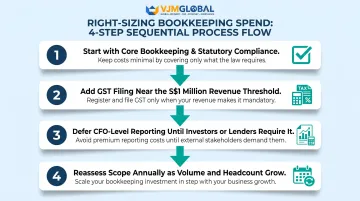
A practical way to right-size your spend:
- Start with core bookkeeping and statutory compliance only
- Add GST filing only if your revenue exceeds or approaches the S$1 million registration threshold
- Defer CFO-level reporting until you have investors or lenders requiring it
- Reassess scope annually as transaction volume and headcount increase
Frequently Asked Questions
How much does accounting services cost in Singapore?
Accounting service fees in Singapore typically range from S$60-S$400/month for small businesses with low transaction volumes. Comprehensive packages including GST filing, corporate tax filing, and payroll management run S$600-S$1,200+/month depending on business size and transaction volume.
Is outsourcing bookkeeping cheaper than hiring an in-house accountant in Singapore?
Yes, outsourcing is generally more cost-effective for SMEs. In-house bookkeepers carry salary, CPF, annual leave, and overhead costs totaling S$3,000-S$3,500/month minimum, while equivalent outsourced services cost S$150-S$450/month for typical small businesses.
What is typically included in an outsourced bookkeeping package in Singapore?
Most packages include transaction recording, bank reconciliation, and basic financial statements. GST filing, payroll processing, and corporate tax filing may be bundled or charged separately depending on the provider.
Are bookkeeping and accounting fees tax-deductible in Singapore?
Yes, fees paid for bookkeeping and accounting services are tax-deductible business expenses under IRAS rules. IRAS explicitly lists "Accounting fee" as deductible, effectively reducing the net cost of outsourcing through corporate tax savings.
How do I know which pricing tier is right for my business?
Your monthly transaction volume, GST registration status, and payroll needs determine the right tier more reliably than revenue alone. Businesses with under 50 transactions and no GST registration fit the basic tier; those with 100-200 transactions and GST obligations need mid-tier services.
Do outsourced bookkeepers in Singapore use cloud accounting software like Xero or QuickBooks?
Yes, most outsourcing providers use cloud platforms such as Xero, QuickBooks, or Sage for real-time collaboration and efficiency. Some charge a separate software subscription fee (S$39-S$95/month for Xero Singapore plans) while others include it in their package pricing — confirm which applies before committing to a provider.