Introduction
Singapore businesses are increasingly setting up operations in Dubai, attracted by the UAE's 0% personal income tax, strengthening trade ties, and world-class free zones. Bilateral merchandise trade between Singapore and the UAE reached S$24 billion in 2024, while nearly 400 Singaporean companies now operate through DMCC alone—representing over half of all Singapore businesses in the UAE.
Yet many Singapore business owners underestimate the compliance-heavy accounting environment waiting for them in Dubai. VAT filing, corporate tax obligations, IFRS-compliant financial statements, and mandatory free zone audits create a cost structure that differs sharply from Singapore's IRAS and ACRA cycles.
Businesses often benchmark costs against what they pay at home, only to face unexpected bills for compliance work they didn't budget for—or overpay for services they don't actually need.
What follows is a practical breakdown of Dubai accounting costs, the compliance obligations that drive them, and where Singapore businesses most often get the budget wrong.
Key Takeaways
- Dubai accounting services range from AED 500/month (≈SGD 170) for basic bookkeeping to AED 15,000+/month (≈SGD 5,175+) for enterprise packages, depending on compliance scope
- VAT status, corporate tax obligations, and free zone vs. mainland structure are the biggest cost drivers
- Most Singapore businesses underestimate mandatory Dubai costs: VAT filing, IFRS statements, and free zone audits are non-negotiable
- Outsourcing to a Dubai-based firm is almost always more cost-effective than hiring in-house for Singapore-owned SMEs
- The right accounting budget reflects your compliance obligations and business stage, not just the lowest quote available
How Much Do Accounting Services in Dubai Cost?
There is no fixed price for accounting services in Dubai. Costs vary significantly based on service type, business size, transaction volume, and compliance requirements. Singapore businesses accustomed to relatively standardised fee structures may find this range surprising. Choosing a low-cost provider that doesn't cover mandatory UAE filings often backfires — resulting in FTA penalties or a costly mid-year provider switch.
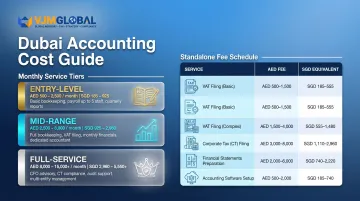
Typical Price Ranges by Tier
| Service Tier | Monthly Range (AED) | Monthly Range (SGD) | What's Included |
|---|---|---|---|
| Entry-level / Basic | 500 – 2,500 | 170 – 860 | Basic bookkeeping, ledger maintenance, bank reconciliation for startups or low-volume free zone companies |
| Mid-range / Standard | 2,500 – 8,000 | 860 – 2,760 | Bookkeeping + VAT filing + payroll + monthly financial reports—most common for Singapore-owned SMEs with active operations |
| Full-service / Enterprise | 8,000 – 15,000+ | 2,760 – 5,175+ | All of the above + corporate tax compliance + IFRS statements + audit preparation + strategic advisory for regional HQs or multi-entity structures |
Critical exclusions: VAT filing, corporate tax filing, and audit fees are often charged separately unless explicitly bundled in Standard or Enterprise packages. Always confirm what's included before signing.
Even mid-range packages frequently exclude the filings below. Budget for these separately unless your provider explicitly confirms otherwise.
Additional standalone fees:
| Service | Cost (AED) | Cost (SGD) |
|---|---|---|
| Basic VAT filing (per quarter) | 500 – 1,000 | 170 – 345 |
| Complex VAT filing (per quarter) | 1,500 – 3,000 | 515 – 1,035 |
| Corporate tax filing (annual) | 2,000 – 5,000 | 690 – 1,725 |
| Financial statements preparation (annual) | 1,000 – 3,000 | 345 – 1,035 |
| Accounting software setup (one-time) | 2,000 – 10,000+ | 690 – 3,450+ |
Key Factors That Drive Accounting Costs in Dubai
Pricing across Dubai accounting firms can vary by 3x–5x for seemingly similar services. Understanding what drives these differences helps Singapore businesses make better procurement decisions.
Transaction Volume and Business Activity
The number of monthly invoices, receipts, payroll entries, and banking transactions is the single biggest driver of bookkeeping cost. A Singapore trading company with high-volume import/export activity will pay far more than a consulting firm with a handful of monthly transactions. Firms typically tier pricing based on transaction bands—expect costs to increase sharply once you exceed 100–200 monthly transactions.
Business Structure: Free Zone vs. Mainland
Free zone companies—common among Singapore businesses setting up in the UAE—often face mandatory annual audit requirements imposed by the free zone authority. DMCC, IFZA, JAFZA, and DIFC all require audited financial statements submitted within 6 months of financial year-end. That adds audit fees of AED 5,000–15,000+ (SGD 1,725–5,175+) annually on top of regular accounting costs. Mainland companies have different but comparable obligations under the UAE Commercial Companies Law.
Scope of Compliance Required
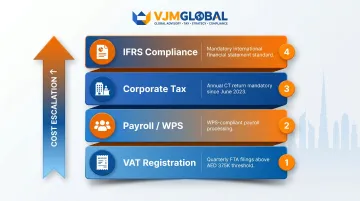
The number of compliance layers directly escalates cost:
- VAT registration: Quarterly FTA filings required for businesses exceeding AED 375,000 in taxable supplies
- Payroll obligations: WPS-compliant payroll processing for businesses with employees
- Corporate tax: Annual CT returns under Federal Decree-Law No. 47 of 2022, effective June 2023
- IFRS compliance: Mandatory for financial statements under UAE Corporate Tax Law
Each layer adds to the monthly or annual fee.
Industry Complexity
Industries common among Singapore investors—trading, logistics, financial services, real estate—carry additional accounting complexity. Inventory accounting, escrow requirements, and transfer pricing rules require specialist knowledge and carry higher fees as a result. Firms with industry-specific expertise typically charge 20–40% more than generalists.
Provider Type: Big 4 vs. Boutique Firm vs. Freelancer
Three cost tiers cover most of the market:
- Big Four firms suit large enterprises or complex multi-jurisdictional structures — but carry premium pricing to match
- Mid-tier boutique UAE firms offer competitive local expertise and transparent pricing, typically 30–50% below Big Four rates
- Freelance accountants charge the least (AED 100–500/hour), but have limited capacity and higher compliance risk — particularly around FTA representation
Freelancers may work well for very small operations, but most Singapore SMEs benefit from the multi-disciplinary teams and regulatory compliance track record that established firms offer.
UAE Compliance Requirements Singapore Businesses Must Budget For
This is where Singapore businesses are most likely to be blindsided. The UAE's compliance environment differs significantly from Singapore's, and the associated costs must be built into every budget from day one.
VAT Registration and Quarterly Filing
UAE VAT at 5% applies to businesses with taxable supplies above AED 375,000 annually. Unlike Singapore's GST, which operates on a similar threshold model, UAE VAT filings are quarterly and require detailed input/output tax reconciliation. Filing deadlines fall within 28 days of the tax period end.
Cost range:
- Basic quarterly VAT filing: AED 500–1,000 (SGD 170–345)
- Complex filings (multi-entity, high transaction volumes): AED 1,500–3,000 (SGD 515–1,035), up to AED 8,000 for highly complex cases
UAE Corporate Tax Compliance
Since the introduction of UAE Corporate Tax in June 2023, all UAE-incorporated businesses must register, file annual returns, and maintain IFRS-compliant financial records for a minimum of seven years.
Key requirements:
- 9% tax on taxable profits exceeding AED 375,000
- 0% on the first AED 375,000 of profits
- Annual CT return filing mandatory
Approximate annual corporate tax compliance fees for SMEs: AED 2,000–5,000 (SGD 690–1,725).
IFRS-Compliant Financial Statements
UAE law requires financial statements prepared under IFRS rather than Singapore FRS. This may require additional reconciliation work for businesses that consolidate with a Singapore parent using different accounting standards. Singapore businesses frequently miss this cost in their initial budgets — the added complexity is real and measurable. Expect AED 1,000–3,000 (SGD 345–1,035) annually for IFRS-compliant statement preparation.
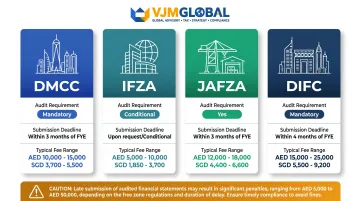
Free Zone Mandatory Audit Requirements
Most UAE free zones require companies to submit audited financial statements to the relevant free zone authority annually. For Singapore businesses setting up in popular free zones, this is a mandatory cost—not optional.
Key free zone audit requirements:
| Free Zone | Audit Requirement | Deadline | Typical Fee Range (AED) | Typical Fee Range (SGD) |
|---|---|---|---|---|
| DMCC | Mandatory for all member companies | 6 months after FY-end | 5,000 – 15,000 | 1,725 – 5,175 |
| IFZA | Mandatory if turnover >AED 3M or 10+ employees | At license renewal | 5,000 – 15,000 | 1,725 – 5,175 |
| JAFZA | Mandatory for most companies | 6 months after FY-end | 5,000 – 15,000 | 1,725 – 5,175 |
| DIFC | Mandatory for all entities | 4 months after FY-end | 5,000 – 15,000 | 1,725 – 5,175 |
All free zone audits must be performed by auditors approved by the respective authority. Late submission can result in fines starting from USD 2,000 in DIFC and license renewal delays in other zones.
Outsourcing vs. In-House Accounting for Singapore Businesses
For most Singapore-owned SMEs in Dubai, the choice isn't whether to use professional accounting—it's whether to hire an in-house accountant locally or outsource to a UAE accounting firm.
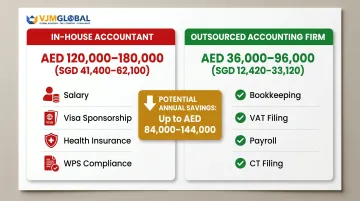
Total annual cost comparison:
| Option | Annual Cost (AED) | Annual Cost (SGD) | What's Included |
|--------|-------------------|-------------------|-----------------|
| Mid-level in-house accountant | 120,000 – 180,000 | 41,400 – 62,100 | Salary + visa (AED 3,000–7,500) + health insurance + WPS compliance |
| Outsourced accounting firm | 36,000 – 96,000 | 12,420 – 33,120 | Full bookkeeping + VAT + payroll + CT filing in Standard package |
For most remote-managed operations, outsourcing wins on four fronts:
- Eliminates visa sponsorship, health insurance, and HR administration costs
- Gives access to VAT specialists, CT advisors, and audit support without separate retainers
- Scales up or down as business activity changes — no fixed headcount commitments
- Keeps compliance current, particularly important post-2023 with new Corporate Tax obligations
This matters most for Singapore businesses managing UAE operations remotely. An experienced cross-border accounting partner understands both the reporting requirements back home and the compliance demands of the operating market — without the overhead of building a local finance function from scratch.
What Singapore Businesses Commonly Overlook About Dubai Accounting Costs
Focusing Only on the Monthly Retainer
Many businesses overlook one-time and periodic costs that sit outside the retainer. These include:
- Audit fees and corporate tax registration
- Accounting software setup (Zoho Books, QuickBooks, and Xero are widely used in the UAE)
- Backlog accounting if records are behind at engagement
Software setup alone can run AED 2,000–10,000+ (SGD 690–3,450+).
Assuming Dubai Accounting Works Like Singapore
Singapore businesses are accustomed to annual compliance cycles with IRAS and ACRA. UAE compliance runs on a different schedule: quarterly VAT filings, annual corporate tax returns, and free zone-specific audit deadlines. Pricing is often structured around these cycles. Not understanding this leads to gaps in scope with providers and surprise invoices mid-contract.
Choosing the Cheapest Provider Without Verifying FTA Registration
Only FTA-registered tax agents can officially represent businesses before the Federal Tax Authority. Hiring an unregistered accountant or freelancer for VAT matters is a direct compliance risk — always confirm FTA registration before signing a contract. The FTA maintains a public registry you can cross-reference.
Conclusion
Accounting costs in Dubai range widely — from a few hundred AED per month for basic bookkeeping to tens of thousands annually once compliance services, audits, and advisory are included. Singapore businesses must budget for the full picture, not just the base fee.
The UAE's compliance environment is non-negotiable. Requirements include:
- VAT registration and periodic filings
- Corporate tax compliance under the 2023 CT regime
- IFRS-based financial reporting
- Mandatory audits for most free zone entities
These are legal obligations with real FTA penalties attached. Skipping or under-resourcing compliance costs far more in fines and remediation than proper accounting support ever would.
For Singapore businesses, the right accounting partner needs two things: fluency in UAE compliance requirements and an understanding of what a Singapore parent entity expects in its reporting. Compliance track record and cross-border experience matter more than the lowest quoted fee.
Frequently Asked Questions
How much does it cost to outsource accounting services in Dubai?
Outsourced accounting packages typically range from AED 1,500–15,000/month (SGD 515–5,175) depending on service scope. Most SMEs fall in the AED 3,000–8,000/month range (SGD 1,035–2,760) for a standard package covering bookkeeping, VAT, and payroll.
Is CPA worth it in the UAE?
While CPA is internationally recognised and valued in the UAE, local accreditations like CA and ACCA are equally respected. For Singapore businesses, what matters most is whether the firm is FTA-registered and has demonstrated experience with UAE VAT and corporate tax compliance.
Can Singapore companies manage their Dubai accounting remotely?
Many Singapore-owned businesses successfully manage UAE accounting through outsourced firms with cloud-based tools. However, certain obligations—VAT representation before the FTA and free zone audit submissions—require a licensed UAE-based firm, not just remote management.
What's the difference between UAE VAT and Singapore GST from an accounting perspective?
Both are consumption taxes, but UAE VAT (5%) is filed quarterly with detailed input/output reconciliation, while Singapore GST (9%) is filed quarterly or monthly based on turnover. UAE VAT also carries distinct invoicing requirements and e-invoicing mandates under FTA submission formats—making locally experienced accountants essential.
Do free zone companies in Dubai need separate accounting services?
Most UAE free zones (DMCC, IFZA, JAFZA, DIFC) require annual audited financial statements submitted to the free zone authority. This is mandatory and typically adds AED 5,000–15,000 (SGD 1,725–5,175) in audit fees on top of regular monthly accounting costs.
Is it cheaper to hire an in-house accountant or outsource accounting in Dubai?
Outsourcing is far more cost-effective for most SMEs. A mid-level in-house accountant in Dubai—visa and benefits included—costs AED 120,000–180,000/year (SGD 41,400–62,100), compared to AED 36,000–96,000/year (SGD 12,420–33,120) for a comparable outsourced package.