Introduction
Hiring talent in another country sounds straightforward until you realize it requires navigating foreign labor codes, registering with local tax authorities, and drafting employment contracts that comply with laws your US HR team has never encountered. According to ADP research reported by HR Brew, 32% of mid-sized US companies and 36% of large US companies planned to expand their workforce globally in 2024 — yet the majority had no existing workers outside the US.
The compliance burden is real. A Vistra survey reported in HR Executive found payroll teams spend an average 16% of their time just monitoring regulatory changes across jurisdictions.
That's where a Global PEO enters the picture. The term gets confused with domestic PEOs and staffing agencies regularly, and that confusion creates real legal exposure when entering new markets.
This guide covers:
- What a Global PEO is and how it differs from other models
- How it works step by step for US companies
- What services it includes
- When it makes sense over the alternatives
Key Takeaways
- A Global PEO becomes the legal employer of your international workers while you retain full day-to-day management control
- Global PEO, International PEO, and Employer of Record (EOR) are interchangeable terms — all differ fundamentally from a domestic US PEO
- US companies can have a legally employed worker abroad in 7–15 business days, versus months for entity setup
- The Global PEO absorbs legal and compliance liability so your US company is not exposed
- A Global PEO is the fastest path to market entry before committing to a foreign subsidiary
What Is a Global PEO?
A Global PEO (Professional Employer Organization) is a third-party organization that legally employs workers in a foreign country on behalf of a US client company.
It assumes full legal employer status — managing payroll, tax withholding, statutory benefits, and labor law compliance in that country — so the US company doesn't need to establish a local legal entity.
The Problem It Solves
Without a Global PEO, US companies wanting to hire internationally face two unattractive options:
- Set up a foreign entity — expensive, slow, and requires ongoing local legal and accounting infrastructure
- Hire as an independent contractor — easier to set up but legally risky; the US Department of Labor identifies misclassification as a serious violation of worker protections, and the IRS warns that employers without a reasonable basis for contractor classification may face employment tax liability under IRC Section 3509
A Global PEO removes both obstacles. You can hire compliantly in a foreign market without forming an entity or taking on misclassification exposure.
What a Global PEO Is NOT
- Not a recruiter — you identify the hire; the PEO handles the legal employment
- Not a staffing agency — workers are dedicated to your company's work, not rotated on assignment
- Covers foreign jurisdictions only — it's not a substitute for US domestic HR administration
Terminology Note
The terms Global PEO, International PEO, and Employer of Record (EOR) are used interchangeably across the market. Everest Group defines an EOR as a third-party organization that becomes the full legal employer and assumes all employee-related responsibilities — which is exactly what a Global PEO does. EOR is the more technically precise term; Global PEO is the more common market term for the same arrangement.
That distinction matters when comparing to a standard domestic US PEO, which operates on a co-employment model within the US — sharing employer responsibilities with your company rather than replacing your entity status entirely.
How Does a Global PEO Work for US Companies?
The process follows a clear sequence from candidate selection to ongoing payroll. At no point does the US company need to register as a foreign employer.
Engagement and Onboarding
The US company drives this process from the start:
- Identify the candidate — you select who you want to hire and agree on compensation
- Engage the Global PEO — the PEO becomes the legal employer in the employee's home country
- Contract drafting — the PEO prepares a locally compliant employment contract in the local language, covering working hours, leave entitlements, termination rights, and statutory benefits required under local law
- Registration — the PEO registers the employee with local tax authorities, social security, and any mandatory pension or insurance schemes
- Documentation — background checks, required ID verification, and onboarding paperwork are handled by the PEO's in-country team
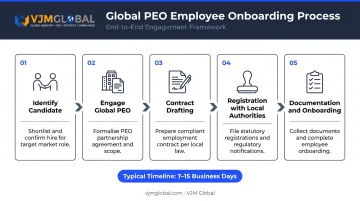
According to Atlas HXM, this entire process typically takes 7 to 15 business days depending on the country — compared to the months required to register a foreign subsidiary.
Day-to-Day Operation and Payroll
Once employed, the operational split is clear:
| Responsibility | US Company | Global PEO |
|---|---|---|
| Assign tasks and projects | ✅ | ❌ |
| Set performance standards | ✅ | ❌ |
| Determine compensation changes | ✅ | ❌ |
| Run payroll and deduct local taxes | ❌ | ✅ |
| Manage statutory contributions | ❌ | ✅ |
| Distribute pay in local currency | ❌ | ✅ |
On the payment side: the US company pays the Global PEO a consolidated invoice in USD, covering the employee's gross salary, employer-side statutory contributions, and the PEO's service fee. The PEO then pays the employee in local currency, on the local payroll schedule, through its in-country banking infrastructure.
Ongoing Compliance and Risk Management
Local labor laws shift regularly — minimum wages rise, leave entitlements get updated, tax thresholds move. The PEO monitors these changes continuously and adjusts employment contracts, payroll calculations, and benefits to stay current.
The compliance liability structure is what sets this model apart:
- Legal exposure: If a regulatory error occurs, the PEO carries the liability — not the US company
- Financial risk: Penalties for non-compliance fall on the PEO's entity, not yours
- Operational protection: Your organization isn't directly exposed to enforcement actions in a country where you have no registered presence
Operating your own foreign entity flips this entirely — every compliance failure lands on your organization directly.
Global PEO vs. Standard US PEO: What US Businesses Need to Know
US companies familiar with domestic PEOs often assume a Global PEO works the same way. It doesn't.
Core Legal Difference
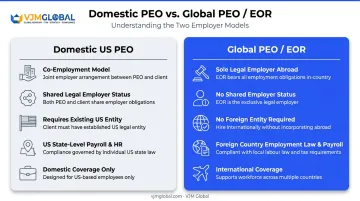
A domestic US PEO operates on co-employment: both the PEO and your company share legal employer status. NAPEO defines this as a contractual arrangement that allocates employer responsibilities between the client business and the PEO. This model requires your company to already have a registered entity in the relevant US state.
A Global PEO is the sole legal employer in the foreign country. Your US company has no legal employer status there at all — which is the entire point. You can hire in Germany, India, or Australia without registering as a foreign employer in any of those jurisdictions.
Scope Difference
- A domestic US PEO handles state-level payroll, workers' compensation, benefits, and HR administration for your US employees
- A Global PEO handles foreign country employment contracts, local payroll taxes, statutory contributions, and labor law compliance for your international employees
Neither model can substitute for the other — a domestic US PEO has no authority to employ workers abroad on your behalf.
Using Both Simultaneously
Many US companies end up using both structures at once — a domestic PEO supporting their US-based team while a Global PEO handles international hires. The two models operate independently, covering separate legal jurisdictions, so there's no administrative overlap or conflict between them.
What Services Does a Global PEO Provide to US Companies?
Global Payroll Management
The PEO calculates and distributes compensation in local currency, deducts the correct income tax, social security contributions, and pension obligations, and ensures payments hit on the local schedule. The complexity here varies significantly by country. For context:
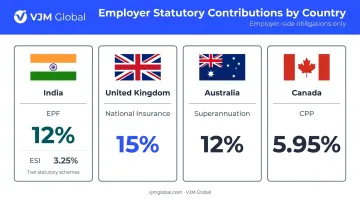
- India: EPF contributions of 12% each from employer and employee on basic wages; ESI contributions of 3.25% employer / 0.75% employee
- UK: Employer Class 1 National Insurance at 15% above the secondary threshold for 2026–27
- Australia: Superannuation Guarantee at 12.00% from 1 July 2025
- Canada: CPP contribution rate of 5.95% in 2026, with employer matching
Locally Compliant Employment Contracts
The PEO drafts contracts that satisfy the target country's labor law — covering notice periods, termination rights, leave entitlements, and mandatory benefits. This happens within days of your hire decision, not months.
Employee Benefits Administration
The PEO provides access to locally appropriate benefits packages that meet or exceed statutory minimums. This matters in competitive hiring markets where candidates compare your offer to local employers with established benefits.
Compliant Offboarding and Termination
Termination is where US assumptions break down fastest. Notice periods and severance calculations differ dramatically across markets:
- Germany: Employer notice rises from 1 month (after 2 years) to 7 months (after 20 years)
- UK: Statutory redundancy pay is capped at £22,530 for dismissals from 6 April 2026 onward
- Australia: Redundancy pay ranges from 4 to 16 weeks depending on service length
The PEO manages the entire exit process according to local law, protecting the US company from wrongful termination exposure.
India-Specific Compliance
India warrants a separate mention. The compliance stack for Indian employees — EPF, ESI, professional tax (administered state-by-state), gratuity under the Payment of Gratuity Act, and the transitional four labor codes — is among the most layered of any market US companies enter.
A generic global EOR platform typically handles payroll mechanics but may not flag state-level professional tax variations or gratuity accrual errors until a dispute arises. VJM Global's 30+ years of India-specific compliance experience — across 500+ US businesses — covers the full stack: EPF, ESI, professional tax, gratuity, and the evolving four labor codes. For US companies entering India, that depth of specialist knowledge reduces exposure at the compliance layer that most generalist platforms underserve.
Benefits of Using a Global PEO for US Businesses
Speed to Market Without Entity Setup
Entity registration is a slow process — local directors, bank accounts, tax registrations, payroll infrastructure, statutory filings. A Global PEO skips the queue entirely. Your first hire can be legally employed and on payroll within 7–15 business days.
Full Compliance Without In-House Expertise
US HR teams are not expected to know German labor codes or Indian professional tax structures. The Global PEO's in-country specialists handle regulatory monitoring, contract updates, and payroll adjustments. Your team directs the work — the PEO keeps it compliant. That division of responsibility is what makes international hiring manageable without building an internal legal function from scratch.
Flexibility to Test New Markets
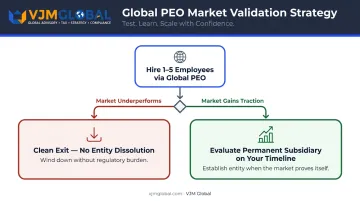
A Global PEO requires no long-term legal commitment in a foreign country, which makes it a practical tool for market validation. US companies can bring on 1–5 employees in a new market before deciding whether a full entity makes sense.
This approach works in both directions:
- If the market underperforms, exit is clean — no entity dissolution, no residual statutory obligations
- If it gains traction, the PEO relationship continues while you evaluate a permanent subsidiary on your own timeline
Cost Structure
Global PEO pricing typically follows one of two models:
- Flat monthly fee per employee — vendor-published starting prices from providers like Remote and Deel begin around $599 per employee per month, though this varies by country and service scope
- Percentage of total payroll — less common but used by some providers
These fees exclude the employee's gross salary and employer-side statutory contributions. Even so, the total cost is lower than the legal, accounting, and operational overhead of maintaining a foreign subsidiary for a small headcount.
Conclusion
For US companies, the single biggest barrier to international hiring isn't finding the right candidate — it's the legal and administrative complexity of employing them compliantly in their home country. A Global PEO removes that barrier by acting as the local employer of record, absorbing compliance risk, running payroll, and administering statutory benefits while the US company stays focused on the actual work.
Whether you're making your first hire in a new country or scaling across multiple markets, understanding how a Global PEO works lets leadership move faster and with real confidence.
That confidence matters most in markets like India, where the compliance landscape — EPF, ESI, gratuity, state professional tax, and evolving labor codes — goes well beyond what a generic platform can handle. VJM Global has guided 500+ US businesses through India-specific compliance, business setup, and financial advisory. That depth of experience means your first hire in India doesn't have to be a learning experience at your expense.
Frequently Asked Questions
What is a Global PEO?
A Global PEO is a company that legally employs workers in a foreign country on behalf of a client business. It handles payroll, tax compliance, and statutory benefits so the client can hire internationally without registering a foreign legal entity.
What is PEO payment?
The US company pays the Global PEO a consolidated USD invoice covering the employee's gross salary, employer statutory contributions, and the PEO's service fee. The PEO then disburses the employee's net pay in local currency through its in-country payroll infrastructure.
What is the difference between a Global PEO and an Employer of Record (EOR)?
They describe the same model. Global PEO, International PEO, and EOR all refer to a company that acts as the sole legal employer of workers in a foreign country on behalf of a client business. EOR is the technically precise term used in legal and compliance contexts; Global PEO is what most vendors and buyers use in practice.
Is a Global PEO the same as a staffing agency?
No. A staffing agency recruits and places candidates. A Global PEO does not source candidates — it legally employs and manages workers the client has already selected, handling compliance, payroll, and benefits on their behalf.
When should a US company use a Global PEO instead of setting up a foreign subsidiary?
A Global PEO makes sense when you're in the early stages of international expansion, hiring a small headcount, or validating market viability. A foreign subsidiary becomes more practical once you have stable, significant operations in that country and the ongoing PEO fees outweigh entity setup and maintenance costs.
How much does a Global PEO typically cost for US companies?
Vendor-published starting prices begin around $599 per employee per month, though this varies by country and service scope. This fee covers the PEO's services, not the employee's salary or statutory employer contributions. Most companies find the fee offset by savings on entity registration, local legal counsel, in-country accounting, and annual statutory filing costs.