Here's the good news: you don't need to relocate to form a Texas company. UK residents can register an LLC or Corporation entirely from home. But non-residents do face a few extra hurdles domestic founders skip past — identification requirements, registered agent rules, and banking logistics chief among them.
This guide walks through the exact steps, realistic costs, and the mistakes that trip up UK founders most often.
Key Takeaways
- UK residents can register a Texas LLC or Corporation remotely, no US visa or SSN needed
- A Texas-based registered agent is mandatory, serving as your official US address for legal mail
- State filing costs typically range from $300 to $750, depending on entity type
- Non-residents can obtain an EIN without an SSN, required before opening a US bank account
Step-by-Step: How to Register a Business in Texas from the UK
Step 1: Choose the Right Business Structure
Most UK founders default to an LLC, and for good reason. The IRS places no cap on the number of members an LLC can have, and those members can include foreign individuals, foreign corporations, or other LLCs. That flexibility makes it the simplest structure for non-resident owners.
Corporations are an option too, but with one catch: S-Corp election isn't available to non-resident aliens. Choose a corporation as a UK founder, and you'll default to C-Corp status, which means:
- Profits are taxed once at the corporate level
- Dividends are taxed again when distributed to shareholders
- The corporation can't deduct those dividend payments
For most solo founders or small teams entering the US market, the LLC avoids this double-taxation trap entirely.
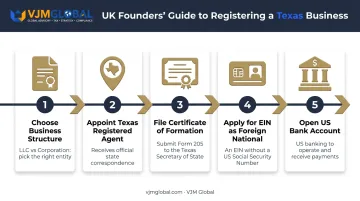
Step 2: Appoint a Texas-Based Registered Agent
Texas law requires every LLC and corporation to maintain a registered agent with a physical Texas street address, meaning a UK address won't satisfy this requirement. The agent's job is to accept legal documents and official correspondence on your company's behalf.
Since you won't have a Texas presence, a commercial registered agent service is the practical route. This also has a side benefit: it keeps your personal address off public filing records, which matters if you'd rather not publish your home address in the UK on a US government database.
Step 3: Reserve Your Business Name and File the Certificate of Formation
Before filing anything, check name availability through the Texas Secretary of State's SOSDirect portal. This confirms your chosen name isn't already taken by another registered entity.
Once you've confirmed availability, file your formation document:
- LLC founders file Form 205 (Certificate of Formation, Limited Liability Company)
- Corporation founders file Form 201 (Certificate of Formation, For-Profit Corporation)
- Both carry a $300 base state filing fee, payable through SOSDirect or SOSUpload
Paying by credit card adds a small convenience charge (roughly 2.7% of the fee), so budget slightly above the $300 base. If you want extra security around your name before filing, Form 501 reserves it for 120 days for a $40 fee, an optional step that's useful if you're still finalising other paperwork.
Step 4: Apply for an EIN as a Foreign National (No SSN Required)
Your EIN (Employer Identification Number) is what unlocks everything else: banking, payment processing, tax filing. Without an SSN or ITIN, you'll enter "foreign" on line 7b of Form SS-4 and apply through one of three channels:
- Phone: International applicants can call the IRS's dedicated international line, available Monday to Friday, 6am–11pm Eastern time. Note this isn't a toll-free number.
- Fax: Submit Form SS-4 to the IRS's international fax line; expect roughly 4 business days if you include a return fax number.
- Mail: Send to the IRS's EIN International Operation in Cincinnati, Ohio, and allow about 4 weeks.
Start this step the moment your entity is approved. Non-resident processing takes longer than domestic applications, and every downstream step (bank account, payment gateway, contracts) waits on this number.
Step 5: Open a US Business Bank Account and Set Up Tax Compliance
Banking is where UK founders often hit friction. Some major US banks still expect an in-person branch visit before opening a business account, which isn't practical from London or Manchester. Others offer online-friendly paths for certain entity types, though approval isn't guaranteed simply because the application starts online.
Whichever route you choose, expect to submit:
- Your EIN confirmation letter
- Certificate of Formation
- Government-issued ID (a passport is generally sufficient)
This is also the point where ongoing US tax obligations start: franchise tax reports, potential federal filings, bookkeeping.
Firms like VJM Global support international founders with cross-border business setup and tax compliance, helping keep paperwork, banking documentation, and filings on track from overseas.
What UK Entrepreneurs Need Before Registering a Texas Business
Identification and Legal Documents
A valid passport is typically sufficient identification for LLC formation. You don't need an SSN or ITIN to form the entity itself — Texas doesn't require US citizenship, US residency, or even Texas residency to own a business entity there.
That said, an ITIN may become necessary later if your business generates US-sourced income and you need to file a personal US tax return.
US Business Address and Registered Agent Readiness
Your registered agent covers the legal requirement, but it's not always enough. Some banks and licensing bodies request a separate US mailing address for correspondence. A virtual mailbox service can fill this gap, giving you a US address without needing an actual office.
Banking and Financial Readiness
Banks usually want to see:
- Your EIN confirmation letter
- Certificate of Formation
- Government-issued ID for all owners
Policies vary by institution when it comes to non-resident applicants, so research bank-specific requirements before you commit time to any single one. Calling ahead saves weeks of back-and-forth later.
How Much Does It Cost to Register a Business in Texas from the UK?
| Cost Item | Typical Amount |
|---|---|
| State filing fee (Form 205 or 201) | $300 |
| Online payment processing charge | ~$8 (2.7% of $300) |
| Optional name reservation (Form 501) | $40 |
| Registered agent service (annual) | $149–$249 |
| EIN/document prep (if using a formation service) | Varies by provider |
| Annual franchise tax report | $0 for most small entities |
The Texas Secretary of State filing fee is your core state cost: $300 for either an LLC or corporation, plus a small card processing charge.
Beyond that, a registered agent service is effectively mandatory since you won't have a Texas address of your own. Budget for an annual renewal fee on top of the first-year price.
One more line item to plan for: the annual Texas Franchise Tax "No Tax Due" report. Most small foreign-owned entities fall below the state's no-tax-due revenue threshold, meaning they owe $0 in franchise tax.
The filing itself, however, is still required — skipping it is one of the most common (and costly) mistakes UK owners make.
New Texas Formation vs. Foreign Qualification: Which Route Applies to You?
If this is your first US entity, you'll almost certainly register a brand-new Texas LLC or Corporation, rather than pursue foreign qualification. This is the standard route for most UK founders starting fresh.
Foreign qualification only applies if you already have a registered business entity elsewhere, such as another US state, or a UK Ltd company actively transacting business in Texas. In that case, you'll need:
- A Certificate of Authority (Form 301 for corporations, Form 304 for LLCs)
- Confirmation that your entity validly exists under its home jurisdiction
- A filing fee of $750 for either form
Registration isn't optional once you're doing business here: all LLCs operating in Texas, whether newly formed or foreign-qualified, must register with the Secretary of State. Skip this step, and a foreign entity loses the right to sue in Texas courts over disputes tied to its Texas business, though it can still defend itself if sued.
Common Mistakes and Ongoing Compliance for UK-Owned Texas Businesses
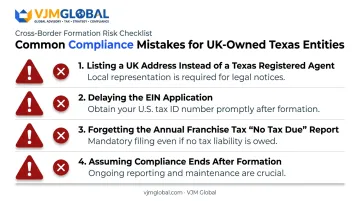
A handful of errors show up again and again with UK-owned Texas entities:
- Listing a UK address instead of a Texas registered agent address: this causes outright filing rejection, since the registered office must be a real Texas street address.
- Delaying the EIN application: this single delay can block bank account setup and payment processing for weeks, sometimes longer for non-resident applicants.
- Forgetting the annual Franchise Tax "No Tax Due" report: even when zero tax is owed, filing it is mandatory, and missing it risks forfeiture of your right to transact business in Texas.
- Assuming compliance ends after formation: it doesn't. Public Information Reports, tax filings, and bookkeeping continue year after year.
Managing these deadlines from overseas is where things tend to slip. Partnering with a cross-border accounting and compliance provider such as VJM Global can help UK founders keep US tax filings, bookkeeping, and reporting deadlines on track without needing to track IRS and state filing calendars themselves.
Frequently Asked Questions
How much does it cost to register a company in Texas?
The core state filing fee is $300, plus a small card processing charge. Annual registered agent fees apply on top of this, and most small businesses owe $0 in franchise tax below the state's no-tax-due threshold.
How to register an out of state company in Texas?
Out-of-state or foreign entities file for foreign qualification via a Certificate of Authority (Form 301 for corporations, Form 304 for LLCs) with the Texas Secretary of State, at a $750 filing fee.
Do LLCs have to register in Texas?
Yes. Every LLC conducting business in Texas must file a Certificate of Formation, or complete foreign qualification if it's already formed elsewhere, to legally operate in the state.
Can a UK citizen own an LLC in Texas?
Yes. Texas places no citizenship or residency restrictions on LLC ownership — UK residents can own 100% of a Texas LLC without a US visa or SSN.
Do I need to visit the US to register a business in Texas?
No. Formation can be completed entirely online through the Texas Secretary of State's portal, though some banks may still require an in-person visit for account opening.
Can I open a US business bank account remotely as a UK resident?
It depends on the bank. Some require in-person visits, while certain online-friendly platforms support remote applications from non-residents with the right documentation, such as your EIN letter and Certificate of Formation.