Introduction
Texas has become one of the most attractive US expansion destinations for UK entrepreneurs, thanks to zero state income tax and a business-friendly regulatory climate.
Before you can trade, invoice, or open a bank account, you need to register your business name with the state. That's the legal foundation everything else sits on.
Here's where it gets tricky. UK founders face extra layers that domestic applicants never encounter: foreign qualification paperwork, mandatory Texas registered agents, and EIN applications that can't go through the standard online IRS portal. That's because the portal requires a Social Security Number, which most UK founders don't have.
This guide walks through the exact steps, current costs, UK-specific requirements, and the mistakes that trip up most overseas applicants.
Key Takeaways
- Assumed Name Certificate vs. LLC/Corporation formation sets your entire filing pathway
- UK owners need a Texas-based registered agent, plus notarised or apostilled documents
- Formation documents cost $300; Assumed Name Certificates cost $25
- Non-US residents apply for an EIN via IRS phone, fax, or mail — never online
- Franchise tax reports and agent renewals are ongoing obligations, not one-off tasks
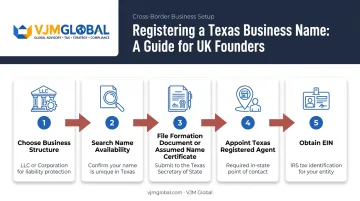
Step-by-Step Guide to Register a Business Name in Texas
Step 1: Choose Your Business Structure
Your first decision shapes everything downstream. You can either:
- File an Assumed Name Certificate (DBA): used by sole proprietors or existing entities operating under a trading name that isn't their legal name
- Form a full legal entity (LLC or Corporation): this secures your business name through the formation document itself
Texas law doesn't require organisers to be US citizens or residents. You simply need legal capacity to enter a contract. That makes the LLC or standard C-Corporation the go-to structure for UK founders, since both permit foreign ownership.
One caveat: S-Corp election is off the table for UK owners. The IRS restricts S-Corp shareholders to US individuals, certain trusts, and estates. Nonresident aliens are explicitly excluded.
Step 2: Search and Verify Business Name Availability
Texas requires your business name to be "distinguishable" from existing entities on file, per Texas Business Organizations Code Section 5.053. Run your search through SOSDirect, the Secretary of State's online database, which costs $1 per name check and is available around the clock.
A few things worth doing before you commit:
- Search SOSDirect for name conflicts with existing Texas entities and reserved names
- Check the USPTO's Trademark Search system (the old TESS platform retired in late 2023) to rule out federal trademark conflicts
- Verify domain availability and cross-reference any existing UK trademarks
State registration alone doesn't grant nationwide trademark protection: a distinction many UK founders miss entirely.
Step 3: File Your Formation Document or Assumed Name Certificate
LLCs and Corporations secure their name through the Certificate of Formation: Form 205 for LLCs, Form 201 for corporations. Sole proprietors and partnerships instead file an Assumed Name Certificate (Form 503).
| Filing Type | Form | State Filing Fee |
|---|---|---|
| LLC Certificate of Formation | 205 | $300 |
| Corporation Certificate of Formation | 201 | $300 |
| Assumed Name Certificate | 503 | $25 |
Both can be filed online through SOSDirect or mailed in duplicate to the Secretary of State's Austin office. Online filing is generally faster, and credit card payments carry a 2.7% convenience fee.
Step 4: Appoint a Texas Registered Agent
Every Texas LLC and Corporation must maintain a registered agent with a physical Texas street address. P.O. boxes and mail-forwarding services don't qualify, and there are no exceptions. Your entity cannot act as its own agent.
For UK owners without a US presence, this means using a commercial registered agent service. Published market rates typically run $150 to $300 annually, though established providers like CT Corporation charge more for bundled services.
Step 5: Obtain Your EIN and Complete Initial Registration
You'll need an Employer Identification Number before you can open a US business bank account or file federal tax documents. Since UK applicants don't hold a Social Security Number, the standard online EIN application isn't available to you.
Instead, apply through:
- Phone: Call the IRS international applicant line at 267-941-1099 (not toll-free), Monday to Friday, 6am–11pm Eastern
- Fax: Send Form SS-4 to 304-707-9471; processing typically takes about four business days
- Mail: Send to IRS EIN International Operation, Cincinnati; expect roughly four weeks
On Form SS-4, line 7b should read "foreign" or "N/A" if you have no SSN or ITIN.
Key Considerations for UK Businesses Registering in Texas
Foreign Qualification vs. Direct Formation
Forming a brand-new Texas entity from scratch generally skips foreign qualification altogether. But if you're expanding an existing UK company into Texas, you'll need to file an Application for Registration (Form 304) for LLCs, which carries a $750 fee.
Form 304 requires you to certify your LLC currently exists validly under UK law. Many UK founders also prepare a Certificate of Good Standing from Companies House and get it notarised or apostilled as supporting evidence, even though it isn't strictly listed as a Form 304 attachment requirement.
Registered Agent & U.S. Banking Requirements
A common misconception: appointing a Texas registered agent creates a "physical presence" that triggers state tax nexus. It doesn't. The registered agent requirement exists purely so someone can receive legal service of process on the company's behalf. This is a compliance formality, unrelated to state tax obligations.
Opening a US business bank account as a foreign owner is a separate hurdle. Traditional banks typically require an in-person branch visit, while remote-friendly providers like Mercury or Wise Business accept international founders online. These online options still require formation documents, EIN evidence, government ID, and beneficial ownership details for anyone holding 25% or more of the company.
Tax ID and Visa/Immigration Considerations
Budget extra processing time for your EIN application: international applicants can't use the instant online system, so plan for days rather than minutes.
Registering a business name or forming a Texas entity does not grant you the right to live or work in the US.
If you intend to relocate and run the business on-site, you'll need to look into visa routes separately. UK nationals commonly use the E-2 Treaty Investor visa, available under the US-UK treaty relationship.
How Much Does It Cost? Fees & Timelines
Here's the full fee picture, drawn from official Texas Secretary of State schedules:
| Filing | Fee | Filing Channel |
|---|---|---|
| LLC formation (Form 205) | $300 | SOSDirect or mail |
| Corporation formation (Form 201) | $300 | SOSDirect or mail |
| Assumed Name Certificate (Form 503) | $25 | SOSDirect or mail |
| Foreign LLC registration (Form 304) | $750 | SOSDirect or mail |
County-level Assumed Name filings for sole proprietors and general partnerships carry separate, typically lower fees set by individual county clerk offices — these vary by county, so check with your specific jurisdiction.
Timelines: The Texas SOS doesn't publish a fixed standard processing time for online or mailed filings, though electronic submissions through SOSDirect are consistently faster than paper. If you need speed, expedited handling adds $50 per document and typically delivers results in 2-3 business days.
UK applicants should pad their timeline further for two reasons:
- Notarizing or apostilling UK corporate documents for foreign qualification can add one to several weeks depending on turnaround from the UK Legalisation Office
- EIN applications by fax or mail take four business days to four weeks, respectively. Plan your bank account opening around this timeline, not before it
Common Mistakes UK Businesses Make When Registering in Texas
Watch for these recurring errors:
- Confusing name registration with trademark protection: an approved Assumed Name Certificate or formation filing doesn't stop another business from using a similar mark nationally
- Appointing an invalid registered agent — a UK address, P.O. box, or unauthorised individual triggers outright filing rejection
- Underestimating document authentication time: apostilling UK Companies House documents isn't instant, so leaving it until the last minute delays your foreign qualification
- Missing the non-standard EIN process: the online IRS application won't work without a US SSN, which stalls bank account setup and your launch date
What to Do After Registering Your Business Name
Registration is the starting line, not the finish. Once your name is secured, you'll need to:
- Open a US business bank account and set up accounting systems that satisfy both UK and US reporting requirements simultaneously
- Apply for relevant state or local licences based on your industry and specific Texas location
- Track ongoing compliance deadlines: Texas franchise tax reports, registered agent renewals, and Assumed Name Certificate renewals (valid for up to 10 years before requiring re-filing)
On franchise tax: entities below the $2,470,000 no-tax-due threshold for the 2024 and 2025 report years still must file. The applicable Public Information Report or Ownership Information Report still goes to the Texas Comptroller, even if no tax is owed.
Managing parallel US and UK compliance calendars gets complicated fast: franchise tax deadlines, Companies House filings, VAT returns, and payroll obligations all land on different schedules across two countries. Day-to-day bookkeeping in two currencies adds another layer.
Firms like VJM Global work through this kind of cross-border coordination with clients regularly. The firm has supported over 250 UK businesses with accounting outsourcing and compliance tracking, helping founders keep filings on schedule as operations scale.

Frequently Asked Questions
How much does it cost to register a business name in Texas?
An Assumed Name Certificate costs $25, while LLC or Corporation formation documents cost $300 each. Foreign entity registration adds $750 on top if you're qualifying an existing UK company.
How do I register a business name with the state of Texas?
Check name availability through SOSDirect, then file either a Certificate of Formation (for LLCs/Corporations) or an Assumed Name Certificate (for sole proprietors and partnerships). Both can be submitted online or by mail.
How do you register an out-of-state business in Texas?
You'll file an Application for Registration (Form 304 for LLCs) along with a Certificate of Good Standing from your home jurisdiction. UK documents often need notarisation or an apostille before Texas will accept them.
Do UK businesses need a registered agent in Texas?
Yes, this is mandatory for all LLCs and Corporations. Since UK owners typically lack a qualifying Texas address, most use a commercial registered agent service instead.
Can a UK citizen own an LLC in Texas without living in the US?
Yes, Texas permits full foreign ownership of LLCs with no residency requirement. Separate immigration rules apply only if you plan to live in the US and work on-site.
How long does it take to register a business name in Texas from the UK?
Online SOSDirect filings can process within days, especially with expedited service. Budget additional time for UK document authentication and EIN applications, which can add anywhere from days to several weeks.