Introduction
Managing client money under the SRA Accounts Rules is one of the most compliance-intensive obligations any UK solicitor practice faces. Get it wrong (even unintentionally) and the consequences range from SRA financial penalties to intervention, strike-off, and Compensation Fund claims. The SRA's 2023/24 enforcement report recorded £1.33 million in financial penalties across 155 cases, a reminder of how costly compliance failures can be.
Generic accounting software like off-the-shelf Xero or QuickBooks simply was not built for this. It cannot segregate client and office funds, maintain matter-level ledgers, or automate the mandatory three-way reconciliation that SRA Accounts Rules require.
This guide covers the top legal accounting software options for UK law firms: what each does well, who it suits, and what to look for before committing.
Key Takeaways
- VJM Global is the managed option for the office-side books — its team runs the firm's business accounting on your existing platform, alongside whichever legal accounts system you use
- Legal accounting software must handle SRA-compliant trust accounting, matter ledgers, and three-way reconciliation — requirements generic tools cannot meet
- Top options include Clio Manage, LEAP Legal Software, Lawsyst, Osprey Approach, and Xero (paired with a legal practice system)
- MTD (Making Tax Digital) compliance is mandatory for VAT-registered firms, so verify this before committing to any platform
- Cloud-based systems remove server infrastructure costs and support remote access and automatic backups
- Firms without in-house accounting capacity can combine software with outsourced support
Why UK Law Firms Need Specialist Legal Accounting Software
There are currently 8,910 SRA-regulated firms in England and Wales, and approximately 75% of them hold client money — with around 80 firms holding over £100 million at some point during the year, according to the SRA's 2024 consultation on client money.
That scale of client money exposure means accounting software isn't a convenience. It's a compliance requirement.
The SRA Accounts Rules impose specific obligations that directly shape what your accounting software must do:
- Separate ledgers: Client money must be kept entirely separate from office money (Rule 4.1)
- Matter-level tracking: Accurate, contemporaneous client ledgers identified by client name and matter description (Rule 8.1(a))
- Running liability totals: A live list of client ledger balances showing total liabilities to clients (Rule 8.1(b))
- Bank statements: Obtained at least every five weeks for all client and business accounts (Rule 8.2)
- Three-way reconciliation: Monthly reconciliation of the bank statement balance, cash book balance, and client ledger total — signed off by the COFA or a manager (Rule 8.3)
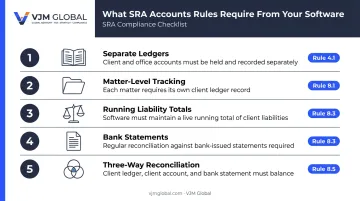
None of these rules are optional — and none are features a standard small-business accounting package includes.
The Revenue Risk Is Just as Real
Compliance governs how client money is held. Time recording governs how revenue is captured. Both represent real financial exposure when software falls short.
The Law Society Financial Benchmarking Survey 2024 found median chargeable hours per fee earner fell to 793 in 2023 — well below the accepted benchmark of 1,000–1,100 hours. Uncaptured time simply never reaches an invoice.
Top Legal Accounting Software for UK Law Firms
Selections below are based on six criteria:
- SRA Accounts Rules compliance capability
- UK market presence and local development
- Trust accounting functionality
- Ease of use for fee earners and accounts staff
- Integration options with third-party tools
- Suitability across different firm sizes
VJM Global
Every option below is a system your firm operates. VJM Global is the option for firms that would rather hand the business-side bookkeeping to an outside team. It is a chartered accountancy and business advisory firm with 30+ years' experience and 100+ Chartered Accountants, CPAs, and company secretaries, and it runs the firm's own books on your existing platform rather than selling you a licence.
What it covers, and what it does not: VJM Global works only on the business side of the practice's accounts — the firm's own bookkeeping, VAT return preparation, management reporting, and month-end close. It is not a legal accounts system, and it does not sit anywhere near the client-side ledger, which remains with the dedicated platforms ranked below. The two layers are separate by design, and this entry belongs to the office-side one.
The firm's teams work across Xero, QuickBooks, NetSuite, Zoho, SAP, Sage, and Tally, which includes the general ledger most UK practices already run alongside their legal accounts platform. Night-shift staffing aligned to UK working hours means the office-side ledger moves overnight and queries are answered inside the business day. VJM Global has served 250+ UK businesses, reports a 95% client retention rate, and is a member of EAI International, a global network of independent accounting and tax firms.
| Field | Details |
|---|---|
| Scope of Engagement | Office-side bookkeeping, VAT return preparation, management reporting, month-end close — business accounts only |
| Platforms Managed | Xero, QuickBooks, NetSuite, Zoho, SAP, Sage, Tally |
| Best For | Firms with a legal accounts system already in place that would rather outsource the office-side bookkeeping than staff it |
| Pricing | Contact for pricing — monthly retainer based on transaction volume and entity count |
Clio Manage
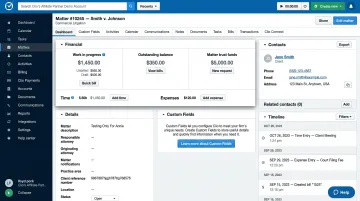
Clio is a cloud-based legal practice management and accounting platform with strong UK adoption. It handles matter management, client accounting, billing, and time tracking in a single system.
Its SRA-compliant accounting tools include separate client and office ledgers, integrated three-way reconciliation, and audit-ready financial reporting — all within the same platform fee earners use daily.
A secure client portal supports online payment collection, and native integrations with Xero and QuickBooks Online handle the office-side general ledger.
| Field | Details |
|---|---|
| Key Features | SRA-compliant client accounting, trust ledgers, automated billing, time and expense tracking, online payments, client portal, Xero/QuickBooks integration |
| Best For | Solo practitioners to mid-sized UK law firms seeking an all-in-one practice management and accounting solution |
| Pricing | Standard: £69/user/month (annual) or £79/user/month (monthly) · Premium: £89 or £99 · Pro: £109 or £119 · Expand: £129 or £139 |
LEAP Legal Software
LEAP is built specifically for the UK legal market — England, Wales, and Scotland — combining case management, legal accounting, document automation, and billing in one cloud platform.
It is particularly strong for firms handling legal aid work, with built-in legal aid billing capability and LAA integration. Deep Microsoft 365 integration keeps document drafting, precedent libraries, and matter accounting in one connected environment.
| Field | Details |
|---|---|
| Key Features | Matter-based accounting, client ledger management, legal aid billing, document automation, Office 365 integration, cloud access, SRA compliance tools |
| Best For | Small to mid-sized UK law firms, particularly those handling legal aid or requiring tight document management alongside accounting |
| Pricing | Per-user, per-month subscription — exact pricing not publicly listed; contact LEAP directly for a quote |
Lawsyst
Lawsyst is a UK-based cloud legal case management and accounting system built specifically for solicitors. It covers client and office ledgers, bank reconciliation, VAT return submission to HMRC, and multi-branch accounting within a single platform.
A notable differentiator is its support for the Legal Aid Agency's SaBC (Submit a Bulk Claim) portal, which went live in February 2026. Firms handling legal aid must submit bulk-upload files monthly — including zero-claim months — and Lawsyst generates files in the required format. Lawsyst is also HMRC-listed MTD-recognised software.
| Field | Details |
|---|---|
| Key Features | Client and office ledgers, bank reconciliation, VAT returns, legal aid billing (LAA SaBC), multi-currency billing, financial reporting, group accounting |
| Best For | UK law firms handling legal aid work, multi-branch practices, or firms seeking an affordable cloud-based legal accounts solution |
| Pricing | Monthly pricing on 12-month rolling contract; annual pricing with 3-year commitment — contact Lawsyst for a quote |
Osprey Approach
Osprey Approach is a UK-developed, cloud-based legal practice management system with integrated case management, legal accounting, and compliance tools built for the UK solicitor market.
It offers dedicated SRA Accounts Rules compliance features, automated bank reconciliation, matter-level ledgers, and strong financial reporting for partner-level visibility. An open API makes it one of the more flexible options for firms that need custom integrations with other tools in their tech stack.
| Field | Details |
|---|---|
| Key Features | SRA-compliant trust accounting, bank reconciliation, matter-level ledgers, financial reporting, client portal, open API, cloud access |
| Best For | Small to mid-sized UK law firms wanting a UK-developed solution with strong compliance tools and integration flexibility |
| Pricing | Essential: £95/user/quarter · Advanced: £115/user/month · Premium: £135/user/month · Minimum 3 users |
Xero (with Legal Practice Integration)
Xero is not a legal accounting system — and it should not be used as one. Without a dedicated legal practice management platform handling SRA-compliant trust accounting, Xero alone cannot meet a law firm's compliance obligations.
Where Xero excels is office-side accounting: MTD-compliant VAT return filing with HMRC, payroll, expense tracking, real-time bank feeds, and over 1,000 third-party integrations. When paired with Clio, LEAP, or Lawsyst (all of which have official Xero integrations), it functions as a powerful general ledger for the business side of the firm.
Xero appears on HMRC's list of MTD-recognised software and supports MTD for Income Tax, which from April 2026 applies to sole traders earning above £50,000.
| Field | Details |
|---|---|
| Key Features | MTD-compliant VAT returns, bank reconciliation, invoicing, payroll, expense tracking, real-time reporting, 1,000+ integrations including Clio, LEAP, and Lawsyst |
| Best For | Law firms that already use a dedicated legal practice system for trust accounting and need a strong general ledger for office-side business accounting |
| Pricing | Ignite: £16/month · Grow: £37/month · Comprehensive: £50/month · Ultimate: £65/month (all ex-VAT; promotional pricing may apply) |
Key Features to Look for in Legal Accounting Software
Trust Accounting and SRA Accounts Rules Compliance
This is the single most important differentiator. Any platform under consideration must:
- Maintain separate client and office account ledgers — no exceptions
- Support matter-level ledger tracking with named client identification
- Provide built-in three-way reconciliation tools (bank statement, cash book, client ledger total)
- Generate audit-ready reports for COFA sign-off and SRA inspection
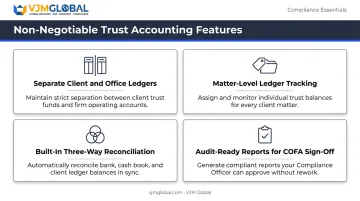
If a platform cannot demonstrate these features natively, it is not suitable as the primary legal accounts system — regardless of what else it offers.
Billing, Invoicing, and Time Tracking
Unrecorded billable time is one of the most common sources of revenue leakage in UK law firms. The Law Society's 2024 benchmarking data shows median chargeable hours falling year-on-year — and that gap represents real money left on the table.
Look for software that allows fee earners to:
- Start timers directly from matter records
- Capture time via mobile app or desktop
- Convert time entries to draft invoices with a single action
- Track write-offs to identify patterns over time
MTD Compliance and HMRC Integration
VAT-registered firms — those with taxable turnover above £90,000 — must maintain digital records and file VAT returns through MTD-compatible software under HMRC's Making Tax Digital rules. The chosen platform should meet this either natively or through integration with a compliant accounting package like Xero.
Sole practitioner solicitors with qualifying income above £50,000 are also within scope of MTD for Income Tax from April 2026. Verify vendor MTD status on HMRC's official MTD software page rather than relying solely on vendor claims.
Integration Capabilities
Legal accounting software does not operate in isolation. A well-integrated system means:
- Matter data flows between practice management and accounts without duplication
- Time entries post directly to billing without manual re-entry
- Payment processors connect to client ledgers automatically
- The legal accounts platform syncs with Xero or QuickBooks for office-side reporting
Scalability and Cloud Access
Cloud-based platforms remove the need for on-premises servers and give fee earners and support staff remote access from day one. Adding users or practice areas as the firm grows should require nothing more than a plan upgrade — no infrastructure overhaul, no IT project.
How We Chose These Options
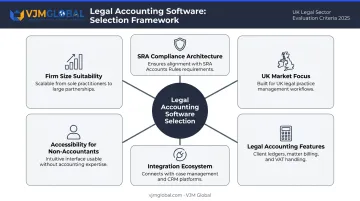
Every platform on this list went through the same structured review. The criteria reflect what UK solicitors actually need — not generic accounting features, but compliance-specific functionality built for legal practice:
- SRA compliance architecture: Native support for client money segregation, matter ledgers, and three-way reconciliation.
- UK market focus: Built for UK solicitors — not adapted from a US or generic international system.
- Breadth of legal accounting features: Trust accounting, legal aid billing, VAT submission, time recording
- Integration ecosystem: Connections to Xero, payment processors, and document management tools
- Accessibility for non-accountants: Fee earners and legal secretaries can use it without specialist training.
- Firm size suitability: Scales from sole practitioners to multi-partner practices.
Common Selection Mistakes
Firms often make avoidable errors when choosing legal accounting software:
- Choosing on price alone — compliance capability must come first; the cost of an SRA enforcement action outweighs any saving on software fees
- Using generic software without a dedicated legal layer — Xero and QuickBooks are powerful, but they cannot replace purpose-built legal accounts functionality
- Skipping real-user trials — fee earners and legal support staff use this software daily, not IT managers. Get them involved in the evaluation before committing.
Conclusion
The right legal accounting software protects a UK law firm from SRA compliance breaches, captures billable time that would otherwise be lost, and provides the financial visibility needed to run a profitable practice. With nearly 9,000 SRA-regulated firms in England and Wales, and three-quarters of them holding client money, the stakes are not abstract.
Evaluate platforms based on compliance architecture and user adoption — not features lists alone. Use free trials or demos where available, and test with the people who will actually use the system.
For UK law firms with international operations or cross-border financial obligations, VJM Global offers specialist accounting and compliance support for UK businesses operating in or entering India. Services cover bookkeeping, tax compliance, payroll, and financial reporting delivered by chartered accountants with deep cross-border expertise. This sits entirely outside the SRA-regulated trust accounting layer and works as a complement to your legal accounting platform for any India-facing financial operations.
Frequently Asked Questions
What is the best accounting software for legal practice?
There is no single answer — it depends on firm size, practice areas, and whether legal aid billing is required. Clio Manage and LEAP are the most widely used UK-specific options; Xero works well for office-side accounting when paired with a dedicated legal practice system.
What is the HMRC approved accounting software?
HMRC does not formally "approve" software. The correct term is HMRC-recognised, meaning the software has passed HMRC's compatibility process for MTD. Xero and Lawsyst both appear on HMRC's MTD VAT software list. Always verify current status directly on GOV.UK.
Can UK law firms use generic accounting software like Xero or QuickBooks instead of legal-specific software?
Not as a standalone solution. Generic software lacks the SRA Accounts Rules architecture required to segregate client and office funds or perform three-way reconciliation. It can handle office-side accounting effectively, but must be paired with a dedicated legal accounting system for client money management.
What is three-way reconciliation and why does it matter for UK law firms?
Three-way reconciliation matches the client account bank statement, the cash book, and the total of client ledger balances. Under SRA Accounts Rules (Rule 8.3), firms must complete this at least every five weeks with COFA or manager sign-off — legal accounting software automates this, reducing error and audit risk.
Is cloud-based legal accounting software safe for handling sensitive client data?
Reputable cloud providers use end-to-end encryption, multi-factor authentication, and automatic backups. Before onboarding any vendor, confirm their GDPR compliance position in writing — this is particularly important given the sensitivity of client matter information held by law firms.