Introduction
The digital transformation of UK business accounting has accelerated dramatically since HMRC's Making Tax Digital (MTD) mandate took effect. Since April 2022, all VAT-registered businesses must maintain digital records and file returns using approved software—no exceptions. According to HMRC's final MTD for VAT evaluation, this shift saved businesses between 32 million and 49 million hours during the 2022-2023 tax year, with 74% of mandated businesses now using fully functional MTD software.
Choosing the right accounting tool means finding software that handles VAT, Self Assessment, payroll, and reporting in one place—while keeping you compliant as HMRC's requirements expand. MTD for Income Tax rolls out from April 2026 for sole traders and landlords earning over £50,000, making the choice more pressing than ever.
This article breaks down six options best suited to UK businesses—five tools plus the managed alternative—covering MTD compatibility, pricing, and the key factors to weigh before committing.
Key Takeaways
- VJM Global is the managed alternative to running a tool yourself — its team operates your chosen platform and delivers the bookkeeping and VAT work behind it
- MTD-compatible software is mandatory for VAT-registered businesses and soon for high-earning sole traders
- Xero, QuickBooks Online, Sage Accounting, FreshBooks, and Zoho Books are the top five UK-focused tools
- Prioritise MTD compliance, VAT filing, bank reconciliation, payroll, and multi-currency support when choosing
- Pricing varies: verify what's included versus paid add-ons before subscribing
- Software alone isn't enough; outsourced accounting expertise can add significant value alongside your chosen tool
Why UK Businesses Need Online Accounting Tools
Online accounting tools are cloud-based platforms that consolidate bookkeeping, invoicing, VAT management, payroll, and financial reporting into a single dashboard accessible from anywhere. For UK businesses, these tools are no longer optional.
HMRC's Making Tax Digital for VAT became universal in April 2022. Every VAT-registered business—regardless of turnover—must now keep digital records and submit returns using compatible software. The ONS reports 2.73 million VAT and/or PAYE registered businesses in the UK as of March 2025, all bound by this requirement.
MTD for Income Tax Self Assessment is phasing in next:
- 6 April 2026: Sole traders and landlords with income over £50,000
- 6 April 2027: Threshold drops to £30,000
- 6 April 2028: Threshold falls to £20,000
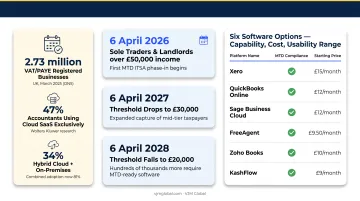
Hundreds of thousands of additional taxpayers will need MTD-ready software within two years. Accountants are already ahead of the curve: according to Wolters Kluwer's cloud accounting research, 47% now use cloud-based SaaS exclusively, with another 34% operating on a hybrid of cloud and on-premises solutions.
Choosing the right tool means weighing compliance capability against cost and usability — the six options below cover that full range.
Top 6 Online Accounting Tools for UK Businesses
Each option below was assessed for UK compliance support (MTD, VAT, HMRC), feature depth, pricing, and fit across business types — from sole traders to growing SMEs. The right choice depends on your team size, budget, and how central billing or payroll is to your workflow.
VJM Global
Every tool below is something you operate. Someone codes the transactions, checks the VAT figures before they go to HMRC, and closes the month. VJM Global is the option for businesses that would rather that not be them. It is a chartered accountancy and business advisory firm with 30+ years' experience and 100+ Chartered Accountants, CPAs, and company secretaries, and it runs your chosen platform on your behalf rather than selling you a subscription.
Why it sits ahead of the tool comparison:
- Works across Xero, QuickBooks, NetSuite, Zoho, SAP, Sage, and Tally — including every tool ranked below
- Keeps the software decision reversible: pick what suits the business, and VJM operates it
- Handles day-to-day bookkeeping, VAT return preparation, management reporting, and month-end close
- Night-shift staffing aligned to UK working hours, so work moves overnight and queries are answered inside the business day
- 250+ UK businesses served, with a 95% client retention rate
VJM Global is a member of EAI International, a global network of independent accounting and tax firms.
| Scope of Engagement | Bookkeeping, VAT return preparation, management reporting, month-end close, delivered by the firm's team |
|---|---|
| Platforms Managed | Xero, QuickBooks, NetSuite, Zoho, SAP, Sage, Tally — the platform decision stays yours |
| Pricing | Contact for pricing — monthly retainer based on transaction volume and entity count |
| Best For | UK businesses whose constraint is finance capacity rather than software features, and those without in-house bookkeeping staff |
Xero
Xero is a cloud accounting platform widely adopted by UK small businesses and SMEs. Its ecosystem spans over 1,000 third-party app integrations, and every paid plan supports multiple users — a practical advantage for teams that outgrow single-user tools quickly.
Why Xero stands out for UK businesses:
- MTD-ready with direct VAT submissions to HMRC
- Bank feeds from over 21,000 financial institutions worldwide
- Payroll included in higher-tier plans
- Favoured by Xero-certified accountants across the UK
- Unlimited invoices on all plans except Ignite
However, the entry-level Ignite plan caps invoices at just 20 per month, pushing most businesses to the Grow plan (£33/mo) immediately.
| Key Features | Bank reconciliation, VAT filing, invoicing, stock management, payroll (higher tiers), customisable reports, 1,000+ app integrations |
|---|---|
| Pricing (excl. VAT) | Ignite £16/mo · Grow £33/mo · Comprehensive £47/mo · Ultimate £59/mo. One month free for new users; 80% off for first 6 months also available. |
| Best For | Sales-oriented SMEs, businesses with multiple users, companies wanting a large integration ecosystem |
QuickBooks Online
QuickBooks Online is one of the most recognised accounting platforms globally, offering UK-specific features including Self Assessment support, VAT returns, and a CRM module for managing customer relationships alongside financials.
- Customisable financial snapshots with standout reporting depth
- Up to 25 users on the Advanced plan — the highest user capacity of any tool reviewed
- AI-powered income and expense management
- Client portal where customers can view and pay invoices directly
- 90% off for the first six months across all plans — the deepest introductory discount available
Worth noting: QuickBooks prepares Self Assessment but does not file tax returns directly to HMRC. VAT returns can be submitted directly.
| Key Features | Invoicing, VAT filing, Self Assessment preparation, bank reconciliation, CRM, AI-powered expense tracking, up to 25 users |
|---|---|
| Pricing (excl. VAT) | Sole Trader Plus £10/mo · Simple Start £16/mo · Essentials £38/mo · Plus £56/mo · Advanced £123/mo. 90% off for 6 months or 30-day free trial. |
| Best For | Fast-growing businesses, companies needing detailed reporting, teams with multiple users |
Sage Accounting
Sage is a UK-headquartered accounting software company used by millions of businesses globally, with a strong reputation for HMRC-recognised, MTD-compatible software designed for micro-businesses and SMEs alike.
What separates Sage from the pack is what's bundled in at no extra cost:
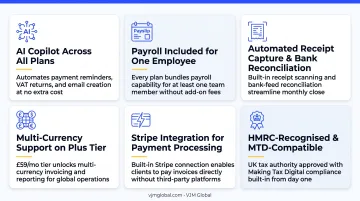
- AI Copilot across all plans — automates payment reminders, VAT returns, and email creation
- Payroll included for at least one employee on every plan
- Automated receipt capture and bank reconciliation
- Multi-currency support on the Plus tier (£59/mo)
- Stripe integration for built-in payment processing
For businesses that need payroll and AI automation without paying for add-ons, Sage is the most cost-efficient choice in this review.
| Key Features | Invoicing, VAT submission, cash flow forecasting, AI receipt capture, multi-currency (Plus plan), payroll included, Stripe integration |
|---|---|
| Pricing (excl. VAT) | Start £18/mo (1 user, 1 employee) · Standard £39/mo (3 users, 1 employee) · Plus £59/mo (unlimited users, 5 employees). 3 months free until 30 June. |
| Best For | Micro-businesses, sole traders, UK-based businesses wanting a home-grown platform with HMRC recognition |
FreshBooks
FreshBooks is a cloud accounting platform built around client billing. Its invoicing-first design and simple interface suit freelancers and service providers where chasing payments — not managing stock — is the daily priority.
- Client self-service portal included on all plans
- VAT returns filed directly to HMRC
- Low learning curve — most users are operational within an hour
- Advanced accounting features available on premium tiers
However, the Lite plan restricts clients to just 5, and additional team members cost £8/mo each—making FreshBooks best suited for freelancers and micro-businesses with small, stable client bases.
| Key Features | Invoicing, VAT filing, expense tracking, client portal, financial reporting, accounts payable (higher tiers) |
|---|---|
| Pricing (excl. VAT) | Lite £16/mo (5 clients) · Plus £30/mo (50 clients) · Premium £42/mo (unlimited clients) · Select (custom pricing). 50% off for 3 months. |
| Best For | Sole traders, freelancers, service-based businesses with straightforward bookkeeping needs |
Zoho Books
Zoho Books is an HMRC-recognised, MTD-ready accounting platform offering one of the most competitive pricing structures in the UK market. It's the only tool in this review with a genuinely free plan for micro-businesses.
- Free plan supports 1 user, 1,000 invoices/year, and is MTD-ready — at no cost
- Multilingual invoicing in over 25 languages
- Multi-currency transactions with automatic exchange rate updates (Professional plan upward)
- Inventory management and automated workflows included
- Deep integration with the broader Zoho ecosystem (CRM, HR, project tools)
The Free plan does exclude bank feeds, multi-currency, and vendor bill management. For startups keeping overheads near zero, it covers the essentials no other tool on this list offers for free.
| Key Features | VAT and Self Assessment filing, bank reconciliation, inventory management, multi-currency (premium tiers), automated workflows, Zoho app integrations |
|---|---|
| Pricing (excl. VAT) | Free £0/mo (1 user, 1,000 invoices/year) · Standard £12/mo · Professional £24/mo · Premium £30/mo · Elite £99/mo · Ultimate £199/mo (annual pricing lower). |
| Best For | Budget-conscious businesses, companies trading internationally, those already using the Zoho ecosystem |
What to Look for When Choosing UK Accounting Software
MTD Compliance
Confirm that any tool you shortlist appears on HMRC's official list of approved MTD software. MTD for VAT is already mandatory for all VAT-registered businesses. MTD for Income Tax Self Assessment rolls out from April 2026 for sole traders and landlords earning over £50,000 annually.
Non-compliant software creates immediate legal exposure and potential HMRC penalties — so this check should come first.
UK-Specific Features
On top of MTD compliance, check that your shortlisted tools support:
- VAT scheme options: Standard, Flat Rate (£150,000 turnover cap), and Cash Accounting (£1,350,000 cap)
- Self Assessment filing: Preparation or direct submission to HMRC
- Corporation Tax preparation: For limited companies
- Payroll: PAYE and National Insurance calculations
- Direct HMRC submission: For VAT and Income Tax where applicable
Pricing Transparency
Many platforms advertise a low "starting from" price but charge separately for payroll, multi-currency, additional users, or MTD-specific features. Map your actual use case against each plan before comparing costs — here's how the main tools differ:
- Xero's Ignite plan (£16/month) caps invoices at 20
- Sage bundles payroll on all plans; Xero does not
- FreshBooks charges £8/month per additional team member
- Zoho Books' Free plan excludes bank feeds
Scalability and Integrations
What works for a two-person startup often breaks down once you hit 15–20 staff, multiple users, or higher transaction volumes. Before committing, assess:
- User capacity (QuickBooks Advanced supports 25 users; Sage Plus supports unlimited users)
- Integration with key tools: e-commerce platforms, CRMs, payroll providers
- Transaction volume limits and performance at scale
How We Chose the Best Tools
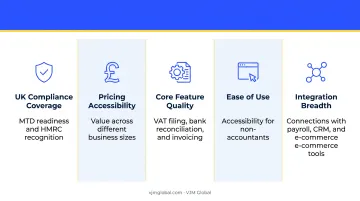
Our evaluation framework covered five areas:
- UK compliance coverage — MTD readiness and HMRC recognition
- Pricing accessibility — value across different business sizes
- Core feature quality — VAT filing, bank reconciliation, and invoicing
- Ease of use — accessibility for non-accountants
- Integration breadth — connections with payroll, CRM, and e-commerce tools
A common mistake UK businesses make is choosing based on price alone without checking whether essential features — payroll, multi-currency, or additional users — are included in the base plan or cost extra. MTD compliance is equally easy to overlook until a filing deadline appears.
For businesses managing compliance across multiple entities or jurisdictions, working with a specialist like VJM Global (which supports 250+ UK businesses) can help assess tool fit alongside actual compliance requirements. Their outsourced accounting services cover VAT management, MTD filing support, and payroll administration — useful context when evaluating what a software tool needs to handle versus what an adviser handles directly.
Conclusion
All six options are credible choices for UK businesses, but the right fit depends on your structure, team size, and whether VAT or MTD compliance is already in play. Here's a quick summary to guide your decision:
- VJM Global — The managed route, for businesses that would rather outsource the work than operate a tool
- Xero — Broadest feature set with strong UK-market integration
- Sage — Deep UK-native compliance tools, suited to growing businesses
- QuickBooks — Best introductory pricing and highest user capacity
- FreshBooks — Simple, clean fit for freelancers and sole traders
- Zoho Books — The lowest monthly cost of the five, ideal for budget-conscious teams
Trial tools using free plans or trial periods before committing, and involve your accountant or bookkeeper in the decision—the software needs to work for the person managing the numbers, not just the business owner.
For UK businesses that need more than just software—including expert accounting, VAT management, and compliance support—VJM Global offers outsourced accounting and compliance services for UK businesses operating across borders, particularly those with operations or interests in India. Visit vjmglobal.com to see how their team of chartered accountants and tax professionals can support your compliance needs alongside the tools you use.
Frequently Asked Questions
Which online accounting software is best in the UK?
The right choice depends on your business size, VAT status, and MTD compliance needs. Xero and Sage are among the most widely used HMRC-approved options for UK businesses, with strong feature depth across both platforms.
What do accountants use instead of QuickBooks in the UK?
UK accountants frequently use Xero, Sage, and FreeAgent as alternatives to QuickBooks. Xero in particular has a strong network of certified UK accountants and is a go-to platform for practices serving SMEs.
Where can I get free tax or accounting advice in the UK?
HMRC provides free guidance tools, GOV.UK resources, and a Self Assessment helpline (0300 200 3310). For tailored or complex queries, working with a chartered accountant or outsourced firm often saves more in avoided penalties than the advisory fee.
What are the golden rules of accounting in the UK?
The three foundational rules cover personal accounts (debit the receiver, credit the giver), real accounts (debit what comes in, credit what goes out), and nominal accounts (debit expenses, credit income). Together, they underpin the double-entry bookkeeping required by UK GAAP.
Can accountants advise on pensions in the UK?
Accountants can advise on the tax implications of pension contributions, including relief at source and salary sacrifice arrangements. However, regulated pension advice falls under FCA-authorised financial advisers. Business owners should work with both professionals for full coverage.