This guide covers the best accounting software options purpose-built for medium-sized UK businesses, the key features to evaluate, and UK-specific compliance factors—including Making Tax Digital (MTD), VAT, and Companies House filings—that should shape your final decision.
Key Takeaways
- VJM Global is the managed alternative to running the system in-house — its team operates your chosen platform and delivers the bookkeeping and management reporting behind it
- Medium-sized UK businesses need software beyond invoicing—covering multi-entity support, automated reporting, and HMRC compliance
- Top options: Sage 200, QuickBooks Online Advanced, Xero, Microsoft Dynamics 365 Business Central, and AccountsIQ—each suited to different complexity levels
- MTD compliance is mandatory for VAT-registered businesses — confirm your shortlisted software is on HMRC's official MTD-compatible list
- Check user limits, transaction capacity, multi-currency support, and integration flexibility
- Businesses with international operations may benefit from pairing software with specialist outsourced accounting support
Why Medium-Sized UK Businesses Need More Than Basic Accounting Software
Under Section 465 of the Companies Act 2006, a company qualifies as medium-sized if it meets at least two of three criteria: turnover not exceeding £54 million, balance sheet total not exceeding £27 million, or average employee count not exceeding 250. These thresholds were raised in April 2025, meaning more companies now qualify for medium-sized filing exemptions.
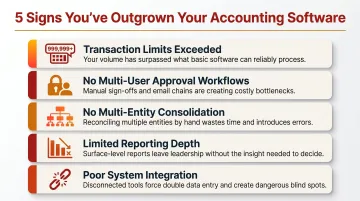
Medium-sized businesses face a distinct challenge: they've outgrown small-business tools but aren't yet ready for enterprise ERP systems. Common breaking points include:
- Transaction limits exceeded – Standard Xero and QuickBooks plans have published thresholds that growing businesses routinely hit
- Lack of multi-user approval workflows – No segregation of duties or authorisation controls
- Inability to consolidate accounts across entities – Manual spreadsheet reconciliation for group reporting
- Limited reporting depth – Basic P&L and balance sheet without dimensional analysis
- Poor integration with payroll/CRM/ERP systems – Data silos causing delayed reporting and manual re-entry errors
UK compliance requirements are tightening on multiple fronts. MTD for VAT is fully mandated; all VAT-registered businesses must now use MTD-compatible software. MTD for Income Tax Self Assessment (ITSA) extends this further, with quarterly digital reporting required for sole traders and landlords above these income thresholds:
- Over £50,000 from 6 April 2026
- Over £30,000 from April 2027
- Over £20,000 from April 2028
Companies House requirements add further pressure. The online filing service closed on 31 March 2026, so businesses must now file annual accounts through commercial software.
Best Accounting Software for Medium-Sized Businesses in the UK
These platforms were evaluated on scalability, UK compliance readiness, reporting capability, integration ecosystem, and total cost of ownership for mid-market businesses. Ahead of them sits a different kind of option — the managed route, for businesses that would rather not staff the finance function around the software at all.
VJM Global
Every platform below assumes a medium-sized business will run it: someone owns the chart of accounts, someone reconciles across entities, someone produces the month-end pack before the board meeting. VJM Global is the option for businesses that would rather hand that work to an outside team. It is a chartered accountancy and business advisory firm with 30+ years' experience and 100+ Chartered Accountants, CPAs, and company secretaries, and it operates your chosen platform on your behalf rather than selling you a licence.
Why it sits ahead of the platform decision: VJM Global's teams work across Xero, QuickBooks, NetSuite, Zoho, SAP, Sage, and Tally — which covers every platform ranked below. For a medium-sized business, that changes the calculus: the constraint on scaling is usually finance headcount rather than software capability, and this route addresses the headcount side directly. The firm's staff handle day-to-day bookkeeping, VAT return preparation, management reporting, and month-end close.
Night-shift staffing aligned to UK working hours means the ledger moves overnight and month-end questions are answered inside your business day. VJM Global has served 250+ UK businesses, reports a 95% client retention rate, and is a member of EAI International, a global network of independent accounting and tax firms.
| Scope of Engagement | Bookkeeping, VAT return preparation, management reporting, and month-end close delivered by the firm's team |
| Platforms Managed | Xero, QuickBooks, NetSuite, Zoho, SAP, Sage, Tally — the platform decision stays yours |
| Pricing | Contact for pricing — monthly retainer based on transaction volume and entity count |
Sage 200
Sage 200 is a longstanding UK-built solution designed to bridge the gap between Sage 50 (for small businesses) and Sage Intacct (enterprise-level), covering finance, stock control, and business intelligence.
What makes it stand out for UK mid-market:
- Native MTD compliance with strong HMRC integration
- Robust multi-currency support
- Well-established UK partner and support network, making implementation and ongoing support more accessible
- Available in cloud-based (Standard) and flexible deployment (Professional) models
Key features include:
- Multi-currency and purchase order management
- Stock control and warehouse management
- Customisable reporting and project accounting
- Bill of Materials (BOM) management
- Microsoft 365 integration
| UK Compliance | MTD-compliant, HMRC-recognised; supports VAT returns, PAYE, and Companies House reporting |
| Pricing | Subscription-based; pricing varies by module and user count—verify current tiers at Sage UK |
QuickBooks Online Advanced
QuickBooks Online Advanced is Intuit's mid-market tier, raising the user ceiling to 25 full-access users and adding automated workflows, advanced reporting with Finance AI, and batch transaction processing.
Differentiators for UK medium businesses:
- Large ecosystem of 750+ app integrations
- HMRC MTD-recognised
- Dedicated UK accountant and ProAdvisor network for external support
- Promotional pricing often available for new subscribers
Key features include:
- Up to 25 users with batch invoicing
- Advanced reporting and Finance AI analytics
- Automated approvals and revenue recognition
- Custom report builder
- Unlimited classes and locations
| UK Compliance | MTD-compliant for VAT; HMRC-recognised; Self Assessment and CIS support available |
| Pricing | £123/month (+VAT); verify current UK pricing and promotional offers at QuickBooks UK |
Xero (Comprehensive / Ultimate Plan)
Xero is a cloud-native platform with unlimited users across all plans, a 1,000+ app marketplace, and a clean interface — popular among UK SMEs growing into the mid-market, particularly in service-based and retail sectors.
Key consideration for medium-sized businesses: Xero's performance guidance recommends reducing line items to 5–10 per transaction and using third-party apps for summary invoices in high-volume environments.
There is also no native multi-entity consolidation: each entity requires a separate organisation file with manual export/import for group reporting. This makes Xero best suited to the lower end of the medium-sized range.
Key features include:
- Unlimited users with real-time bank feeds
- Inventory tracking and project management
- 1,000+ integrations
- Multi-currency (Comprehensive and Ultimate plans only)
- Xero Expenses and Xero Analytics Plus (Ultimate)
| UK Compliance | MTD-compliant; HMRC-recognised; VAT return submission; payroll available as add-on |
| Pricing | Plans range from £7 (Simple) to £65 (Ultimate); multi-currency and advanced analytics require Comprehensive or Ultimate — verify at Xero UK |
Microsoft Dynamics 365 Business Central
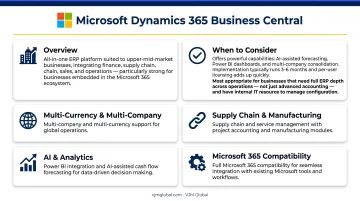
Microsoft Dynamics 365 Business Central is an all-in-one ERP platform suited to upper-mid-market businesses, integrating finance, supply chain, sales, and operations — particularly strong for businesses embedded in the Microsoft 365 ecosystem.
When to consider Business Central: It offers powerful capabilities: AI-assisted forecasting, Power BI dashboards, and multi-company consolidation. That said, implementation typically runs 3–6 months and per-user licensing adds up quickly.
Business Central is most appropriate for businesses that need full ERP depth across operations — not just advanced accounting — and have internal IT resource to manage configuration.
Key features include:
- Multi-company and multi-currency support
- Supply chain and service management
- Project accounting and manufacturing modules
- Power BI integration and AI-assisted cash flow forecasting
- Full Microsoft 365 compatibility
| UK Compliance | MTD-compliant; HMRC-recognised; supports VAT, PAYE, and Companies House requirements |
| Pricing | Per-user monthly: £61.50 (Essentials), £84.60 (Premium), £6.20 (Team Members) — verify at Microsoft UK |
AccountsIQ
AccountsIQ is a cloud platform built specifically for mid-market and multi-entity organisations. It handles consolidation and group reporting at a fraction of the cost of NetSuite or Sage Intacct, making it a practical option for businesses that have outgrown SME tools but don't need a full ERP.
Mid-market differentiators:
- Automated multi-entity consolidation for up to 300 entities
- Dimensional reporting and BI dashboards
- Open API for CRM, billing, and expense integrations
- Faster implementation timelines (claimed 4–6 weeks) compared to enterprise ERP alternatives
- Particularly strong for group structures, charities, and service businesses
Key features include:
- Multi-entity consolidation and automated workflows
- Advanced BI reporting and multi-currency support
- Approval controls and open API integrations
- Flexible general ledger with chart of accounts amendments
| UK Compliance | MTD-compliant; supports VAT returns and multi-currency tax management; cloud-hosted with enterprise-level security |
| Pricing | Quote-based for mid-market; positioned at approximately 1/6th the cost of full-scale ERPs — verify at AccountsIQ |
What to Look for in Accounting Software for UK Medium-Sized Businesses
UK-Specific Compliance Must Be Your First Filter
Any shortlisted software should be HMRC-recognised and MTD-compliant for VAT. Check HMRC's official MTD-compatible software list. From April 2026, MTD for Income Tax Self Assessment requires quarterly digital reporting for businesses with qualifying income over £50,000, so MTD readiness beyond current requirements is essential. Confirm the software supports Companies House annual accounts preparation and PAYE if staff are employed.
Scalability Criteria Specific to Medium-Sized Businesses
Check hard limits on:
- Monthly transactions (sales invoices, purchase bills, bank feeds)
- Number of users
- Tracked inventory items
- API calls
Tools like standard Xero or QuickBooks Online (non-Advanced) have published thresholds that growing businesses routinely exceed. Ask vendors directly how the platform handles growth without requiring a full migration.
Multi-Entity and Multi-Currency Requirements
Medium-sized UK businesses with subsidiaries, divisions, or cross-border operations need:
- Consolidated reporting across entities
- Multi-currency handling that converts automatically to sterling
- Automated intercompany eliminations
- Group-level financial reporting without manual spreadsheet reconciliation
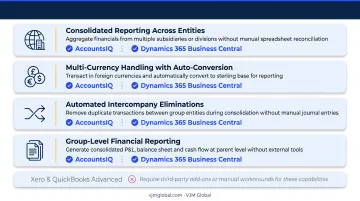
This is where platforms like AccountsIQ and Dynamics 365 Business Central pull ahead—Xero and QuickBooks Advanced require third-party add-ons or manual workarounds.
Integration Capability
Beyond multi-entity needs, integration capability determines how well accounting software fits into your existing stack. Disconnected systems cause delayed reporting, manual re-entry, and compounding errors. Look for:
- Open APIs
- Pre-built connectors with platforms you already use
- App marketplaces (Xero has 1,000+, QuickBooks has 750+)
When Software Alone Isn't Enough
For UK businesses with operations in India or other international markets, software alone often can't cover every compliance layer. Pairing the right platform with specialist outsourcing fills that gap.
VJM Global has supported over 250 UK businesses managing subsidiaries, joint ventures, or operations in India. Services cover:
- Bookkeeping and management reporting
- GST compliance and regulatory filings
- FEMA guidelines for inbound investments
- Back-office accounting operations
How We Chose the Best Accounting Software
We assessed solutions specifically for UK medium-sized businesses — small-business tools were excluded even if they appear in general comparison lists. Key criteria included:
- HMRC/MTD compliance status – Verified against official HMRC lists
- Transaction and user scalability – Checked published limits and vendor documentation
- Multi-entity and reporting capabilities – Native consolidation, dimensional analysis, BI dashboards
- Integration ecosystem breadth – API availability, app marketplace size, pre-built connectors
- Verifiable UK market presence – UK support, UK-based partners, UK pricing transparency
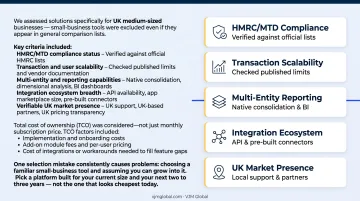
Total cost of ownership (TCO) was considered—not just monthly subscription price. TCO factors included:
- Implementation and onboarding costs
- Add-on module fees and per-user pricing
- Cost of integrations or workarounds needed to fill feature gaps
One selection mistake consistently causes problems: choosing a familiar small-business tool and assuming you can grow into it. Pick a platform built for your current size and your next two to three years — not the one that looks cheapest today.
Conclusion
The right accounting software for a medium-sized UK business matches your current operational complexity, handles UK compliance requirements out of the box, and scales without forcing a disruptive migration within the next few years. Sage 200, QuickBooks Advanced, Xero, Dynamics 365 BC, and AccountsIQ each have distinct strengths depending on business size, structure, and sector.
Before deciding, evaluate three factors beyond the feature list:
- Implementation support — who handles setup, data migration, and staff training
- Vendor UK presence — local support teams and UK-specific compliance updates
- Ongoing upgrade costs — licensing changes, add-on fees, and version migration paths
Businesses managing international operations, multi-jurisdiction compliance, or rapid growth often find that software alone isn't enough. VJM Global's chartered accountants and business advisors have supported over 250 UK businesses with accounting, compliance, and cross-border operations — particularly those with Indian market exposure. Contact the team to discuss how advisory support can work alongside your software investment.
Frequently Asked Questions
What is the best accounting software for medium-sized businesses in the UK?
No single platform suits every business. The strongest options include Sage 200, QuickBooks Online Advanced, Xero, Microsoft Dynamics 365 Business Central, and AccountsIQ. The right choice depends on your complexity, multi-entity needs, UK compliance requirements, and budget.
Which accounting software is most widely used in the UK?
Xero leads UK digital visibility with 45.11% of payroll and accounting search share versus QuickBooks at 17.78% (February 2026 PPC data). Sage products — particularly Sage 50 and Sage 200 — have historically dominated the mid-market installed base, with Sage reporting 10% UK and Ireland revenue growth in 2025.
What features should medium-sized UK businesses look for in accounting software?
Critical features include MTD and HMRC compliance, multi-user access with approval workflows, multi-entity or multi-currency support, advanced reporting and dashboards, and integration capability with payroll, CRM, and procurement systems.
Is Xero suitable for medium-sized businesses in the UK?
Xero suits the lower end of the medium-sized range — it has published transaction limits and requires paid add-ons for multi-entity consolidation. Larger or more complex businesses typically need a platform built specifically for mid-market use.
What is Making Tax Digital (MTD) and how does it affect my choice of accounting software?
MTD is HMRC's initiative requiring businesses to keep digital financial records and file tax returns through HMRC-recognised software. VAT-registered businesses must already comply, and MTD for Income Tax Self Assessment (ITSA) phases in from April 2026. Any software you shortlist must be HMRC-recognised and MTD-ready.