Introduction
UAE entrepreneurs are looking at Australia with fresh interest. DFAT reports AUD 12.7 billion in two-way trade for 2024-25 and AUD 23.7 billion in two-way investment stock, with the UAE now Australia's largest trade and investment partner in the Middle East.
The Australia-UAE CEPA, in force since October 2025, only adds momentum.
But there's a catch. UAE founders are used to free-zone LLCs, 100% ownership, and same-day licensing. Australia has no "LLC" at all.
The closest equivalent is the Private Limited Company, or Pty Ltd. It plays by very different rules: ASIC regulation, a resident-director requirement, and standard company taxation.
This guide covers what a Pty Ltd is, what UAE-based founders need to set one up, how it compares to a branch, the registration steps, and the tax and compliance obligations that follow.
Key Takeaways
- A Pty Ltd offers limited liability with no residency requirement for shareholders
- UAE individuals and UAE-registered companies can own 100% of shares, but one director must reside in Australia
- Company profits are taxed at 25% or 30%, with no UAE–Australia tax treaty to offset double tax
- Remote registration from the UAE can finish in a few days once documents are certified
- Cross-border advisers align UAE attestation requirements with ASIC and ATO compliance
What Is a Private Limited Company (Pty Ltd) in Australia?
A Pty Ltd is a proprietary company limited by shares, incorporated under the Corporations Act 2001 and regulated by the Australian Securities and Investments Commission (ASIC). Every registered entity carries the "Pty Ltd" suffix by law.
The limited liability principle is straightforward: shareholders' personal assets stay protected. Their exposure is capped at whatever amount remains unpaid on their shares - nothing more.
Here's the part that catches most UAE founders off guard: Australia has no direct "LLC" equivalent. A US or UAE LLC often functions as a pass-through entity for tax purposes. A Pty Ltd doesn't. It's taxed as a standalone company, full stop.
Key structural rules:
- Maximum 50 non-employee shareholders - the default structure for privately-held SMEs and foreign subsidiaries
- Every Pty Ltd needs an Australian Company Number (ACN) from ASIC, a unique 9-digit identifier
- Most also need an Australian Business Number (ABN) from the ATO for tax and GST purposes
Pty Ltd vs UAE Company Structures
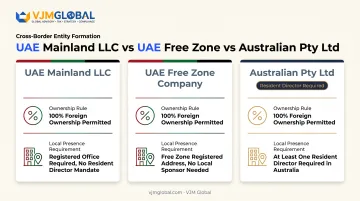
For founders in Dubai or Abu Dhabi, this side-by-side view against familiar UAE structures shows where the models diverge.
| Structure | Ownership rule | Local presence requirement |
|---|---|---|
| UAE Mainland LLC | Up to 100% foreign ownership for most reformed activities | Some sectors retain restrictions |
| UAE Free Zone company | 100% foreign ownership, no local partner needed | Office space usually tied to activity/headcount |
| Australian Pty Ltd | 100% foreign shareholding permitted | At least one director must reside in Australia |
The real friction point is the resident-director rule, which has no real parallel in either UAE model.
Key Requirements for UAE Founders Setting Up a Pty Ltd
Good news first: full foreign ownership is permitted. UAE nationals, UAE residents of any nationality, and UAE-registered companies can hold every share in an Australian Pty Ltd. There's no local shareholding quota to satisfy.
The requirement that trips people up is different. Under the Corporations Act, at least one director must ordinarily reside in Australia—even if the company is 100% UAE-owned.
Founders who don't want to relocate usually appoint a nominee resident director through a corporate services provider.
Beyond that, here's what every UAE founder needs to arrange:
- Director ID — required for every director, including those based in the UAE (identity checked via certified documents, a notary, or an Australian diplomatic post)
- Registered office address — a physical Australian address for official mail, separate from where the business operates
- Company name reservation — checked and locked with ASIC before incorporation
- Governance framework — a custom constitution, or the Corporations Act replaceable rules
- At least one issued share — no minimum share capital, but you must issue at least one share on incorporation
Directors can apply for a Director ID up to 12 months before appointment. Start early if certified-document checks from the UAE may slow verification.
Pty Ltd vs Branch Office (ARBN): Which Structure Fits Your UAE Business?
Not every UAE business needs a standalone Australian company. An alternative is registering the existing UAE entity as a foreign company branch, which receives an Australian Registered Body Number (ARBN) rather than an Australian Company Number (ACN).
The legal difference is structural. A branch is not a separate entity; it is the same legal person as the UAE parent, which stays fully liable for Australian obligations and claims.
When a Pty Ltd fits better:
- Long-term market presence
- Bidding on government tenders
- Building local banking and credibility relationships
When a branch fits better:
- Short-term market testing
- Projects with a defined end date
- No second Australian corporate tax residency layer
| Factor | Pty Ltd | Branch (ARBN) |
|---|---|---|
| Legal identity | Separate Australian entity | Same entity as UAE parent |
| Liability exposure | Shareholders limited to unpaid shares | UAE parent bears full liability |
| Setup speed | Days, once documents are ready | Similar timeline, different filing pack |
| Local representative | Resident director required | Local agent required |
| Ongoing compliance | Annual review, solvency resolution | Registered office, periodic financial statements |
For most UAE businesses building an ongoing Australian presence rather than a short pilot, a Pty Ltd’s local credibility is worth the resident director requirement.
Step-by-Step: Registering a Pty Ltd in Australia from the UAE
The process is fully doable without setting foot in Australia. Here's how it typically runs:
- Reserve a unique company name with ASIC. Check availability and lock it in before drafting incorporation documents.
- Appoint at least one Australian resident director. UAE founders who will not relocate often use a professional resident-director service. VJM Global, for example, has supported over 250 Australian business setups this way.
- Obtain a Director Identification Number for every director, including directors based in the UAE. If online verification is not possible, ABRS accepts certified copies via a notary public or an Australian embassy, high commission, or consulate.
- Attest and translate UAE documents - trade licence, passport, Emirates ID - through MOFA and a certified translator. MOFA's digital attestation typically completes within 2 hours during working hours; courier-based attestation runs 1-3 business days.
- Lodge ASIC Form 201. The online application takes roughly 15 minutes to complete, with confirmation and your ACN usually issued within 2 business days.
- Handle post-incorporation compliance: apply for an ABN, register for GST once turnover crosses AUD 75,000 (within 21 days of exceeding it), and open a business bank account. Overseas signatories should expect extra KYC checks—Australian banks scrutinise this closely.
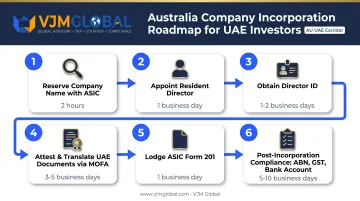
Document certification on the UAE side is usually the longest part of this process, not the ASIC filing itself.
Tax, Compliance & the UAE-Australia Trade Backdrop
Once incorporated, a Pty Ltd is taxed as its own entity. The current rates are 25% for base-rate entities and 30% otherwise, with dividend franking credits reducing double taxation for Australian shareholders receiving distributions.
Here's the part that surprises UAE founders most: there is no Double Taxation Agreement between the UAE and Australia. Profits repatriated home face standard ATO withholding rates rather than any treaty-reduced figure.
As of the current schedule, that means 10% on interest, and 30% on unfranked dividends and royalties. Compare that to the UAE's own 9% corporate tax above AED 375,000, and the gap in after-repatriation returns becomes a real planning consideration.
Ongoing ASIC obligations don't stop at incorporation:
- Pay the annual review fee (AUD 342 for a proprietary company)
- Keep company details current with ASIC
- Pass a solvency resolution within the required window each year
Those filings sit against a wider trade backdrop. The Australia-UAE CEPA covers goods, services, digital trade, and investment facilitation, and makes Pty Ltd formation a more practical vehicle for UAE capital moving into Australia.
Firms like VJM Global already coordinate entity formation, tax, and payroll compliance across both markets. They typically handle UAE-side document requirements and Australian ASIC and ATO filings under one engagement, which cuts the back-and-forth for founders working across two jurisdictions.
Frequently Asked Questions
What is an Australian private limited company?
A Pty Ltd is Australia's standard privately-held company structure, offering shareholders limited liability. It's registered with and regulated by ASIC under the Corporations Act 2001.
Does Australia trade with the UAE?
Yes, substantially. Australia's Department of Foreign Affairs and Trade (DFAT) records AUD 12.7 billion in two-way trade for 2024-25, backed by the Australia-UAE CEPA, which entered into force in October 2025.
Can a UAE company own 100% of an Australian Pty Ltd?
Yes. There's no local shareholding requirement, so UAE individuals or UAE-registered companies can hold every share. A separate rule requires one Australia-resident director regardless of ownership.
Do I need to live in Australia to set up a Pty Ltd?
No. Shareholders and even most directors can be based anywhere. You do need at least one director who ordinarily resides in Australia, often filled through a nominee director arrangement.
How is a Pty Ltd taxed compared to a UAE free zone company?
A Pty Ltd pays company tax at 25% or 30%. The UAE charges 9% above AED 375,000, and often 0% in qualifying free zones. With no UAE–Australia tax treaty, repatriated profits also face standard ATO withholding rates.
How long does it take to register a Pty Ltd from the UAE?
ASIC itself processes online applications within about 2 business days. The bigger variable is UAE document certification and translation, which usually adds several days before lodgement.