Introduction
A UK holding company sounds like an easy win for UAE business owners. It opens doors to treaty networks, adds banking credibility that pure offshore structures often lack, and carries the reputational weight of a G7 jurisdiction.
But here's the tension few advisors mention upfront: the paperwork to incorporate takes days, while the tax mechanics that determine whether the structure actually works need careful, condition-by-condition analysis.
Many UAE business owners conflate "UK holding company" with "UK tax-free structure." That's a costly assumption. Exemptions like the dividend exemption and Substantial Shareholding Exemption (SSE) are conditional, not automatic.
Miss a test, and the tax leakage you were trying to avoid can land at the UK’s 25% main corporation tax rate.
This guide breaks down corporation tax treatment, dividend and capital gains exemptions, withholding tax under the UK-UAE treaty, substance and CFC risk, and how the UK regime stacks up against the UAE's own holding company framework.
Key Takeaways
- Dividend income from UK or foreign subsidiaries is generally exempt from UK corporation tax (anti-avoidance rules apply)
- Substantial Shareholding Exemption (SSE) can make disposal gains tax-free if ownership, holding, and trading tests are met
- The UK charges 0% withholding tax on outbound dividends, reinforced by the UK-UAE tax treaty
- Central management and control, not owner residency, determines UK tax residency
- The right jurisdiction depends on where subsidiaries and income actually sit, not where the owner lives
Corporation Tax, Dividend Exemption & Substantial Shareholding Exemption (SSE)
The UK's corporation tax rates break down as follows:
- Main rate: 25% on profits over £250,000
- Small-profits rate: 19% on profits below £50,000
- Marginal relief: applies between £50,000 and £250,000 (HMRC fraction 3/200)
Companies with more associated entities or shorter accounting periods see these thresholds reduced proportionately.
For most UAE-owned holding companies, there's often little or nothing to tax. A pure holding vehicle that only receives dividends from subsidiaries typically has minimal trading income.
That doesn't mean you can skip registration. HMRC requires notification within three months of the start of the accounting period in which the company becomes active. Receiving interest or dividends alone counts as "active," even without a single trading transaction.
Dividend Exemption for UAE-Owned UK Holdcos
Dividends received from both UK and foreign subsidiaries are generally exempt from UK corporation tax under the dividend exemption regime in CTA 2009 Part 9A. That exemption lets profits from operating subsidiaries flow up through a UK Holdco to a UAE parent without UK tax leakage.
The exemption isn't unconditional, though. It can be denied where arrangements involve:
- Manipulation of the controlled-company or portfolio-holding tests
- Payments designed primarily to secure the exemption rather than reflect genuine profit distribution
- Non-arm's-length terms between related parties
For most operating groups with real trading subsidiaries, these anti-avoidance triggers rarely bite. They matter most where the structure looks engineered purely for tax outcomes.
Substantial Shareholding Exemption (SSE) on Disposals
SSE is where a UK Holdco earns its value for a UAE group planning an exit. The core conditions:
- Ownership threshold - at least 10% of the investee's ordinary share capital, held continuously
- Holding period - a 12-month qualifying period ending within five years before disposal
- Trading test - both the investing company and the investee must meet the trading company or trading group requirement
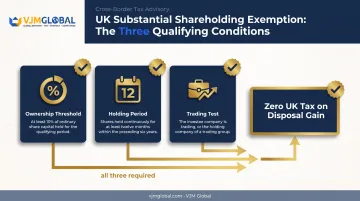
Meet all three, and selling a subsidiary through the UK Holdco can produce zero UK corporation tax on the gain.
Miss the trading test — for instance because the subsidiary has become a passive investment vehicle — and the exemption disappears entirely, exposing the full gain to tax.
Withholding Tax and the UK-UAE Double Taxation Agreement
This is the part of the UK regime that genuinely surprises most UAE clients: the UK doesn't impose withholding tax on outbound dividends, regardless of destination country. That's unusual among major economies, most of which apply a default withholding rate reduced only by treaty.
For a UAE parent receiving distributions from a UK Holdco, this removes a layer of friction entirely:
- No tax to reclaim on outbound dividends
- No treaty form to file for dividends specifically
- No timing mismatch while waiting on a refund
The UK-UAE Double Taxation Convention, in force since December 2016, reinforces this. Where the beneficial owner is UAE tax resident, dividends generally carry 0% source-state withholding tax, avoiding double taxation on repatriated profits.
Interest and royalties work differently. They are not automatically covered at 0%:
- Reduced or nil withholding depends on beneficial ownership conditions under the treaty
- Each payment needs testing on its own facts, not a blanket assumption
- A poorly structured related-party loan can still attract withholding that a documented arm's-length arrangement would avoid
The UK holds tax treaties with more than 100 countries. That network lets a single UK Holdco extend treaty protection to subsidiaries well beyond the Gulf, which is exactly why UAE groups with pan-regional operations often add a UK layer above them.
Set against the UAE's own no-withholding-tax position, the two regimes are complementary, not competitors. A group with subsidiaries split between treaty-friendly and non-treaty jurisdictions can use the UK layer where treaty access matters and the UAE layer where it doesn't need to.
Substance, CFC Rules and Anti-Avoidance Exposure
Here's where structures fail quietly, often without the owner realising until an HMRC inquiry lands. UK tax residency doesn't turn on where the owner lives. It turns on central management and control (CMC): where the real decisions actually get made.
If board resolutions are drafted in the UK but the substantive decisions happen in Dubai, HMRC can challenge the company's UK residency status—and any treaty benefits that depend on it. CMC is the foundation the whole structure rests on.
The CFC Regime
If a UK Holdco controls a low-taxed non-UK subsidiary, the UK's Controlled Foreign Companies (CFC) rules can pull some of that subsidiary's profits into UK tax. That can apply even when the subsidiary itself sits outside the UK.
Exemptions exist, but none are automatic. Each has specific tests:
- Low profits exemption — available where the CFC's total profits stay within statutory limits
- Low profit margin exemption — accounting profits before interest must not exceed 10% of relevant operating expenditure
- Excluded territories exemption — CFCs resident in listed low-risk jurisdictions that meet the statutory conditions
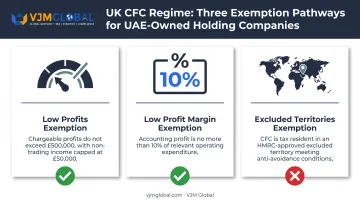
Each exemption needs evidence. Get the tests wrong and the profit is taxed in the UK anyway.
Where GAAR and PPT Come In
HMRC's General Anti-Abuse Rule applies a "double reasonableness" test: could the arrangement reasonably be regarded as a reasonable course of action? Treaty Principal Purpose Tests apply a similar filter to dividend, interest and royalty relief under the UK-UAE DTA.
In practice, documented board minutes and genuine UK-based decision-making are the evidence that keeps a holding structure intact. Without them, HMRC has a clear path to unwind treaty relief and residency claims.
Interest Deductibility, Group Relief and VAT Treatment
Three mechanical areas trip up UAE groups running a UK Holdco above multiple subsidiaries.
Corporate Interest Restriction. Net interest expense above £2 million a year is restricted under the default fixed-ratio method, capped at 30% of UK tax-EBITDA. Below that £2 million de minimis, no restriction applies.
Intra-group loans also need arm's-length pricing. Connected-party rates that drift from market terms invite transfer pricing adjustments.
Group relief. UK companies within a 75% group can transfer trading losses between entities. That matters where a UK Holdco sits above both a new loss-making venture and a profitable operating subsidiary. Losses from one can offset profits in the other if the 75% ownership and profit-entitlement tests are met.
VAT treatment. This one catches people off guard:
- A passive holding company that only holds shares for dividends generally can't recover input VAT on its costs
- A holding company that charges subsidiaries for management or administrative services conducts an economic activity, which supports VAT registration and recovery on related costs
The distinction often determines whether setup and running costs are a real VAT drag or a recoverable expense.
UK vs UAE Holding Company Tax Regime: Which Fits a UAE Group's Structure
Neither regime is universally better. The right answer depends on where the underlying subsidiaries and income actually sit.
| Factor | UK Holdco | UAE Holdco |
|---|---|---|
| Headline rate | 25% (main rate, over £250,000) | 9% above AED 375,000 |
| Dividend/gains relief | Dividend exemption + SSE | Participation exemption (Article 23) |
| Withholding tax on dividends | 0% to any country | 0% |
| Substance requirement | No standalone test; CMC governs residency | Qualifying Free Zone Person conditions, including adequate substance |
| Treaty network | 100+ countries | Growing, but narrower for some jurisdictions |
The UAE's Corporate Tax Law sets its own participation exemption under Article 23: broadly, at least 5% ownership held for 12 months, with the participation taxed at 9% or an equivalent qualifying rate.
UAE Free Zone holding companies seeking the 0% Qualifying Free Zone Person rate must also stay within a de minimis non-qualifying income limit of the lower of 5% of revenue or AED 5 million. Breach that limit and the status is lost for the current period and the following four.
A UK Holdco earns its place when:
- Subsidiaries sit across Europe or other treaty jurisdictions beyond the Gulf
- International banking relationships and lender familiarity with UK corporate structures matter to the group's financing plans
- The group needs SSE-style disposal relief ahead of a planned exit
Keeping the structure UAE-based makes more sense when:
- Subsidiaries and income are concentrated regionally
- The group prefers the UAE's Free Zone participation exemption and lower headline rate
- There's no near-term need for a broad treaty network
VJM Global works across both the UK and UAE, which matters here because this decision is not a UK or UAE question in isolation. It is a subsidiary-footprint question.
Mapping where group income actually sits against both regimes—and coordinating Companies House and HMRC compliance with UAE Federal Tax Authority filings in one engagement—tends to catch gaps that appear when each jurisdiction is treated as a separate project.

Frequently Asked Questions
What are the tax implications for UK holding companies?
A UK Holdco faces corporation tax only on income outside the dividend exemption. SSE can make disposal gains tax-free, and outbound dividends carry 0% withholding tax—provided ownership, holding-period, and trading tests are met.
Can I move my UK business to Dubai?
Yes, usually by forming a new UAE entity rather than redomiciling—the UK has no straightforward company migration process. Assess tax residency, any UK exit charges, and where central management and control will sit before you move.
Does the UK charge withholding tax on dividends paid to a UAE parent company?
No. The UK imposes no withholding tax on outbound dividends to any country, including the UAE, and this is reinforced by the UK-UAE Double Taxation Agreement for treaty-eligible income.
Does the Substantial Shareholding Exemption apply to a UAE-owned UK holding company?
Yes. SSE applies regardless of the parent company's residency. What matters is meeting the 10% ownership threshold, the 12-month holding period, and the trading company or trading group test.
Do UK holding companies face economic substance requirements like UAE free zones?
No standalone Economic Substance Test exists in the UK. Central management and control still determines tax residency and treaty access, which functions as its own substance requirement in practice.
Is a UK holding company more tax-efficient than a UAE holding company?
It depends entirely on where the group's subsidiaries and income are based, not on where the owner lives. A structure review comparing both regimes against the actual subsidiary footprint is the only reliable way to answer this.