Introduction
More UAE entrepreneurs are registering UK entities to reach British and European buyers, investors, and suppliers. The first decision they hit is structural: a UK LLP or a UK Ltd.
This choice isn't cosmetic. It shapes your UK tax exposure, how easily you open a UK bank account, and whether investors take you seriously. It also determines how much compliance paperwork lands on your desk each year, both in London and back home in Dubai or Abu Dhabi.
Get it wrong, and you could face an unexpected HMRC bill, a rejected banking application, or a costly restructure two years in.
This guide compares both structures side-by-side and gives situational recommendations based on how and where your UAE business actually operates.
Key Takeaways
- UK LLPs pass profits straight to partners' personal tax returns; UK Ltds pay corporation tax on 100% of company profits
- LLPs suit UAE-managed consulting or holding structures wanting light UK tax exposure and minimal formalities
- Ltds suit businesses building UK-facing credibility, banking relationships, or investor capital
- Both structures allow 100% UAE ownership with zero residency restrictions
- Running genuine UK operations through an LLP purely to dodge UK tax is the costliest mistake UAE founders make
UK LLP vs UK Ltd: Quick Comparison
Here's how the two structures stack up on the factors that matter most to a UAE-based owner:
| Factor | UK LLP | UK Ltd |
|---|---|---|
| Taxation | Tax-transparent; partners taxed individually based on residence and income source | Pays UK corporation tax on all profits; dividends taxed again at shareholder level |
| Ownership & Management | Members own and run the business directly; minimum two members required | Shareholders own, directors manage; can be formed with one UAE-based director/shareholder |
| Compliance Burden | Files SA800 partnership return, confirmation statement, and accounts — no corporation tax return | Files CT600 corporation tax return, annual accounts, and confirmation statement |
| Credibility & Funding | Limited ability to raise equity; less familiar to UK banks and investors | Share structure makes raising capital and building institutional trust easier |
| Treaty Access | Cannot claim UK-UAE treaty benefits itself; partners must assert their own position | Company and shareholders can each rely on treaty provisions more directly |
LLPs keep tax simpler but carry less weight with banks and investors; Ltds take on heavier filing in return for stronger credibility and funding options. Which trade-off suits you depends on what your UK presence actually looks like.
What Is a UK LLP?
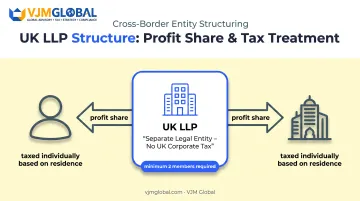
A UK LLP (Limited Liability Partnership) is a body corporate registered at Companies House under the LLP Act 2000. It's legally structured like a company, complete with limited liability, but taxed like a partnership.
That hybrid status is exactly why UAE owners like it. You get liability protection without a UK corporate-level tax charge sitting on top of your profits.
Two core benefits drive this appeal:
- Pass-through taxation — profit goes to each partner's tax return based on residence and where the income arises, often with lower UK tax exposure for a UAE-managed business than a company route
- Flexible governance — profit-sharing and management sit in a partnership agreement, without fixed share classes, board meetings, or dividend vouchers
- Separate legal personality — the LLP can contract and hold assets in its own name, distinct from its members
One structural quirk to know: an LLP needs at least two members to incorporate. Both individuals and UAE-registered companies can serve as designated or ordinary members — there's no nationality or residency restriction under Companies House rules.
Where a UK LLP Fits for UAE Businesses
LLPs work best when the UK footprint is genuinely light. Think:
- Consulting firms invoicing UK clients from Dubai
- IT services teams contracting with UK companies remotely
- Import/export intermediaries structuring joint ventures with UK partners
These arrangements share one trait: decision-making, staff, and day-to-day operations stay in the UAE, while the UK entity handles contracting and invoicing.
But there's a hard warning in recent case law. In Mark Wallace v HMRC (2025), the First-tier Tribunal ruled that a non-UK-resident LLP member was taxable on his full profit share, not an apportioned slice. The LLP's film trade was found to be wholly carried on in the UK.
The tribunal didn't care where the member lived. It cared where the trade actually happened.
That's the exact risk facing any UAE owner who assumes an LLP automatically shields profit from UK tax regardless of where the real work gets done.
What Is a UK Ltd?
A UK Ltd is a separate legal entity with share capital. It pays UK corporation tax on its worldwide profits, no matter where its shareholders live. If you're planning a genuine UK trading presence, this is the structure that fits.
Two features make it the go-to for growth-focused founders:
- Clean governance split: shareholders own the business; directors manage it. Banks, suppliers, and clients recognise this structure instantly, which smooths bank and supplier onboarding.
- Equity-raising capability: a Ltd can issue shares to UK or international investors—something an LLP can't do in the same way.
Unlike an LLP's two-member minimum, a Ltd can be formed with just one UAE-resident director and shareholder — the same person can hold both roles.
Where a UK Ltd Fits for UAE Businesses
Ltds dominate where the UK isn't just a mailing address:
- E-commerce sellers needing UK VAT registration to sell to British customers
- Import/export traders setting up a genuine UK subsidiary to hold stock or contracts
- Startups courting UK or European investment rounds
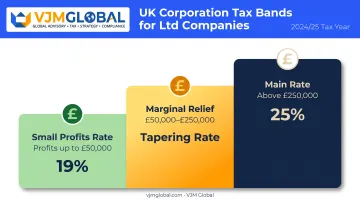
The tax trade-off is straightforward. The UK corporation tax main rate is 25% on profits above £250,000, with a 19% small-profits rate on profits of £50,000 or less and marginal relief in between.
Retained profits are taxed once inside the company. That differs from an LLP's pass-through treatment, where the entity pays nothing and partners are taxed individually.
Which Structure Is Better for UAE Businesses?
There's no universal winner here. The right answer hinges on five questions:
- Where do management decisions actually happen: UAE or UK?
- How much UK tax exposure are you comfortable with?
- Do you need strong UK banking or client-facing credibility?
- Are you planning to raise UK or international investment?
- Can your team handle UK compliance filings without it becoming a burden?
Choose an LLP if your operations and decisions stay substantively in the UAE, your UK presence is limited to contracting, and you want partnership-style tax transparency with lighter paperwork.
Do not assume an LLP automatically shields profit from UK tax. Wallace shows HMRC will look past the entity type to where the trade genuinely occurs.
Choose a Ltd if you're building a real UK-facing subsidiary, want corporation tax certainty, or plan to raise UK investment and need solid banking and client trust.
Treaty Relief Works Differently for Each
The UK-UAE Double Tax Treaty, signed in 2016, doesn't treat LLPs and Ltds the same way:
- LLPs can't claim treaty benefits directly. HMRC treats the LLP as not UK-resident for this purpose, so each UAE-resident partner must assert their own treaty position
- Ltds let the company and its UAE shareholders rely on treaty provisions more directly, because the company itself is the taxable entity
How much this helps still depends on your facts: where staff sit, who signs contracts, and whether UK meetings create a permanent establishment. Have the structure and PE risk reviewed by a firm with combined UK and UAE tax expertise before you incorporate.
VJM Global's cross-border team runs this kind of structural review as part of UK entity formation support for UAE clients.
A Hypothetical Scenario: Consulting Firm Weighing LLP vs Ltd
Picture a Dubai-based IT consulting firm that set up a UK LLP years ago purely to invoice British clients. As the business grew, it started sending staff to London for extended client engagements and even leased a small serviced office there.
That's when the uncertainty crept in: did those UK-based staff and that office create a permanent establishment, meaning UK tax on the full profit share rather than just the invoicing slice?
The trigger for resolving it might be an HMRC enquiry letter, an investor's due-diligence request, or a UK bank flagging the account for review. In any of these cases, the fix usually follows the same steps:
- Map where decisions genuinely get made
- Review whether UK activity meets the fixed-place-of-business or dependent-agent PE tests
- Decide whether converting to a Ltd removes the ambiguity going forward
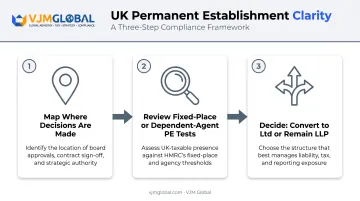
Takeaway: don't wait for HMRC to ask first. If your UK footprint is growing, get the structure reviewed before it becomes a dispute. VJM Global's UK-UAE tax team can walk through this assessment before you incorporate or restructure.
Conclusion
An LLP suits UAE businesses keeping genuine management and substance outside the UK. A Ltd suits those building real UK-facing operations, seeking investment, or needing stronger banking and client trust.
Neither structure wins by default. The right choice depends on how your business actually operates on the ground.
Whichever way you lean, the choice ties directly to tangible outcomes: UK tax exposure, compliance cost, banking access, and how ready you are to scale. Get a professional cross-border review from VJM Global before incorporating either structure. It's far cheaper than untangling the wrong one later.
Frequently Asked Questions
What are the key differences between a UK Ltd and a UK LLP for UAE businesses?
An LLP is tax-transparent, with profits taxed at partner level, while a Ltd pays UK corporation tax on all profits and offers separate shareholder/director governance. The right choice depends on where your business substance genuinely sits.
Can a UAE resident or company own 100% of a UK LLP or UK Ltd?
Yes. There's no residency or nationality restriction on LLP members or Ltd shareholders/directors. A Ltd can be formed with just one UAE-based director and shareholder, while an LLP needs a minimum of two members.
Which structure is better for UAE e-commerce businesses selling to UK customers?
A Ltd is generally more suitable due to UK VAT registration needs, banking credibility, and a clearer corporate structure for supplier and marketplace relationships.
Do UAE-owned UK LLPs or Ltds pay UK corporation tax?
A Ltd always pays UK corporation tax on its profits. An LLP itself pays none. UAE-resident partners owe UK tax only on UK-source income or where a UK permanent establishment exists.
Is a UK LLP or UK Ltd easier to open a UK bank account for?
Ltds generally have an easier path to UK banking relationships thanks to their familiar corporate structure and stronger perceived credibility with banks.
Can I convert a UK LLP into a UK Ltd later if my UAE business grows?
Conversion is possible but there's no direct statutory route. It requires forming a new Ltd, transferring assets and contracts, and formally dissolving the LLP. It's worth planning your initial structure with future growth in mind.