Introduction
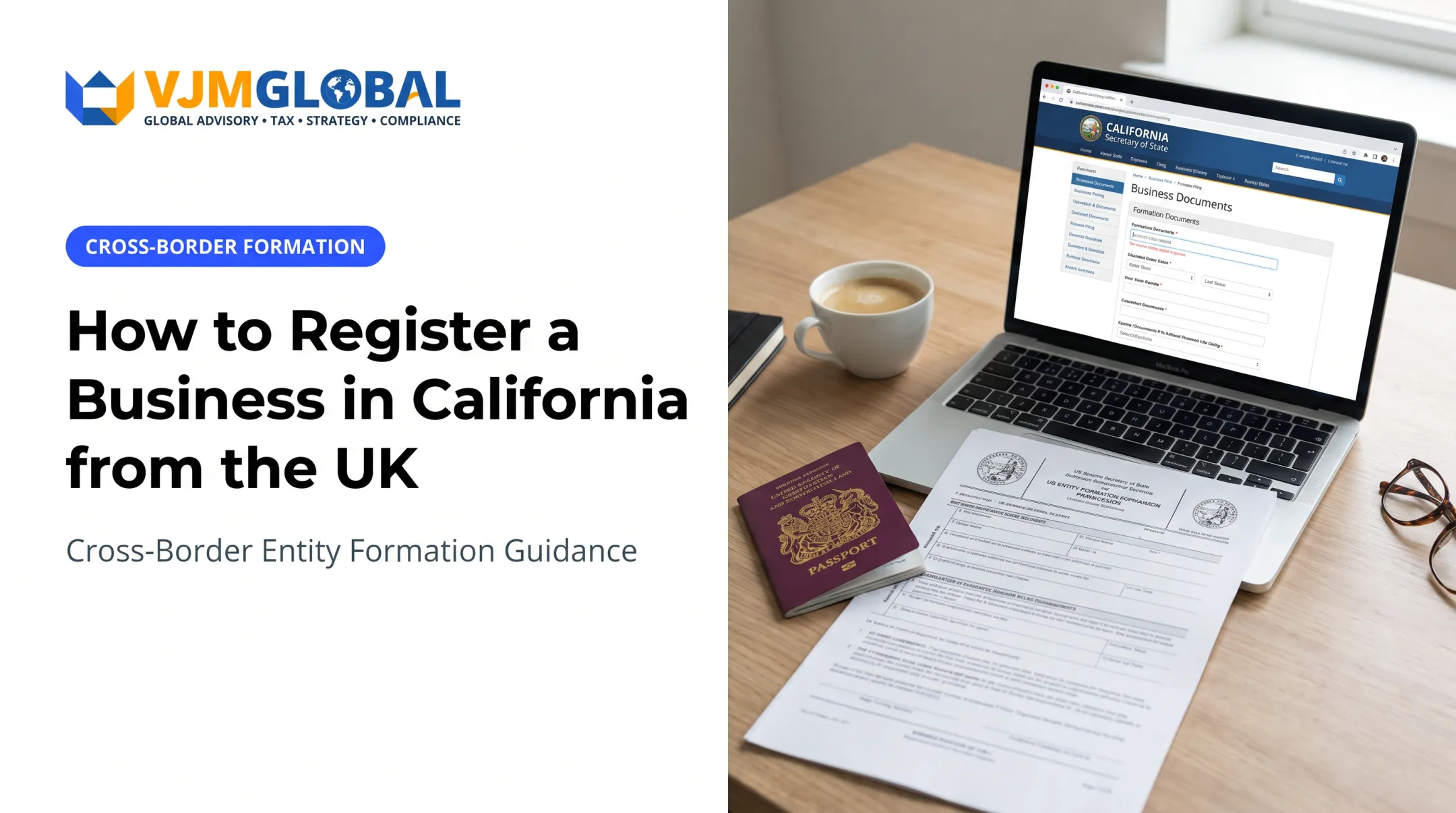
Forming a California LLC from a laptop in Manchester or London is entirely achievable. A UK resident does not need US citizenship, a green card, or even a US visit to own one.
But formation is only the starting line. Once the California Secretary of State accepts your Articles of Organization, you inherit state franchise tax obligations, federal IRS filings, and potentially UK reporting duties that don't disappear just because you're 5,000 miles away.
Many UK founders choose California because it sounds prestigious. Fewer stop to ask whether their business actually operates there.
This guide covers eligibility, the seven-step formation process, current costs, and EIN mechanics if you lack a US Social Security number. It also flags the tax questions that matter on both sides of the Atlantic.
Key Takeaways
- UK residents can fully own a California LLC with a compliant registered agent in place
- Formation requires a compliant name, Articles of Organization, an operating agreement, and an EIN
- California charges an $800 minimum annual franchise tax, regardless of profitability
- A California LLC doesn't remove UK tax obligations — HMRC treats US LLCs as opaque, not transparent
- Cross-border formation and compliance can be outsourced to reduce filing errors on both sides
How to Form an LLC in California from the UK
Step 1: Confirm California Is the Right State
Before filing anything, identify your actual connection to California. Ask whether your business has:
- An office, warehouse, or inventory physically located in the state
- Employees or contractors working from California
- California-based customers, investors, or business partners
- Plans to raise venture capital from California-based investors
If none of these apply, you may be forming in California purely for name recognition — an expensive habit, since California's $800 minimum annual franchise tax applies whether or not the LLC ever turns a profit. Compare this against Delaware or Wyoming, which many location-independent founders choose instead.
If your business genuinely operates in California, forming there (rather than registering a foreign entity to "do business" in the state) is usually the cleaner route.
Step 2: Choose and Verify the LLC Name
Search the California Secretary of State's business search tool to confirm your proposed name is distinguishable from existing entities on record. The name must include an LLC designator, such as "LLC" or "L.L.C." — if you omit it, the state adds it for you.
Two things trip up UK founders here:
- State approval isn't trademark protection. A name can pass California's registry check and still infringe someone else's trademark.
- Trading under a different name requires a separate fictitious business name filing with the county clerk, not the Secretary of State.
Step 3: Appoint a California Registered Agent
Your LLC must maintain an agent for service of process with a physical California street address. A PO box won't work, and the LLC cannot act as its own agent.
For a UK-based founder, this almost always means using a commercial registered agent service. Beyond satisfying the legal requirement, a professional agent:
- Keeps your home address off public record
- Forwards legal and state correspondence promptly
- Reduces the risk of missing a notice that could affect your LLC's good standing
Agent fees are set by private providers, not the state, so compare current quotes before committing.
Step 4: File the Articles of Organization
File Form LLC-1 with the California Secretary of State. The current filing fee is $70, whether submitted online through bizfileOnline, by mail, or in person (in-person filings carry an additional $15 special-handling fee).
Your LLC legally exists only once the state accepts the filing, not when you submit it. Processing times fluctuate based on submission volume, so check the Secretary of State's current processing dates rather than relying on a fixed turnaround estimate. Keep the stamped or electronic confirmation; you'll need it for your EIN application and bank account.
Step 5: Prepare the Operating Agreement
California doesn't file your operating agreement, but skipping it is a mistake. This internal document should cover:
- Ownership percentages and member contributions
- Management authority (member-managed vs. manager-managed)
- Profit distribution rules
- Transfer restrictions and exit or dissolution procedures
Even single-member LLCs benefit from a written agreement. It separates you from the business legally and financially, which matters if a US bank, investor, or HMRC ever questions the entity's structure. A generic template rarely accounts for cross-border ownership, related UK entities, or IP transfers, so treat it as a starting point rather than finished legal advice.
Step 6: Obtain an EIN and Set Up Operations
Without a US Social Security number, you can't use the IRS's online EIN application. Instead:
- Complete Form SS-4, entering "Foreign" in the responsible party's tax ID field
- Apply by phone (267-941-1099, Monday–Friday, 6am–11pm Eastern), fax, or mail
According to the IRS's SS-4 instructions, fax applications with a return number typically process within four business days; mail applications take roughly four weeks. Phone remains the fastest route for eligible international applicants.
Once you have your EIN, US banks and payment platforms will typically request your formation documents, EIN confirmation, passport identification, and ownership details. Requirements vary by provider, so confirm directly before applying.
Step 7: Complete California and Local Registrations
File your Initial Statement of Information (Form LLC-12) within 90 days of formation, then every two years after. The fee is $20.
Separately, budget for:
| Obligation | Amount | Frequency |
|---|---|---|
| Annual franchise tax | $800 minimum | Yearly |
| Gross-receipts fee (if California income exceeds $250,000) | $900–$11,790, tiered | Yearly |
| Statement of Information | $20 | Every 2 years |
Depending on your activities, you may also need sales tax registration, payroll tax registration, or local business licences. Verify current thresholds directly with the Franchise Tax Board before filing.

Is a California LLC the Right Choice for a UK Business?
California makes sense when your business has a real foothold there: a physical presence, California customers you're actively servicing, or investors who require it. For those founders, the recurring costs are simply the price of doing business in one of the world's largest economies.
For a location-independent online business with no California ties, the calculation looks different. You're paying $800 a year minimum, plus registered agent fees, plus potential gross-receipts charges, for a state connection that adds no commercial value.
A few things a California LLC will not do for you:
- Grant immigration status or a right to work in the US
- Guarantee approval for a US bank account or payment processor
- Automatically reduce your UK tax bill
Weigh the commercial upside of a California presence against the ongoing filing, tax, and advisory costs before committing. If the business is genuinely borderless, states like Wyoming or Delaware often carry lower recurring burdens.
What UK Founders Need Before and After Formation
Before filing, gather:
- Passport or other identity evidence
- UK residential and business address details
- Ownership structure and proposed company name
- A clear description of the business activity
- Registered agent details and responsible-party information
Some documents may need certification, translation, or apostille depending on the specific filing, bank, or tax application involved. There's no single universal checklist, so confirm requirements with each institution.
Federal and UK Filings to Watch
A single-member LLC wholly owned by a foreign person and treated as disregarded for federal tax purposes generally must file Form 5472 alongside a pro forma Form 1120 for reportable transactions with related parties. According to the IRS's Form 5472 instructions, the penalty for failing to file starts at $25,000, with additional penalties for continued non-compliance.
On the UK side, HMRC generally views US LLCs as opaque entities, not transparent ones. That means the "pass-through" treatment you get in the US may not carry over to your UK tax return.
This mismatch can complicate foreign tax credit claims, so don't assume US and UK tax treatment will align automatically. You may also need to address:
- UK Self Assessment reporting
- Companies House filings if a UK entity owns the LLC
- Potential controlled foreign company (CFC) implications
Coordinated cross-border advice matters here. VJM Global works with UK founders on US company formation, EIN coordination, and the accounting and reporting obligations that follow on both sides. Tax positioning in this structure needs input from both US and UK-qualified advisors.

Key California and Cross-Border Variables That Affect the Result
Several factors shift your actual cost and timeline:
- State fees: $70 formation fee, $20 biennial Statement of Information, $800 minimum annual tax, plus gross-receipts charges if California income exceeds $250,000
- Timing: State processing queues change regularly; EIN processing without a US SSN adds days to weeks; bank onboarding adds further time
- Physical presence: Offices, employees, inventory, or fulfilment arrangements in California can trigger nexus and tax duties even for a business formed elsewhere
- Ownership structure: Single-member LLCs face simpler compliance than multi-member ones, and electing corporate tax treatment changes your entire filing calendar
- Banking checks: From August 2026, most US-formed companies are exempt from federal beneficial ownership reporting, but banks still run their own due diligence. An EIN alone does not guarantee account approval
Ongoing governance matters too. Keep business and personal finances separate, document member transactions, and file state reports on time. Missing a Statement of Information deadline can put your LLC out of good standing.
Common Mistakes, Troubleshooting, and Alternatives
Watch for these common formation mistakes:
Choosing California for credibility alone. If there's no real business connection, revisit the state choice and calculate total recurring costs — not just the $70 filing fee — before committing.
Using an unreliable registered agent address. Inconsistent details or an address that can't reliably receive mail leads to rejected filings and missed legal notices. Double-check every field before submission.
Assuming an EIN or bank account replaces tax registration. These are separate obligations. An EIN doesn't register you for sales tax, payroll tax, or foreign-owner information filings. Each requires its own action.

When formation is delayed, the cause is usually fixable. Check for:
- Name conflicts with existing entities
- Missing or inconsistent information on the Articles of Organization
- Payment processing issues
- Signature or authorisation problems
You can check filing status directly with the California Secretary of State and resubmit corrected documents where needed.
If California no longer looks like the right vehicle, compare these alternatives:
- Forming a UK company only, if you have no US operations planned
- Registering an existing UK company to do business in the US instead of forming a new LLC
- Forming in a lower-cost state such as Wyoming or Delaware
- Using a US subsidiary or branch structure for larger, funded businesses
The right choice depends on where you operate, how you're funded, and your appetite for ongoing compliance. Get coordinated legal and tax guidance before you change an existing UK–US structure, hire US staff, or transfer intellectual property into the new entity.
Conclusion
Forming a California LLC from the UK is administratively straightforward — the harder question is whether California is the right state at all. Your answer depends on your actual US footprint, ownership structure, and how the entity interacts with your UK tax position.
The sequence stays consistent:
- Confirm state suitability
- Choose a compliant name
- Appoint a registered agent
- File your Articles of Organization
- Draft an operating agreement
- Obtain an EIN
- Stay current on state and federal filings
If you'd rather not manage California franchise tax deadlines and IRS forms alongside your UK Self Assessment, VJM Global supports UK founders with US entity formation, EIN coordination, and ongoing cross-border accounting and tax compliance. Get in touch to talk through your specific structure before you file.
Frequently Asked Questions
How much does it cost to form an LLC in California?
The California state filing fee is US$70, before ongoing costs. Budget for the US$800 minimum annual franchise tax, a US$20 Statement of Information every two years, and registered agent fees. Confirm current amounts with the California Secretary of State and Franchise Tax Board.
How do I start an LLC in California?
Choose a compliant name, appoint a California registered agent, file Articles of Organization, draft an operating agreement, and obtain an EIN. Then open a US business bank account, complete tax registrations, and file your Initial Statement of Information.
How long does it take to form an LLC in California?
State processing times depend on filing volumes and whether you file online or by mail. UK founders should allow extra time for EIN processing without a US Social Security number, plus US bank onboarding after the LLC is formed.