
Introduction
China made global headlines in late 2025 for a new wave of AI-powered "one-person companies," with cities like Suzhou and Shanghai handing solo founders free office space and computing power. The South China Morning Post reported on this incubator-driven trend in December 2025.
That's not what this guide is about.
For a Malaysian business, a "One Person Company" is something far more concrete: a single-shareholder legal entity under China's Company Law.
Solo entrepreneurs, SME owners in cross-border e-commerce, and groups that want a lean China subsidiary without a local partner often struggle to confirm eligibility and what compliance follows.
This guide covers eligibility for Malaysian investors, the registration process, and the ongoing obligations that come with the structure.
Key Takeaways
- China's one-person company is a single-shareholder LLC—not a solo-operator brand trend
- Malaysian individuals and companies can register a single-shareholder entity, usually structured as a WFOE
- Annual audits are the main proof that personal and company finances stay separate
- Expect a dual track: SAMR incorporation plus foreign-investment filing rules
- Early structuring errors can weaken limited liability—get the entity path right first
What Is a One Person Company in China?
A one-person company in China is a limited liability company owned by one shareholder (either an individual or a corporate entity) rather than the two-to-fifty shareholders typical of an ordinary LLC.
A quick clarification on the media confusion: the "AI-OPC" trend covered in recent Chinese tech coverage refers to government subsidies, incubator space, and computing credits for solo or small AI startups. That's an industrial policy trend, not a statutory company type. A business registered under the sole-shareholder provisions of China's Company Law is a completely separate legal matter.
How the structure actually works
Under China's revised Company Law (effective 1 July 2024), a single-shareholder LLC has distinct governance features:
- No shareholders' meeting, since there's only one shareholder to consult
- The sole shareholder must put decisions normally reserved for a shareholders' meeting in writing, then sign and keep that record at the company
- The business license explicitly reflects sole shareholding
- Decision-making authority sits entirely with the one shareholder
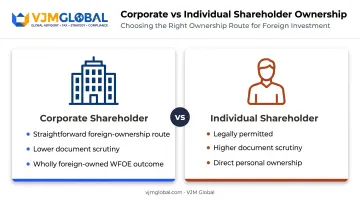
Ownership can take two forms: a single corporate shareholder (a Malaysian company wholly owning its China subsidiary) or a single natural-person shareholder (a Malaysian individual holding the entity directly). Corporate shareholding is generally the more straightforward route for foreign investors, since it avoids some of the added scrutiny individual shareholders can face.
Under Article 23 of the revised law, a sole shareholder must prove that company property is legally independent from personal property. Fail to prove that, and the shareholder becomes jointly liable for company debts.
That reversed burden of proof—unlike an ordinary multi-shareholder LLC—is why the annual audit carries so much weight for this entity type.
Can a Malaysian Business Set Up an OPC in China? Eligibility and Restrictions
Yes. A Malaysian individual or company can set up a one-person company in China. In practice, it's structured as a Wholly Foreign-Owned Enterprise (WFOE) that satisfies both the Company Law's sole-shareholder provisions and China's Foreign Investment Law.
Two routes for Malaysian investors
- Malaysian company as sole corporate shareholder — the more common route, resulting in a fully foreign-owned WFOE with straightforward governance
- Malaysian individual as sole natural-person shareholder — legally available, though it can attract more scrutiny during document review
A notable update: the older Company Law restricted one natural person to holding just one such company. That restriction does not appear in the version effective from 1 July 2024.
In principle, a Malaysian individual may now hold more than one such entity. Because the change is recent, confirm current practice with a qualified advisor before you rely on it.
Business scope matters just as much as ownership structure. Whatever activity the entity plans to carry out must be checked against China's Negative List for foreign investment. Some sectors — value-added telecoms, certain agriculture and aviation activities, specific education models — are restricted or require a Chinese partner, which rules out a wholly foreign-owned single-shareholder structure entirely.
Don't forget the Malaysian side
Setting up in China isn't just a Chinese regulatory exercise. Bank Negara Malaysia's Notice 3 sets out reporting obligations for outbound investment:
- Using foreign-currency funds: no cap under the general rule
- Using Malaysia-sourced ringgit funding: capped at RM1 million per calendar year for individuals, sole proprietorships, and general partnerships
- Resident entities: capped at RM50 million per calendar year from the same category of funding
Transactions outside these categories require prior BNM application.
Chinese negative-list checks, entity structuring, and Malaysian outbound reporting all need to line up before you file. A cross-border advisor that applies each market's own regulators, such as VJM Global, can help you confirm the right ownership route first.
How to Register a One Person Company in China – Step-by-Step
The process combines standard SAMR company registration with extra filings for a single foreign shareholder.
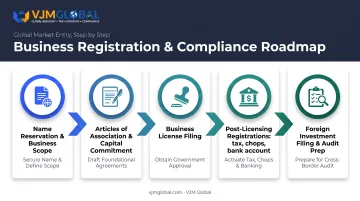
Step 1: Reserve the company name and define business scope File through SAMR's name declaration system. Once approved, a name is usually reserved for two months (or up to a year if the business scope needs pre-approval). Define business scope carefully: it must align with items cleared on the Negative List.
Step 2: Draft Articles of Association and commit registered capital The Articles must reflect sole shareholding, name the shareholder, and set out the contribution amount, method, and timeline. Under Article 47, the shareholder must pay the entire subscribed capital within five years of establishment, unless special sector rules say otherwise.
Step 3: File for the business license Submit to SAMR:
- Notarised and legalised shareholder documents (passport for individuals, incorporation documents for companies)
- Domicile-use evidence for your China business address
- Application forms, Articles, and legal representative appointment documents
Malaysian documents typically need notarisation plus legalisation via the Chinese Embassy in Malaysia. Treaty exceptions can occasionally simplify this.
Step 4: Complete post-licensing registrations Once licensed, complete these registrations:
- Register for tax and activate invoicing
- Obtain your company chops
- Open your RMB basic bank account (and a foreign-currency capital account if needed)
- Register for social insurance and housing fund before hiring staff
Step 5: File foreign investment reports and prepare for the annual audit Submit your initial report through the foreign-investment information system alongside establishment. Annual reports are due between 1 January and 30 June each year through the National Enterprise Credit Information Publicity System.
This is where many foreign shareholders slip up. They treat the annual audit as optional, when it is the evidence trail that supports limited liability protection.
Realistic timelines run three to six months from document preparation through post-registration completion, according to China Briefing's WFOE setup guide. Foreign shareholders often need longer because of legalisation requirements.
One Person Company vs WFOE: Which Structure Fits Your China Entry?
For a Malaysian company acting as sole shareholder, the "OPC" and "WFOE" labels describe the same entity. The distinction becomes more meaningful when the sole shareholder is a natural person rather than a corporate one.
The real choice is usually single-shareholder structure versus joint venture.
| Factor | Single-Shareholder OPC/WFOE | Multi-Shareholder JV |
|---|---|---|
| Control | Full control via written resolutions | Shared per shareholder agreement |
| Liability | LLC protection, but reversed burden of proof under Article 23 | Ordinary LLC rules, no reversed proof requirement |
| Capital | Subscribed capital, paid within 5 years | Same, unless sector rules differ |
| Audit | Same statutory audit, but higher stakes for liability protection | Standard annual audit |
| Best suited for | Sectors open to full foreign ownership | Sectors requiring a local partner (telecoms, certain agriculture, market research) |
A single-shareholder structure gives you full control and removes the risk of partner disputes later. A joint venture becomes necessary, not optional, in sectors where China's Negative List requires Chinese equity participation, such as basic telecoms or specific agricultural activities.
Compliance, Risks, and Costs After Incorporation
Under Article 208 of the revised Company Law, every company, not just single-shareholder ones, must prepare annual financial statements audited by an accounting firm.
For an OPC, that audit carries extra weight: it is your primary evidence that company assets stay separate from personal assets, which is what Article 23's reversed burden of proof demands. Skip it, or keep sloppy records, and you weaken your own liability shield.
Your compliance calendar
| Filing or event | Timing / requirement |
|---|---|
| SAMR/FIE annual report | 1 January – 30 June (preceding year) |
| CIT prepayment | Within 15 days after each month or quarter |
| Annual CIT reconciliation | Within 5 months after year-end |
| Dividend distribution | Allocate 10% of after-tax profit to statutory reserve until it reaches 50% of registered capital |
| Bank remittance for repatriation | Distribution resolution, audit report, tax filing proof, and proof capital was paid on schedule |
Profit repatriation back to Malaysia needs this full documentation trail at the bank. Miss one piece, and the remittance stalls.
Plan for recurring costs beyond incorporation: annual audit, CIT filings, SAMR reporting, local bookkeeping, and forex paperwork for dividends. These are the line items that protect limited liability and keep funds moving to Malaysia.
When SAMR filings, tax reconciliations, audits, and repatriation documents stack up each year, cross-border accounting and tax support helps keep the trail complete. VJM Global supports multi-jurisdiction audit and assurance work that helps single-shareholder structures maintain that liability separation over time.

Frequently Asked Questions
Can a foreigner set up a one-person company in China?
Yes. Foreigners, including Malaysian individuals and companies, can set up a single-shareholder entity, typically structured as a WFOE. It must satisfy both Company Law and Foreign Investment Law requirements.
What is the minimum registered capital for a one-person company in China?
China now runs on a subscribed capital system with no general statutory minimum under Article 47. You choose the amount and must pay it in full within five years. Verify current sector-specific rules before filing.
Is an annual audit compulsory for a one-person company in China?
Yes, all companies must prepare audited annual financial statements under Article 208. For an OPC specifically, this audit doubles as key evidence protecting your limited liability status.
What is the difference between a one-person company and a WFOE in China?
A foreign-owned OPC is typically set up as a WFOE; in practice they are the same entity. The "OPC" label matters most when the sole shareholder is a natural person rather than a company.
Can one Malaysian individual own more than one OPC in China?
The old law restricted one natural person to a single OPC, but that restriction doesn't appear in the Company Law effective from 1 July 2024. Confirm current practice with an advisor before relying on this.
How long does it take to register a one-person company in China?
Realistically, three to six months from document preparation to full post-registration completion. Foreign-shareholder cases often run longer because of notarization and legalization requirements.