Introduction
One person, no team, no office, no outside funding — just AI tools and a product. In China, that's now enough to run a real company.
China's "one-person company" (OPC) wave is generating serious international attention, covered by The Straits Times, South China Morning Post, and Xinhua. By mid-2025, China had over 16 million registered one-person companies — more than a quarter of all newly formed enterprises. In H1 2025 alone, 2.86 million new OPCs were registered, representing 47% year-on-year growth.
For Singapore businesses, this trend sends two clear signals:
- Competitive pressure: Chinese solo operators are building digital products at ultra-low cost, and some are targeting the same markets Singapore companies serve.
- Strategic opportunity: The OPC ecosystem also surfaces potential partners, tools, and operating models worth adopting.
This article covers what AI-powered OPCs are, the tools and policies driving their growth, and what it means for Singapore-based companies.
Key Takeaways
- One person + AI tools can now cover full business cycles with minimal overhead
- OpenClaw, an open-source AI agent, catalyzed China's OPC movement into the mainstream
- 20+ Chinese cities offer OPC incentives: compute subsidies, collateral-free loans, and more
- Singapore SME AI adoption sat at 14.5% in 2024 — China's momentum raises the competitive stakes
- Singapore entrepreneurs can replicate the OPC model using globally available AI tools
What Is an AI-Powered One-Person Company in China?
The Operating Model, Not Just a Legal Form
In China, a one-person company (一人公司) is legally defined as a limited liability company with a single shareholder. That legal form has existed for years. What's new is the operating model — where a single individual uses AI tools to independently complete the full commercial cycle, from product design and development through to market launch, with extremely lightweight organisation and near-zero fixed costs.
Xinhua describes AI OPCs as individuals using AI to complete this full chain with "extremely lightweight organization and low operating cost." The Chinese Academy of Social Sciences further frames them as "light asset, high intelligence, new business format" entities — distinct from traditional self-employed individuals or freelancers.
How OPCs differ from freelancing:
- Freelancers sell time and skills on a per-project basis
- OPC founders build systems — products, platforms, or automated services that generate revenue independently of the founder's direct time input
- AI functions as a force multiplier, not just a productivity shortcut
The Human-AI Division of Labour
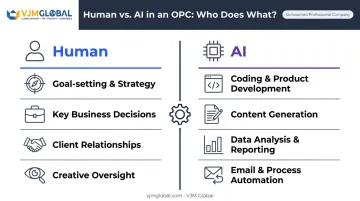
That distinction shapes how work is actually divided. The individual handles:
- Goal-setting and strategic direction
- Key business decisions
- Client relationships
- Creative oversight
AI handles:
- Coding and product development
- Content generation
- Data analysis and reporting
- Email management and process automation
The result is closer to a two-person team than a solo operation — except one team member runs 24 hours a day at no payroll cost.
Origins and Scale
The concept was formally articulated at the 2025 Jiangsu AI Innovation and Development Conference held in Suzhou on November 11, 2025, where Jiangsu "first systematically proposed" the OPC entrepreneurship paradigm. People's Daily reported 7.315 million new one-person companies registered across all of 2025, up 42.3% year-on-year — corroborating the scale of the trend.
One important caveat: not all 16 million+ registered OPCs are AI-powered. No official government data separately tracks AI-enabled OPCs versus traditional single-shareholder companies. The AI-OPC is a subset and a methodology — not a census category.
The AI Tools Powering China's OPC Founders
OpenClaw: The Catalyst
The single tool most associated with China's OPC surge is OpenClaw — an open-source personal AI assistant that runs locally on a user's device and connects to chat applications, browsers, and APIs. It links large language models to real tasks: managing files and emails, writing and executing code, scraping data, and controlling web interfaces autonomously.
What spread OpenClaw beyond the developer community was its accessibility. Non-technical users discovered they could "raise a lobster" — Chinese internet slang for deploying an OpenClaw agent — and have it handle complex multi-step workflows without writing a single line of code. The phrase went viral, and the OPC concept followed.
Rest of World reported that district-level governments began subsidising OpenClaw integration into industrial applications. Shenzhen's Longgang district proposed three months of free compute alongside free OpenClaw deployment for eligible OPC community enterprises.
Who Is Actually Building These Businesses?
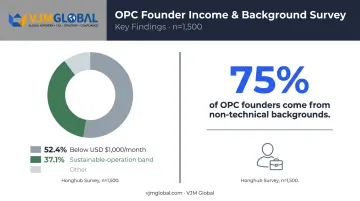
That government-backed accessibility is showing up directly in who builds these businesses. According to a Honghub survey of 1,500 OPC founders (reported by Securities Times), 75% came from non-technical backgrounds — former salespeople, marketers, teachers, and designers building functional AI-powered products without traditional coding skills. Domain expertise, not technical ability, has become the deciding advantage.
What the verified OPC toolset includes:
- OpenClaw — handles autonomous, multi-step workflows: file management, web scraping, code execution, and browser control
- AI content and video generators — produce marketing assets and AIGC output at scale without a dedicated creative team
- Large language models (including DeepSeek) — used for research, client-facing drafting, and competitive analysis
Note: Tools like Cursor, Codex, Figma AI, and Claude Code are used broadly in AI development, but have not been verified by authoritative sources as specifically prevalent among Chinese OPC founders. Verify the current toolset before making product decisions.
China's Government OPC Policy Machine
China's approach to new industries follows a recognisable pattern: central directive, then city-level competition for implementation. The same model accelerated e-commerce and electric vehicles. It is now being applied to AI and OPCs.
The National Signal
On June 18, 2026, MIIT joined six other ministries — including NDRC, MOST, MOFCOM, CAC, SAMR, and the National Data Administration — to issue the Action Plan for Promoting Coordinated Development of Large, Medium and Small Enterprises in the Platform Economy (2026-2028). The plan explicitly calls to "accelerate cultivation of Artificial Intelligence One-Person Companies (AIOPC)."
City-level adoption had already been building. By early 2026, over 20 Chinese cities had issued dedicated OPC support policies, and Shanghai, Jiangsu, and Guangdong had incorporated OPCs into their 15th Five-Year Plans — before the national directive formalised the push.
City-Level Incentive Packages
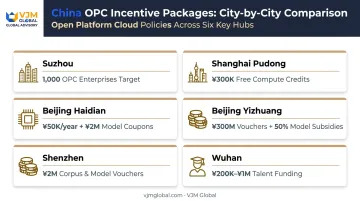
| City/District | Key Incentives |
|---|---|
| Suzhou | 1,000 OPC enterprises + 30 OPC communities by 2028 |
| Shanghai Pudong | Up to ¥300,000 in free compute support for new OPC registrations |
| Beijing Haidian | ¥50,000/year startup funding (2 years), model coupons up to ¥2M/year, rent support |
| Beijing Yizhuang | Annual vouchers up to ¥300M, 50% model subsidies, high-potential OPC support up to ¥2M |
| Shenzhen | 10+ OPC communities by 2027, corpus and model vouchers up to ¥2M each |
| Wuhan | Talent funding ¥200,000–¥1M, startup assistance up to ¥1M |
Financial Services Innovation
China's banking sector has moved in step with government policy. In Suzhou, three banks launched OPC-specific loan products within months of the city's formal support programme:
- ICBC Suzhou — "OPC Initial Talent Loan" offering up to ¥5M (pure credit) or ¥30M (secured)
- Everbright Bank Suzhou — "OPC Entrepreneurship Loan" up to ¥3M
- Bank of Communications Suzhou — pure-credit "OPC Entrepreneurship Talent Loan"
These products assess creditworthiness based on founder credentials and soft information — not corporate assets. For a solo operator with no corporate collateral, that means access to up to ¥5M in pure-credit financing based on who you are — not what your balance sheet shows.
What China's OPC Trend Means for Singapore-Based Companies
Singapore sits at an unusual vantage point. It has strong trade ties with China, a mature digital infrastructure, a rule-of-law environment, and — according to IMDA's 2025 Singapore Digital Economy Report — SME AI adoption that rose from 4.2% to 14.5% in 2024, with AI-enabled SMEs reporting 52% average cost savings.
That momentum is real. But China's policy-backed OPC ecosystem compresses company formation costs in ways Singapore's grant programmes don't yet match.
The Competitive Pressure
Singapore businesses in digital content, e-commerce, software, and consulting are increasingly facing competition from ultra-lean Chinese operators. An OPC founder with ¥1 of AI compute cost replacing what Security Times' survey sample benchmarked as ¥72 worth of developer labour is not a hypothetical — it is a documented operational reality for at least a sample of Chinese founders.
Chinese OPC founders are also moving into cross-border e-commerce, including Southeast Asia-facing stores that use AI for product selection, listing creation, customer service, and logistics coordination. Singapore import/export businesses and marketplace operators should take this seriously.
The Partnership Opportunity
Chinese OPCs are building niche enterprise tools — AI agents for logistics, cross-border e-commerce automation, AIGC content pipelines, and industrial AI applications. Singapore companies seeking lean digital solutions or China market access tools could explore partnerships with vetted OPC founders operating through established OPC communities.
This requires careful due diligence. But the talent pool is real, the government infrastructure is in place, and the cost arbitrage is significant.
The Model Adoption Angle
The "one person + AI = company" model isn't unique to China's policy environment. Singapore entrepreneurs can apply the same asset-light framework using globally available tools — and the same logic extends to cross-border structuring decisions.
For Singapore-based companies considering a leaner cross-border structure — whether entering the Indian market, establishing an Asian holding entity, or restructuring toward an asset-light operating model — the compliance and tax architecture matters as much as the business model itself. Advisory firms like VJM Global bring 30+ years of cross-border experience, with end-to-end support covering entity setup, FEMA compliance, DTAA-based tax planning, and accounting outsourcing. For Singapore companies exploring India entry specifically, that kind of integrated advisory removes significant administrative complexity from the process.
Challenges and Risks Singapore Businesses Must Know
Commercialisation Is the Real Barrier
AI lowers the cost of building a product. It does not solve finding customers. Science and Technology Daily reported that high-value OPCs remain rare, citing high compute costs, unclear commercialisation paths, and difficulty securing financing as persistent challenges.
Survey data from the Honghub report adds texture: 52.4% of OPC founders had monthly income below the equivalent of USD $1,000, while only 37.1% were in a sustainable-operation band. This is a survey sample — not a market-wide census — but it complicates the effortless-solo-entrepreneurship narrative more than the headlines suggest.
Policy Gaps Between Announcement and Reality
China's OPC policy machine moves fast, but implementation consistently lags behind announcements. Banking sector observers noted that risk-control models for OPC lending remain immature, with multiple lenders in a "wait and see" mode as of early 2026. Verify actual resource access — computing support, funding disbursements — independently before building any decisions around stated policy incentives.
Regulatory and IP Risks
For Singapore companies partnering with or investing in Chinese OPCs:
- China's cross-border data transfer rules require security assessments, standard contracts, or certifications for qualifying data. Treat data flows as a compliance constraint from day one — not an afterthought once operations begin.
- Foreign IP is not automatically enforceable in China. Register with CNIPA and structure contracts carefully before any commercial engagement, not after a dispute arises.
- The gap between central directives and local implementation is frequently significant. Confirm that computing subsidies and funding disbursements are actually accessible, not just announced.
Cross-border legal and compliance advice from counsel with China-side experience is a prerequisite before any substantive engagement with China's OPC ecosystem — not an optional step once issues surface.
Frequently Asked Questions
What is a one-person company in China?
A one-person company (OPC) in China is an entrepreneurial model where a single individual, supported by AI tools, manages the full cycle from product development to market launch. It's a working methodology, not a legal entity classification — think of it as "one person + AI = company."
Why are Chinese companies moving to Singapore?
Singapore offers political neutrality, strong IP protection, rule of law, and a Singapore-China double-tax treaty in force since 2008. For Chinese tech founders, it provides both a Southeast Asian market gateway and the international credibility needed to expand beyond domestic constraints.
How is a Chinese OPC different from being a freelancer?
A freelancer sells time and skills on a project basis. An OPC founder builds scalable systems or products that generate revenue independent of the founder's direct time input , using AI as a force multiplier. The core distinction is systematic business building versus project-by-project service delivery.
What AI tools do Chinese OPC founders typically use?
The most verified tool is OpenClaw (an open-source AI agent for autonomous multi-step task execution). AI content generators, video tools, and large language models like DeepSeek are also commonly referenced. The toolstack shifts rapidly, so treat any specific list as a starting point rather than a definitive guide.
Can a Singapore-based entrepreneur adopt the OPC model?
Yes. The OPC model is not China-exclusive. Singapore entrepreneurs can apply the same "one person + AI = company" philosophy using globally available AI tools. Singapore's stable digital infrastructure, supportive regulatory environment, and access to international markets make it a strong base for lean, AI-powered business models.
What are the biggest risks for foreign companies engaging with China's OPC ecosystem?
Key risks include cross-border data privacy compliance, IP protection gaps for unregistered foreign IP, inconsistent policy implementation, and immature OPC lending frameworks. Engage qualified legal and compliance advisors before entering any substantive partnership or investment.