Introduction
Singapore is a top choice for Indian entrepreneurs who want solo ownership of a company abroad—without leaving India. Fast incorporation, low corporate tax, global banking access, and the India–Singapore DTAA (which helps limit double taxation) are the usual draw.
That appeal isn’t only for large groups. Solo consultants, IT and SaaS founders, e-commerce sellers, freelancers billing overseas clients, and export-led SMEs hit the same snag: India’s OPC model doesn’t map cleanly onto Singapore’s rules, and it’s unclear whether one person can hold the company from India.
Yes, you can. Singapore allows a single shareholder, but the structure, local-resident requirements, and compliance path differ from an Indian OPC. This guide explains what “one person company” means under Singapore law and the step-by-step process an Indian citizen needs to follow.
Key Takeaways
- Singapore has no legal OPC; the equivalent is a one-shareholder, one-director Pte Ltd
- Indian citizens can own 100% but must appoint a local resident director and registered filing agent
- Incorporation finishes in days once documents are ready; banking and visas take longer
- New Pte Ltds get Start-Up Tax Exemption on early profits, unlike India's OPC tax rules
- Company secretary, annual returns, and tax filing stay mandatory even if you never visit Singapore
What Is a "One Person Company" in Singapore? (Clearing Up the Terminology)
The Legal Structure Behind Solo Ownership
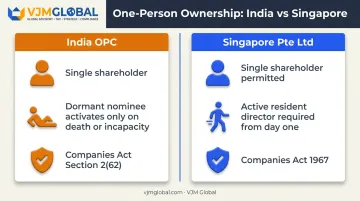
Singapore's Companies Act 1967 doesn't recognise a distinct "One Person Company" category. What it allows instead is a Private Limited Company (Pte Ltd) incorporated with just one shareholder and one director, who can be the same person.
Compare this to home turf: India's Companies Act 2013, Section 2(62), creates OPC as a standalone statutory category. It requires a nominee who steps in only if the sole member dies or becomes incapacitated. That nominee is a dormant safeguard, not an active operator.
Every Singapore company, regardless of shareholder count, needs two components:
- Owner/shareholder: Can be 100% foreign-owned, including by a single Indian individual
- Resident director: At least one director who is "ordinarily resident" in Singapore
Why the Resident Director Rule Trips Up Indian Applicants
This is where Singapore's structure differs from what Indian founders assume. India's OPC nominee is a backup plan that only activates on death or incapacity. Singapore's resident director is an active statutory requirement from day one. They carry ongoing legal responsibility for compliance the moment the company is incorporated.
Foreign founders still retain 100% ownership and full control. The resident director's role is a compliance function, not an equity stake. Many Indian founders satisfy this requirement through nominee director services offered by corporate service providers such as VJM Global, without diluting a single share of ownership.
Can Indian Citizens Register a One-Person Company in Singapore?
Yes. Indian citizens, whether based in India or elsewhere, can fully own a Singapore Pte Ltd. Foreign shareholding is unrestricted across most sectors, and ACRA confirms a local company can be entirely foreign-owned, including by a single individual shareholder.
That said, three requirements are non-negotiable for overseas Indian applicants:
- A registered filing agent — Non-residents cannot access Bizfile without Singpass or Corppass, so a Corporate Service Provider must file on your behalf
- A local resident director — a Singapore citizen, permanent resident, or eligible pass holder
- A local registered address — required for statutory correspondence and inspection
Relocation is optional. You can run the business remotely from India through a nominee director, or apply for an EntrePass, Employment Pass, or ONE Pass if you prefer to manage the company on the ground. Neither route changes your ownership percentage.
How to Set Up a One-Person Company (Pte Ltd) in Singapore from India: Step by Step
These steps assume you're working with a Corporate Service Provider, since self-filing isn't possible without a local Singpass or Corppass account.
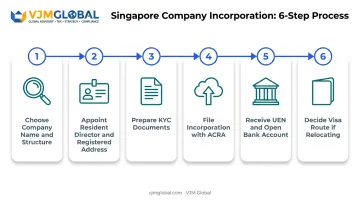
Step 1: Choose Your Company Name and Structure
Check name availability through Bizfile before anything else. ACRA rejects names that are identical or deceptively similar to existing entities. Reservation costs S$15 and, once approved, holds the name for up to 120 days.
Share capital can be as low as S$1. You can stay as sole shareholder at incorporation and split shareholding later if you bring on co-founders.
Step 2: Appoint a Local Resident Director and Registered Address
If you don't have a Singapore-resident co-director available, you'll need a nominee director service. This individual satisfies the residency requirement without touching your equity.
You'll also need a local registered office address for statutory correspondence. This is separate from where you actually operate the business.
Step 3: Prepare and Submit KYC Documents
Your filing agent will need:
- Passport copy
- Proof of Indian residential address
- Personal particulars for due diligence and AML checks
Hand these over, and the agent completes the Bizfile submission on your behalf.
Step 4: File Incorporation with ACRA via the Filing Agent
The agent submits your company name, SSIC code, registered address, share capital, and director/shareholder details electronically. Most straightforward applications are approved soon after payment; more complex cases can take up to 15 working days, and referral cases up to 60 days.
Step 5: Receive the UEN and Open a Corporate Bank Account
Once incorporated, you receive a Unique Entity Number (UEN) and a free business profile. This UEN identifies your company in every dealing with Singapore government agencies.
Opening a bank account as a non-resident is often the slowest part of the process. Some banks accept video KYC; others require in-person verification of directors and signatories. That can mean an unexpected trip if your provider has not arranged remote-friendly banking options.
Step 6: Decide on a Visa Route If Planning to Relocate
If you want to manage the business in person, you'll need an EntrePass, Employment Pass, or ONE Pass. If not, continuing to run the business remotely from India is fully permitted, provided compliance obligations are met on schedule.
Costs, Timeline, and Post-Incorporation Compliance
What It Costs
ACRA's statutory fees are straightforward: S$15 for name application plus S$300 for registration, totalling S$315. On top of this, budget for Corporate Service Provider (CSP) fees. These usually cover nominee director services, a registered address, and filing assistance, and they run as annual packages rather than one-off charges. Amounts vary by provider.
Realistic Timeline
| Stage | Typical Duration |
|---|---|
| Incorporation filing | A few working days to 15 working days |
| Nominee director onboarding | Varies by provider |
| Bank account opening | Days to several weeks (bank-dependent) |
| Visa application (if applicable) | 10 business days (EP) to 6 weeks (EntrePass) |
Incorporation itself moves fast once your documents are ready. Banking and any visa application are what stretch total setup time to several weeks.
Mandatory Ongoing Compliance
Incorporation is the easy part. What follows is where lapses actually cost you:
- Appoint a company secretary within 6 months of incorporation
- Hold an AGM (or qualify for exemption) and file an annual return with ACRA
- Maintain statutory registers of members, directors, and secretaries
- File a corporate tax return with IRAS annually
Those filings sit alongside Singapore's early-stage tax treatment, which is often the commercial reason founders accept the compliance load.
The Tax Advantage: SUTE
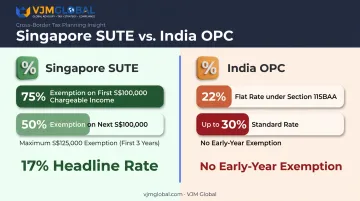
New Pte Ltds qualify for the Start-Up Tax Exemption: a 75% exemption on the first S$100,000 of chargeable income for each of the first three years, plus a further 50% exemption on the next S$100,000. That is a maximum exemption of S$125,000 per year against a headline 17% corporate tax rate.
Compare that with an Indian OPC, taxed as a domestic company at 22% (under Section 115BAA) or up to 30%, with no equivalent early-years exemption. This gap is a major reason Indian founders look at Singapore for holding or operating structures.
Missing a resident director requirement is not a minor slip. ACRA lists it as a common offence with penalties of up to S$10,000, and repeated non-filing can lead to prosecution or striking off.
Because nominee director, registered address, secretarial, and tax filing work all recur after day one, many Indian founders use one cross-border provider rather than separate vendors in each country. VJM Global bundles incorporation with these ongoing Singapore requirements so the post-setup calendar stays coordinated from India.
Conclusion
Singapore doesn't have a formal "OPC" category, but a single-shareholder Pte Ltd delivers the same solo-ownership convenience Indian founders want, with limited liability and clear tax efficiency.
Success here depends on getting the resident-director and compliance requirements right from day one, not treating incorporation as a one-time task. Annual returns, secretarial appointments, and tax filings don't pause just because you're managing the company from India.
Work with an experienced cross-border partner such as VJM Global to handle documentation, banking, and ongoing compliance. That frees you up to focus on growing the business.
Frequently Asked Questions
Can an Indian citizen start a business in Singapore?
Yes. Indian citizens can fully own and control a Singapore Private Limited Company. You must appoint a local resident director, maintain a registered address, and file through a registered agent—self-filing on Bizfile is not available to non-residents.
Does Singapore have a "One Person Company" like India?
No. Singapore's Companies Act has no distinct OPC category. The equivalent is a Private Limited Company incorporated with one shareholder and one director, who may be the same person if residency rules are met.
Do I need to move to Singapore to own a single-shareholder Pte Ltd?
No. The company can be managed remotely from India with a resident director handling local compliance. Relocation is only needed if you plan to work in Singapore on a work visa.
How much does it cost to set up a one-person Pte Ltd in Singapore from India?
ACRA's statutory incorporation fee is S$315 total. Nominee director, registered address, and filing agent fees are extra, vary by provider, and are usually billed as annual packages.
Can a single shareholder also be the sole director of a Singapore Pte Ltd?
Only if that person meets Singapore's residency requirement. Most Indian applicants do not, so they must appoint a separate local resident or nominee director alongside the sole shareholder.
What happens if I don't maintain compliance after incorporation?
Missed filings or an expired nominee director arrangement can trigger ACRA penalties, loss of good standing, or eventual striking off of the company. Resident director lapses alone carry fines of up to S$10,000.