Introduction
India's economy is growing at pace, and UK entrepreneurs—especially NRIs and solo consultants—are taking notice. According to Grant Thornton's India Meets Britain Tracker 2025, 1,197 Indian-owned companies now operate in the UK, generating combined revenues of £72.14 billion. Cross-border investment flows reflect this momentum: NRI deposits surged 43% to ₹1,15,477 crore during April-December 2024, per Reserve Bank of India data.
For UK-based Indian citizens exploring solo entry into the Indian market, the One Person Company (OPC) offers a direct, structured route. Introduced under India's Companies Act 2013, the OPC combines the simplicity of single ownership with the protection of limited liability—ideal for consultants, IT professionals, and service providers who want a lean India presence without the complexity of a Private Limited Company.
This guide covers everything UK-based NRIs need to know: eligibility, the registration process, document apostille requirements, and typical timelines. It also addresses ongoing compliance and when OPC is—and isn't—the right fit.
TL;DR
- OPC is a registered corporate entity under Section 2(62) of India's Companies Act 2013, offering limited liability and separate legal status for a single owner
- Only Indian citizens qualify; NRIs must have stayed in India for 120+ days in the preceding financial year—British nationals without Indian citizenship are not eligible
- Registration is done online via MCA's SPICe+ portal and typically takes 13–14 working days when documents are complete
- UK-sourced documents must carry Hague Apostille certification; a nominee who is an Indian citizen resident in India is mandatory
- OPC suits solo NRI consultants and service providers; those planning external investment or rapid scaling should consider a Private Limited Company
What Is an OPC and Can UK Entrepreneurs Register One?
A One Person Company is a corporate structure defined under Section 2(62) of the Companies Act, 2013. It allows a single person to act as both sole shareholder and director, with the benefits of limited liability, separate legal identity, and perpetual succession through a mandatory nominee.
Who Can Register an OPC from the UK?
Per Rule 3 of the Companies (Incorporation) Rules, 2014, only a natural person who is an Indian citizen — whether resident in India or not — can form an OPC. British nationals without Indian citizenship are not eligible.
The Companies (Incorporation) Second Amendment Rules, 2021, effective April 1, 2021, set the key threshold for UK-based NRIs: a 120-day residency requirement, reduced from the earlier 182-day rule. This means:
- NRIs who spent at least 120 days in India during the previous financial year can register an OPC
- British nationals without Indian citizenship cannot register an OPC — consider a Wholly Owned Subsidiary or Private Limited Company instead
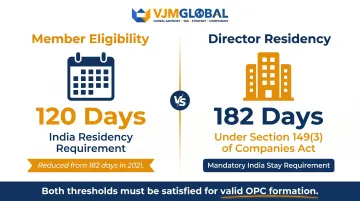
Note that these are two separate thresholds. The 120-day rule governs member eligibility, while Section 149(3) of the Companies Act requires at least one director to have stayed in India for not less than 182 days during the financial year. Your OPC must satisfy both.
How OPC Differs from Other Structures
OPC vs. Sole Proprietorship:
- Separate legal status and limited liability apply to OPCs — a sole proprietorship has neither
- Nominee succession means the OPC continues after the owner's death; a sole proprietorship does not
- Statutory audit is mandatory for OPCs; sole proprietorships face no such requirement
OPC vs. Private Limited Company:
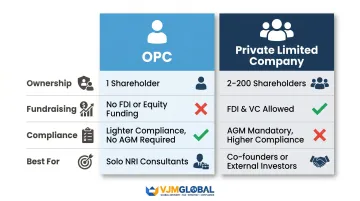
- Only one shareholder is permitted in an OPC; a Pvt Ltd requires between 2 and 200
- External equity and FDI from foreign corporate entities are not available to OPCs — Pvt Ltd structures allow both
- Compliance is lighter for OPCs (no AGM required); Pvt Ltd governance is more structured
- OPC names carry the suffix "(OPC) Private Limited"; Pvt Ltd names end in "Private Limited"
How to Register an OPC in India: Step-by-Step Process
The entire registration process runs online through India's Ministry of Corporate Affairs (MCA) portal using the SPICe+ (Simplified Proforma for Incorporating Company Electronically Plus) integrated form. UK-based applicants typically work with an India-registered Chartered Accountant or Company Secretary to manage filings remotely. VJM Global, which has served 250+ UK businesses, handles the complete process without requiring travel to India.
Step 1: Obtain a Digital Signature Certificate (DSC)
A Class 3 DSC is mandatory for all electronic filings with the MCA. UK-based applicants can obtain this through MCA-recognized certifying authorities, but you'll need to complete video-based KYC or submit notarised/apostilled identity documents. The nominee must also obtain a DSC. Processing typically takes 2 days.
Step 2: Name Reservation via SPICe+ Part A
Submit your proposed company name through SPICe+ Part A on the MCA portal. The name must end with (OPC) Private Limited. You can propose one name at a time. The Registrar of Companies (RoC) reviews for uniqueness and compliance with naming guidelines. Approval typically takes 2–3 working days. The RoC reserves the approved name for 20 days from the approval date.
Step 3: File SPICe+ Part B and Linked Forms
SPICe+ Part B is the core incorporation form covering:
- Director Identification Number (DIN) allotment
- Company details
- Simultaneous registration for PAN, TAN, GST (if applicable)
Each of the following linked forms must be digitally signed and submitted alongside SPICe+ Part B:
| Form | Purpose |
|---|---|
| INC-33 | e-Memorandum of Association (MOA) |
| INC-34 | e-Articles of Association (AOA) |
| INC-3 | Nominee consent (OPC-specific requirement) |
| INC-9 | Declaration by subscribers and first directors |
| DIR-2 | Director consent to act |
Professional certification: Form INC-8 requires certification by a practising Chartered Accountant, Company Secretary, Cost Accountant, or Advocate confirming compliance.
Step 4: Certificate of Incorporation
Upon approval by the RoC, you receive:
- Certificate of Incorporation with Company Identification Number (CIN)
- PAN and TAN auto-generated and issued by email
At this point, your OPC is legally registered and can open a bank account, enter contracts, and commence business.
Typical timeline: 13–14 working days end-to-end when all documents are in order:
| Stage | Time |
|---|---|
| DSC issuance | 2 days |
| Name approval | 2–3 days |
| DIN allotment | 5 days |
| Incorporation | 5 days |
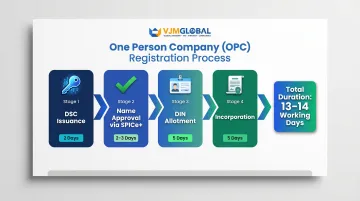
This is a practitioner-cited estimate based on VJM Global's experience with UK clients, not an official MCA guarantee.
Documents UK Entrepreneurs Need for OPC Registration
Identity and Address Documents
For the UK-based applicant:
- Passport: Primary identity document for NRIs/OCIs
- Indian PAN card: Mandatory — apply online through the NSDL portal if you don't already hold one
- Address proof: UK utility bills or bank statements are acceptable but must be apostilled under the Hague Convention
An apostille is an internationally recognised authentication stamp. Both the UK (member since 1965) and India (member since 2005) are signatories to the Hague Convention, so UK-issued documents bearing an apostille are accepted by Indian authorities without further legalisation. Any documents not in English also require certified translation.
Indian Registered Office Proof
Every OPC must have a registered office address in India. You'll need:
- Proof of ownership or rent agreement
- Utility bill not older than 2 months
- No Objection Certificate (NOC) from the property owner
Don't have physical premises yet? Virtual office addresses are accepted by MCA for OPC registration, provided the virtual office provider supplies the documents above. VJM Global can connect UK-based clients with compliant virtual office providers across major Indian cities, so this step doesn't become a bottleneck.
Nominee Documents
The nominee (who takes over in the event of the member's death or incapacity) must be an Indian citizen resident in India. Required documents include:
- PAN card
- Aadhaar card
- Residential address proof
- Recent photograph
- Signed consent in Form INC-3
Critical for UK-based entrepreneurs: Selecting a trustworthy nominee is a decision with real legal and operational weight. Since you're not physically present in India, choose someone reliable—many clients select a family member or professional advisor.
Constitutional Documents and Professional Certification
Once your nominee is confirmed, the final documentation layer covers your company's governing structure:
- e-MOA (Memorandum of Association): Sets out the company's objects and permitted activities
- e-AOA (Articles of Association): Governs internal rules and management procedures
- Form INC-8: A certification by a practising CA, CS, Cost Accountant, or Advocate confirming all compliance requirements are met
VJM Global's professionals handle drafting, certification, and MCA filing on your behalf — you won't need to travel to India at any stage.
Post-Registration: Compliance, Tax & Ongoing Costs
Annual Compliance Obligations
OPCs carry ongoing compliance obligations that must be met to avoid penalties under the Companies Act. The key recurring requirements are:
- Board meetings: At least one per half of each calendar year, with a minimum 90-day gap between them
- Form AOC-4 (financial statements): Filed within 180 days from financial year end
- Form MGT-7A (abridged annual return): Filed within 60 days from the date the resolution is entered in the minute book
- Statutory audit: Mandatory regardless of turnover — a Chartered Accountant must be appointed under Section 139 of the Companies Act
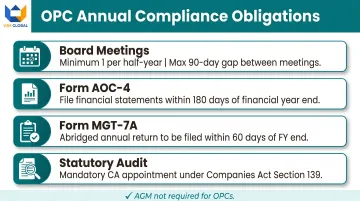
OPCs are exempt from holding Annual General Meetings under Section 96(1), which reduces one layer of administrative burden. Missing filing deadlines, however, attracts penalties — VJM Global manages all ongoing filings, audit coordination, and board meeting documentation for UK-based OPC owners.
Tax Obligations for UK-Based OPC Owners
OPCs pay India's corporate tax rate. Under Section 115BAA, the rate is 22% plus a 10% surcharge and 4% Health & Education Cess — an effective rate of approximately 25.17%.
When repatriating income to the UK, both Indian withholding tax and UK tax may apply. The India-UK Double Taxation Avoidance Agreement (DTAA) limits this exposure:
- Dividends paid to a UK-resident shareholder: 10% withholding (Article 11)
- Royalties and fees for technical services: 10–15% depending on nature
To claim treaty benefits, you'll need to confirm UK tax residency and submit Form 10F and a Tax Residency Certificate to Indian tax authorities. VJM Global's India-UK DTAA advisory service helps OPC owners navigate this process and reduce their cross-border tax liability.
Registration and Professional Costs
MCA Government Fees:
- OPCs with authorised capital up to ₹10 lakh: NIL registration fee
- Name reservation (SPICe+ Part A): ₹1,000 per application
- DIN application: ₹500 per director
Total professional fees for end-to-end OPC registration — covering DSC, name reservation, incorporation filing, MOA/AOA drafting, and CA/CS certification — typically range from ₹15,000–₹25,000 (approximately £135–£225). Virtual office setup and ongoing compliance costs are separate.
Post-Registration Steps Before Commencing Business
Within 180 days of incorporation, you must:
- Open a dedicated company bank account
- Deposit share capital
- File Form INC-20A (commencement of business declaration)
Two additional steps apply from day one:
- Register for GST if annual turnover will exceed ₹20 lakh (normal category states) or ₹10 lakh (special category states)
- Issue share certificates within 2 months of incorporation
UK entrepreneurs should consider appointing a local representative or retaining an India-based compliance firm like VJM Global to manage ongoing filings, GST registration, and bank account setup coordination.
OPC vs Other Business Structures: What UK Entrepreneurs Should Know
OPC vs. Private Limited Company
| Dimension | OPC | Private Limited Company |
|---|---|---|
| Ownership | Single shareholder only | 2–200 shareholders |
| Fundraising | Cannot issue equity to external investors; no FDI from foreign corporates | Can accept FDI, angel/VC funding |
| Compliance | Lighter; no AGM requirement | More structured governance; AGM mandatory |
| Name Format | (OPC) Private Limited | Private Limited |
That comparison shapes two clear decision paths. Here's how to read them.
When OPC Is NOT the Right Choice
Legally unavailable:
- You're a non-Indian UK citizen (British national without Indian origin)—your only routes are Wholly Owned Subsidiary or Private Limited Company
Strategically inappropriate:
- Your business model requires co-founders or external investors
- You operate in restricted sectors (financial services, insurance)
- You plan rapid scaling that may require conversion later—starting as Pvt Ltd may be more efficient
When OPC Is the Right Choice
If none of those constraints apply, OPC is often the most practical starting point.
Ideal for:
- Indian-origin NRIs in the UK who are solo consultants
- IT professionals or digital service providers
- Import-export traders
- Anyone wanting a lean, low-cost India corporate presence with full ownership control and simplified compliance
Growth context: As of December 2024, 62,894 OPCs were registered in India, up 17.8% year-on-year—faster growth than overall company registrations. The 2021 amendments removed mandatory conversion thresholds (previously ₹50 lakh paid-up capital or ₹2 crore turnover), meaning OPCs can now scale revenue without triggering mandatory conversion. Voluntary conversion to Pvt Ltd is permitted at any time.
Frequently Asked Questions
Can a UK citizen or NRI register a One Person Company in India?
Indian-origin NRIs residing in the UK can register an OPC if they meet the 120-day India residency requirement in the preceding financial year. Non-Indian British citizens are not eligible and should consider a Private Limited Company or Wholly Owned Subsidiary instead.
How much does it cost to register a one-person company in India?
MCA government fees are nil for OPCs with authorised capital up to ₹10 lakh. Total costs including professional fees typically range from ₹15,000–₹25,000 (approximately £135–£225 at current exchange rates). Virtual office and DSC costs add to the initial outlay.
How to register one person company in India?
Four main steps: obtain Class 3 DSC, reserve company name via SPICe+ Part A, file SPICe+ Part B with linked forms and nominee consent, and receive Certificate of Incorporation from the Registrar of Companies. The process takes 13–14 working days when documents are complete.
Can a single person start a company in India?
Yes — India's Companies Act 2013 introduced OPC specifically to allow a single individual to form and run a company with limited liability. Eligibility depends on Indian citizenship and residency thresholds outlined in the Act — covered in detail in the NRI eligibility question above.
Which is better OPC or Pvt Ltd?
OPC suits solo entrepreneurs wanting full ownership and lighter compliance. Pvt Ltd is better for those seeking external investment, multiple founders, or faster scaling — and it's the only available route for non-Indian British nationals.
What documents do UK entrepreneurs need for OPC registration in India?
Key items: apostilled passport and UK address proof, Indian PAN card, registered office proof in India (or virtual office documentation), and nominee documents including Form INC-3 consent. All UK-sourced documents must carry Hague Apostille certification.
VJM Global has guided 250+ UK businesses through India entry, including OPC and Pvt Ltd registration for UK-based NRIs. Reach the team at [email protected] or +91 98915 76441 to discuss your setup.