
Introduction
Singapore-based Indian citizens often struggle with establishing a formal corporate presence in India without maintaining physical residency. Many face uncertainty about eligibility rules, the document authentication maze, and whether they can legally incorporate a business remotely. Left unresolved, these gaps delay market entry and create real compliance exposure.
The One Person Company (OPC) structure — introduced under Section 2(62) of the Companies Act, 2013 — directly addresses this. It lets a single individual incorporate and operate a registered Indian company without being physically present in India. For Singapore-based NRIs, that means formal access to the Indian market, credibility with Indian clients and banks, and a structured vehicle for cross-border activity.
This guide covers what Singapore residents specifically need to know: eligibility criteria, Singapore-specific document authentication, the MCA registration process, ongoing compliance obligations, and the most common mistakes to avoid.
Key Takeaways
- Only Indian citizens — including Singapore-based NRIs — can form an OPC; foreign nationals cannot register one
- Registration is entirely digital via the MCA portal; documents must be notarized and apostilled in Singapore
- Four prerequisites before filing: a DSC, DIN, approved company name, and an Indian-resident nominee
- Registration typically takes 10–15 days once documents are in order
- Post-registration, expect annual filings, board meeting minutes, and ROC compliance every year
- Cross-border document errors are the most common cause of rejection — professional support at the apostille and filing stages reduces turnaround significantly
What Is a One Person Company (OPC) in India?
A One Person Company is a corporate structure introduced under Section 2(62) of the Companies Act 2013 that allows a single individual to serve as both sole shareholder and director, with a distinct legal identity separate from its owner.
Key benefits for solo operators include:
- Personal assets are shielded from company debts under Section 3(2)(a)
- Recognized legal entity for contracts, fundraising, and business operations
- Stronger standing with banks, clients, and institutional partners
OPC vs. other structures at a glance:
| Structure | Members | Liability | Separate Legal Entity |
|---|---|---|---|
| Sole Proprietorship | 1 | Unlimited | No |
| OPC | 1 | Limited | Yes |
| Private Limited | 2+ shareholders, 2+ directors | Limited | Yes |
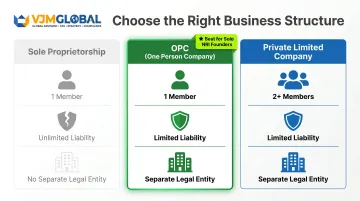
For Singapore-based entrepreneurs entering India solo, OPC delivers full corporate credibility and liability protection — without requiring a second shareholder or a resident co-founder on the cap table.
Who Can Register an OPC from Singapore? Eligibility Rules Explained
Primary requirement: Only a natural person who is an Indian citizen can form an OPC — this includes NRIs. Physical residence in India is not required; Indian citizenship is the qualifier.
2021 regulatory breakthrough: Gazette Notification GSR 91(E) dated 01 February 2021 removed the prior 182-day India residency requirement. Singapore-resident Indian citizens can now incorporate an OPC without fulfilling any minimum stay period in India.
Who is explicitly ineligible:
- Foreign nationals (including Singapore citizens who are not Indian citizens)
- Corporate entities
- Minors
- Persons of Indian origin who have renounced Indian citizenship
Singapore permanent residents of Indian origin who have renounced citizenship cannot register an OPC. A Private Limited Company with FDI compliance is the appropriate route for them.
Mandatory nominee requirement:
Per Rule 3(1) of the Companies (Incorporation) Rules 2014, the sole member must appoint an Indian citizen residing in India as a nominee during incorporation. This nominee steps in to manage the company if the member dies or becomes incapacitated.
The nominee must provide:
- Written consent in Form INC-3
- PAN card, identity proof, and address proof
- Confirmation of Indian citizenship and residency
Two additional constraints apply once you meet the basic eligibility criteria:
- One-OPC limit: A person may be a member of only one OPC at a time. If you become a member of a second OPC as a nominee, you must withdraw from one within 180 days.
- Restricted activities: OPCs cannot engage in non-banking financial investment activities, including acting as an NBFC or investing in securities of other companies. Singapore entrepreneurs in fintech or investment sectors should confirm their intended business activity qualifies before filing incorporation documents.
Documents Required to Register an OPC from Singapore
Director Identity and Address Documents
- Indian passport (essential proof of Indian citizenship)
- PAN card
- Singapore address proof — utility bill or official Singapore government-issued address document
Singapore-Specific Authentication: Apostille Requirement
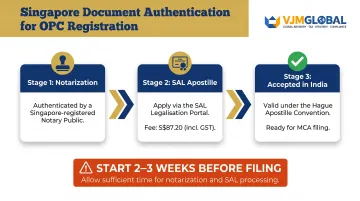
Critical: All documents originating in Singapore must be:
- Notarized by a Singapore-registered Notary Public
- Apostilled through the Singapore Academy of Law (SAL)
India and Singapore are both parties to the Hague Apostille Convention. Documents apostilled by SAL are accepted in India without additional authentication at the Indian consulate. Start this process early — delays here are the most common bottleneck in OPC registrations from Singapore.
SAL apostille process:
- Apply online via the SAL Legalisation Portal
- Authentication fee: S$87.20 (inclusive of GST)
- Processing time: varies; begin 2–3 weeks before filing
Nominee Documents (India-Resident)
The Indian nominee must provide:
- PAN card
- Identity proof (Aadhaar, passport)
- Address proof
- Signed consent in Form INC-3
These documents do not require apostille since the nominee is in India.
Registered Office Documents (India Address)
The OPC must have a registered office address in India. Required documents:
- Rental agreement or property ownership deed
- Utility bill in the owner's name
- No Objection Certificate (NOC) from property owner
For Singapore-based founders without Indian property: A virtual office address service is a practical solution. VJM Global, for instance, offers registered office addresses in Noida, Delhi, Mumbai, Bangalore, Chennai, and Hyderabad — useful if you don't hold Indian property.
Digital Credentials
- Digital Signature Certificate (DSC): Obtain a Class 3 DSC from a certified Indian authority (eMudhra, NSDL, or Sify) — the application is fully remote via video verification.
- Director Identification Number (DIN): No separate application needed; DIN is integrated within the SPICe+ Part B form during filing.
Once all documents are in order, you can move directly to the SPICe+ filing process on the MCA portal — fully accessible from Singapore.
How to Register an OPC in India from Singapore: Step-by-Step
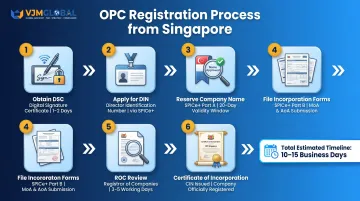
The entire registration is conducted digitally via the Ministry of Corporate Affairs (MCA) portal. The process involves six sequential steps, typically completed in 10–15 days when documents are in order.
VJM Global handles this process end-to-end for Singapore-based clients — coordinating portal filings, document preparation, and ROC correspondence so nothing falls through the cracks.
Step 1: Obtain a Digital Signature Certificate (DSC)
Apply for a Class 3 DSC from a government-certified certifying authority in India. The process is fully remote:
- Submit identity documents digitally
- Complete video verification
- Receive DSC within 1–2 days
The DSC is used to sign all official MCA forms and is required for every filing that follows.
Step 2: Apply for a Director Identification Number (DIN)
DIN application is integrated within SPICe+ Part B. There is no separate filing for new companies. The DIN is a unique number assigned by the MCA to identify company directors and is generated automatically during the incorporation process.
Step 3: Reserve the Company Name
Submit SPICe+ Part A on the MCA portal to propose and reserve a unique company name.
Three rules govern name selection:
- Format: Must follow "[Name] (OPC) Private Limited" — for example, "ABC (OPC) Private Limited"
- Availability: Use the MCA's name search tool to check for conflicts with existing names or trademarks; the MCA rejects names that are too generic, too similar to existing registrations, or potential trademark infringements
- Validity window: Once approved, the MCA reserves the name for 20 days — all incorporation forms must be filed within this period
Step 4: Prepare and File Incorporation Forms
File the following forms via the MCA portal:
Forms required:
| Form | Purpose |
|---|---|
| SPICe+ Part B | Company incorporation, DIN, PAN, TAN, GSTIN |
| SPICe-MoA (INC-33) | Memorandum of Association (business objects) |
| SPICe-AoA (INC-34) | Articles of Association (internal governance) |
Attached documents:
- Apostilled identity proofs
- Registered office documents
- Nominee consent (Form INC-3)
Auto-generated registrations: Upon successful filing, the system automatically generates PAN and TAN for the company — no separate applications needed.
Step 5: Review and Certificate of Incorporation
Once SPICe+ is submitted, the Registrar of Companies (ROC) reviews the application and may request clarifications or additional documents. Upon successful verification, the ROC issues:
- Certificate of Incorporation (Form INC-11): the legal birth document of the OPC
- Corporate Identity Number (CIN): unique identifier for the company
This certificate authorizes commencement of business operations in India.
Timeline: Certificate typically issued within 3–5 working days after SPICe+ submission, assuming no errors.
Post-Incorporation Compliance for Singapore-Based OPC Owners
Immediate Post-Incorporation Steps
Complete these three steps immediately after incorporation:
- Open a corporate bank account in India. Required documents: Certificate of Incorporation, PAN card, and a board resolution authorizing account opening.
- Deposit authorized capital into the newly opened account.
- Register for GST (if applicable). Registration is mandatory if anticipated turnover exceeds ₹40 lakh for goods suppliers or ₹20 lakh for services suppliers.
Annual Compliance Obligations
Board meetings: At least two board meetings per financial year with a minimum 90-day gap between them (Section 173(5) of Companies Act 2013).
Exception: Single-director OPCs are exempt from formal board meetings; resolutions are recorded in the minutes book.
Annual filings:
| Filing | Form | Due Date | Penalty for Late Filing |
|---|---|---|---|
| Financial Statements | AOC-4 | Within 180 days from FY end | ₹100 per day |
| Annual Return (OPC) | MGT-7A | 60 days from AGM date | ₹100 per day |
| Corporate Income Tax | ITR-6 | 31 October of Assessment Year | Interest + penalty |
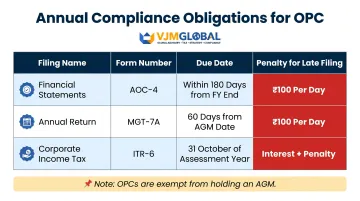
Note: OPCs are exempt from holding an Annual General Meeting (AGM).
India-Singapore DTAA Considerations
Singapore-based OPC owners need to understand how income flows and is taxed across both jurisdictions under the India-Singapore Double Tax Avoidance Agreement.
Article 7 (Business Profits): Business profits of a Singapore-resident enterprise are taxable only in Singapore unless the enterprise maintains a permanent establishment (PE) in India.
Key implication: The OPC registered in India is a separate legal entity (Indian company) and is taxed in India on its Indian-source income. The Singapore-resident owner's personal business profits would generally be taxable only in Singapore unless the owner personally maintains a PE in India.
Permanent Establishment thresholds:
- Construction PE: 183 days
- Service PE: 90 days (30 days for related enterprises)
Statutory Registers Requirement
The OPC must maintain the following registers at its registered office in India:
- Register of directors
- Register of members
- Board meeting minutes
Singapore-based owners generally manage this through a registered office service provider or local compliance partner in India. VJM Global's compliance team handles statutory register maintenance alongside annual filings and DTAA advisory, giving Singapore-based owners a single point of contact for India obligations.
Common Challenges When Registering an OPC from Singapore (and How to Avoid Them)
Document Authentication Delays
The apostille process in Singapore — notarization followed by authentication through SAL — is time-consuming and catches many applicants off guard.
Begin document preparation and authentication at least 2–3 weeks before filing. VJM Global can help you identify exactly which documents require apostille and the correct filing formats.
Nominee Coordination from Abroad
Identifying a trustworthy India-resident nominee and obtaining their properly executed consent before the filing deadline is frequently underestimated.
Common errors that trigger full application rejections include:
- Invalid or expired nominee documents
- Incorrect format in Form INC-3
- Nominee not meeting citizenship or residency requirements
Any one of these errors can reject the entire application. Work with an advisor who has an established nominee network — this is not the step to improvise.
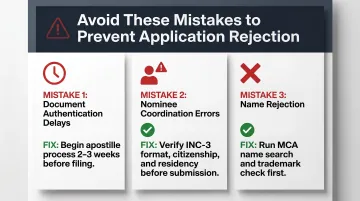
Name Rejection and Resubmission Delays
The MCA rejects names that are:
- Too generic
- Similar to existing registered names
- Trademark infringements
Each rejection requires a new SPICe+ Part A filing and a fresh 20-day window.
Conduct thorough name availability and trademark searches before submitting. Use the MCA's auto-check feature in SPICe+ Part A for first-level screening.
When OPC May Not Be the Right Structure
OPC is not viable if:
- You are a Singapore citizen who has renounced Indian citizenship
- Your business involves financial investment or NBFC-type operations
- You need multiple shareholders or directors from day one
In these cases, a Private Limited Company with FDI compliance is typically the better fit. VJM Global provides FDI advisory and can guide you through the right structure for your specific business model.
Frequently Asked Questions
How to register an OPC company in India?
OPC registration is done entirely online through the MCA portal. Start by obtaining a DSC and DIN, then file SPICe+ forms with the company name, Memorandum of Association, Articles of Association, and supporting documents. Upon ROC approval, the Certificate of Incorporation is issued.
How much does it cost to register an OPC in India?
Core costs include MCA government fees (approximately ₹500 for authorized capital up to ₹1 lakh), name reservation (₹1,000), DIN application (₹500), DSC charges, apostille fees, and state-specific stamp duty. Professional service fees vary based on scope. Contact VJM Global for a tailored quote.
How long does it take to register an OPC in India?
DSC and DIN can be obtained within 1–2 days. The Certificate of Incorporation typically takes 3–5 working days after SPICe+ submission. The full process including document preparation and apostille from Singapore typically takes 10–15 days.
Can OPC be registered as a startup in India?
Yes, an OPC can apply for recognition under the DPIIT Startup India scheme if it meets eligibility criteria: incorporated as a Private Limited Company (OPCs qualify), existence not exceeding 10 years, annual turnover under ₹100 crore, and demonstrable innovation or scalability.
Can a Singapore-based NRI register an OPC in India?
Yes, provided the individual holds Indian citizenship. After the 2021 rule amendment, NRIs (including Singapore residents) no longer need to fulfill the 182-day residency requirement. Singapore citizens who are not Indian citizens are not eligible.
Do I need to travel to India to register an OPC from Singapore?
No physical travel is required. The entire registration process is conducted digitally via the MCA portal. However, documents must be apostilled in Singapore, and you'll need a local Indian address and a resident nominee — both of which VJM Global can help coordinate remotely.
Ready to establish your OPC in India from Singapore? VJM Global's chartered accountants and business setup specialists handle everything from document preparation and apostille guidance to MCA filing and post-incorporation compliance. Contact us at [email protected] or call +91 98915 76441 to get started.