That single change explains why so many Indian entrepreneurs are now incorporating directly from India, without ever setting foot in Dubai or Abu Dhabi. The draw is straightforward: full ownership, a favourable tax position, and a foothold in the wider GCC market.
Many founders still assume a UAE company automatically means sharing equity with a local sponsor. That's no longer true for most activities. This guide walks through eligibility, documentation, jurisdiction choice, and the actual incorporation steps, so you know exactly what to expect before you start.
Key Takeaways
- Own 100% of a UAE LLC in mainland or free zone—no Emirati sponsor required for most activities
- Form the company remotely from India; UAE residency is not required to be sole shareholder
- Choose mainland vs free zone first—it drives cost, market access, and visa entitlement
- Include your name in the trade name if you want, with the correct legal suffix and naming rules
- Complete FEMA/LRS reporting in India separately when you fund the UAE entity
What Is a One-Person LLC in the UAE?
A one-person LLC is exactly what it sounds like: a Limited Liability Company incorporated with a single natural or corporate person as the sole shareholder. That person holds 100% of the shares, and their personal liability stays capped at the capital stated in the company's memorandum of association.
The legal foundation for this comes from Federal Decree-Law No. 26 of 2020, which amended the UAE's Commercial Companies Law and took effect in 2021. It removed the requirement for a majority Emirati shareholder across most mainland commercial and industrial activities.
Cabinet Resolution No. 77 of 2022 then set out the mechanics for single-owner LLCs specifically, including a five-business-day decision window once a complete application is filed.
You have two formats to choose from:
- Mainland single-owner LLC — licensed by the Department of Economic Development (DED) in the relevant emirate
- Free zone single-owner FZE/FZ-LLC — licensed by the specific free zone authority (DMCC, RAKEZ, SPC, JAFZA, and others)
How a UAE One-Person LLC Differs from an Indian OPC
Founders researching both structures often assume the rules mirror each other. They don't.
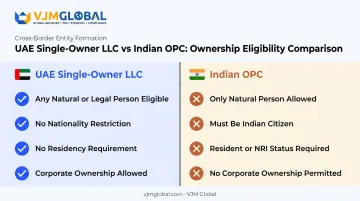
India's One Person Company was updated in April 2021, and any Indian citizen (resident or NRI) can now form one. The catch is that the sole member must be a natural person and an Indian citizen — no exceptions.
The UAE's single-owner LLC works differently:
- Any natural or legal (corporate) person can be the sole shareholder
- There's no nationality restriction and no residency requirement for the owner
- The applicant can complete most steps without ever holding UAE residence status
That last point is what genuinely surprises most founders. You don't need to move to the UAE, or even hold a UAE visa, to legally own the company outright.
Why Indian Entrepreneurs Are Choosing UAE One-Person LLCs
The 2021 reform removed the mandatory 51% Emirati shareholder rule for most commercial and industrial activities. That single change opened the door for solo founders who previously had no realistic path to full ownership on the mainland.
Tax positioning adds to the appeal. The UAE charges 0% personal income tax on individuals, and its corporate tax sits at 0% on taxable income up to AED 375,000, rising to 9% above that threshold.
Free zone entities get a further carve-out: a Qualifying Free Zone Person pays 0% on Qualifying Income. That rate depends on substance requirements, transfer pricing documentation, and audited accounts. Skip those conditions and you risk losing the benefit entirely.
Beyond tax, there's market positioning to consider:
- The UAE sits within easy reach of GCC, African, and European buyers
- It maintains a wide network of double-taxation treaties that ease profit repatriation
- Several free zones now run digital-first setups, with licences issued in as little as ten working days once documents are complete
There's also a credibility factor that founders underestimate. A formal LLC, rather than a freelance permit, opens doors a freelance permit cannot:
- Corporate bank accounts (freelance permits often get rejected outright)
- B2B contracts that require a registered legal entity
- Investor trust, particularly if you're raising capital later
VJM Global’s Chartered Accountants cover both UAE incorporation procedures and Indian FEMA outbound-investment rules. That combination matters. Choosing the wrong jurisdiction or misfiling a remittance form can cost weeks of delay, and founders rarely discover the mistake until the bank account stage.
What to Know Before You Start: Eligibility, Documentation, and Budget
Eligibility is straightforward for most founders. You can set up as a sole shareholder if you clear these basics:
- Any Indian citizen, resident or NRI, can own 100% of the company
- No minimum net worth requirement
- No UAE residency required to register
- Regulated or "strategic" activities may add conditions (the exception, not the rule)
Documents you'll typically need:
- Passport copy (valid, clear scan)
- Passport-size photograph
- Proof of address
- A short description of your intended business activity
- Emirate-specific NOCs, if you're going the mainland route
Most activities no longer require a local Emirati partner or service agent. That exception still applies to certain regulated sectors, so confirm this before you commit to an activity code.
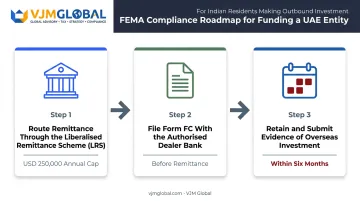
On the Indian side, FEMA compliance runs in parallel with UAE incorporation. Indian residents funding an overseas entity must:
- Route the remittance through the Liberalised Remittance Scheme, which caps outward remittance at USD 250,000 per financial year for resident individuals
- File Form FC with their authorised dealer bank before the first remittance
- Retain evidence of the overseas investment and submit it to the bank within six months of the transaction
Miss that six-month window, and RBI rules require you to repatriate the funds. This is exactly the kind of deadline that gets overlooked when founders focus entirely on the UAE side of the process.
Budget and Timeline to Expect
Costs vary sharply by jurisdiction and activity, so treat these as starting points, not fixed quotes.
| Jurisdiction | Approximate Cost | Visa Included |
|---|---|---|
| DMCC (Dubai) | AED 31,935.60 | Flexi-desk with one-visa eligibility |
| RAKEZ (Ras Al Khaimah) | AED 14,000/year | One residence visa included |
| SPC Free Zone (Sharjah) | AED 5,750 (zero-visa) | Add-on for one visa |
| Mainland (any emirate) | Varies by activity, office rent, and approvals | Tied to office size |
Mainland costs don't have a single published benchmark, since they depend on your activity, external approvals, and office lease. Get a written quote before budgeting.
Timing: Mainland authorities must decide within five business days of a complete application. Free zones vary: some issue licences in about ten working days, others same-day. Corporate bank account opening almost always takes longer than incorporation itself, since banks run enhanced due diligence on single-owner entities.
Once you start trading, budget for:
- Corporate tax registration within three months of incorporation (entities formed after March 2024)
- VAT registration when turnover crosses AED 375,000 (5% rate)
- Annual trade licence renewal
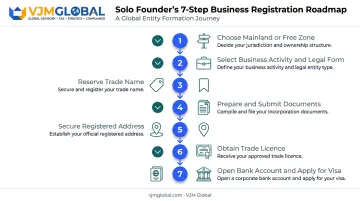
How to Set Up a One-Person LLC in the UAE from India – Step by Step
Most of this process can run remotely from India. Only a handful of steps need your physical presence in the UAE—biometrics for a visa is the main one. One common mistake: picking a free zone purely on price without confirming it actually licenses your specific business activity. That mismatch surfaces late, and it's expensive to fix.
Step 1: Decide Between Mainland and Free Zone
Choose the jurisdiction that matches how you plan to trade:
- Mainland: Trade anywhere in the UAE and internationally with no zone limits
- Free zone: Faster setup, lower entry costs, and in-zone customs benefits
- Mainland trading from a free zone: Usually needs a separate arrangement or distributor
- Visas: RAKEZ entry packages often include one visa at roughly AED 14,000 a year; mainland quotas usually scale with office size
Step 2: Choose the Business Activity and Confirm the Single-Owner LLC Legal Form
Your chosen activity determines who regulates you: the DED for mainland, or the relevant free zone authority otherwise. When you file the application, make sure "single-owner LLC" is explicitly selected as the legal form. Some portals default to a different structure if you're not paying attention.
Step 3: Reserve a Compliant Trade Name
Naming rules are more flexible than many founders assume. Your trade name can derive from your business objective or your own name, provided it carries the correct legal suffix denoting a single-owner LLC. Standard restrictions still apply: no offensive language, and no references to government bodies.
Step 4: Prepare and Submit Incorporation Documents
Documents originating in India, such as passport copies or a power of attorney, may need attestation via the UAE Ministry of Foreign Affairs, depending on which jurisdiction you're incorporating in. Your memorandum of association must clearly reflect sole ownership.
Step 5: Secure a Registered Address
Mainland entities need a physical office backed by an Ejari tenancy contract. Many free zones offer flexi-desk or virtual-office packages instead, which suit solo founders who don't need dedicated floor space.
Step 6: Obtain the Trade Licence and Certificate of Incorporation
Once your application is approved and fees are paid, the licensing authority issues your trade licence and certificate of incorporation. This is the point your LLC becomes legally active.
Step 7: Open a Corporate Bank Account and Apply for a Residence Visa
UAE banks apply enhanced due diligence on single-owner entities. Come prepared with:
- A clear business plan
- Proof of source of funds
- Full company incorporation documents
A residence visa is a separate application from incorporation, filed through GDRFA once your company documents are in order.
Conclusion
Setting up a one-person LLC in the UAE from India is accessible now, thanks to the 2021 ownership reforms. But the outcome still hinges on two things: picking the right jurisdiction for your activity, and getting your FEMA and documentation compliance right from day one.
A cross-border specialist helps you get both right the first time. VJM Global’s Chartered Accountants handle Indian outbound (FEMA) rules and UAE incorporation side by side, so you avoid the documentation gaps and banking delays that stall many solo applicants.
Frequently Asked Questions
What is a One-Person Company (OPC) in the UAE?
It's a single-shareholder LLC recognised under the amended UAE Commercial Companies Law. Unlike a sole proprietorship, it offers limited liability, capping your personal risk at the capital stated in the company's memorandum of association.
Can I form a single-owner LLC (one-person company) in the UAE?
Yes. Both residents and non-residents, including Indian citizens, can form one in mainland or free zone jurisdictions under Federal Decree-Law No. 26 of 2020 and its follow-on regulations.
Can an Indian citizen own 100% of a UAE LLC?
Yes, for most commercial and industrial activities since the 2021 reform. A short list of "strategic" sectors remains restricted or requires special government approval.
Do I need to be a UAE resident to set up a one-person LLC?
No, residency isn't required to incorporate. However, certain steps, such as bank account opening or visa stamping, may require your physical presence in the UAE.
What is the difference between a UAE one-person LLC and an Indian OPC?
An Indian OPC must have a natural-person Indian citizen as its sole member. A UAE single-owner LLC allows any natural or legal person, of any nationality, with no residency requirement.
How long does it take to set up a one-person LLC in the UAE from India?
Free zones can issue licences in around ten working days; mainland authorities must decide within five business days of a complete file. Corporate bank account opening usually adds extra time beyond incorporation itself.