Introduction
The UAE has become the preferred expansion destination for Indian entrepreneurs. Reforms allowing 100% foreign ownership, zero personal income tax, and fully digital incorporation have turned what used to require a local partner into a solo founder's project.
Freelancers, exporters, e-commerce sellers, and even established Indian private companies struggle with the same question: can I set up and own a UAE company entirely on my own, without adding a local shareholder?
The short answer is yes, but the structure isn't called an "OPC" the way Indian founders might expect. This guide covers what a single-owner UAE company actually looks like, why Indian founders choose this route, and exactly how to set one up.
Key Takeaways
- UAE “OPC” means a single-shareholder LLC—not a separate entity type like India’s OPC
- Indian individuals and companies can own 100% of most Mainland and Free Zone entities with no local sponsor
- Licensing usually takes 1–3 weeks; bank approval takes longer and isn’t guaranteed by incorporation
- Free zone costs vary widely—pick for activity and banking fit, not the lowest fee
- Indian founders must complete India-side FEMA/ODI reporting—easy to overlook
What Is a "One Person Company" in the UAE?
Here's a correction worth making upfront: many guides claim the UAE has no formal "OPC" term. That's not quite accurate.
Federal Decree-Law No. 32 of 2021 on Commercial Companies actually names this exact structure a One Person Company (OPC).
Under Article 72, a single-shareholder LLC's trade name must carry the expression "Limited Liability One Person Company (OPC)." Article 71(2) confirms that any single natural or legal person can incorporate and own an LLC, with liability capped at the stated capital.
In practice, a UAE OPC is a one-owner configuration of the standard LLC, not a separate corporate category like India's. Functionally, it gives one individual or corporate shareholder:
- 100% share ownership
- Limited liability protection
- A distinct legal identity, separate from the owner personally
The Trade Name Question
There's some conflicting guidance floating around here. An older Ministry of Economy FAQ states that a one-person LLC's name shouldn't be linked to the owner's personal name. But the 2021 law itself permits an LLC name derived from a partner's name.
Practically, this means naming rules can vary by emirate and free zone authority. Always confirm the current naming policy with the DED or free zone at the application stage rather than assuming either rule applies universally.
Mainland OPC vs. Free Zone FZE
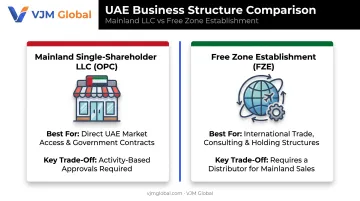
| Structure | Best for | Key trade-off |
|---|---|---|
| Mainland single-shareholder LLC (OPC) | Businesses needing direct UAE market access or government contracts | Subject to activity-based approvals |
| Free Zone Establishment (FZE) | International trade, consulting, holding structures | Selling directly on the mainland usually needs a distributor or separate mainland licence |
An Indian company (Pvt Ltd or LLP) can itself act as the sole corporate shareholder of either structure. That makes the route relevant not just to solo founders, but to Indian companies that want a UAE arm without a local partner.
One caveat: Pvt Ltd companies are routinely accepted as corporate shareholders. LLP constitutional documents sometimes need extra verification by the licensing authority, so confirm this early.
Why Indian Entrepreneurs and Companies Are Choosing This Route
A UAE single-owner company isn't a shortcut to instant global business. It works well under specific conditions.
The upside is real:
- 100% ownership without a local sponsor for most activities
- No personal income tax on individuals
- A competitive corporate tax structure : taxable income up to AED 375,000 is taxed at 0%, with 9% applying above that threshold
Indian interest in UAE incorporation isn't anecdotal. Indian businesses topped the list of nationalities registering new companies with the Dubai Chamber of Commerce during Q1–Q3 2024, with 12,142 new members . That made them the largest group among all non-Emirati nationalities that year.
Where founders underestimate effort:
Incorporation itself is mostly digital and fast. Opening a functional bank account and securing a residence visa are not. Banks run separate KYC checks on the company, its signatories, and its ultimate beneficial owners . This stage often takes longer than the licensing itself.
Don't forget the India side. Setting up a UAE entity isn't purely a UAE decision. Indian residents and companies must file Form FC through their designated bank under RBI's Overseas Investment framework when making a financial commitment or remittance, whichever happens first. Missing this step creates FEMA compliance headaches long after the UAE company is up and running.
Key Decisions Before You Start a One Person Company in the UAE
Most setup problems don't come from paperwork errors. They come from picking the wrong jurisdiction or license type before understanding what the business actually needs.
Mainland or Free Zone?
Mainland suits businesses trading directly within the UAE or bidding for government contracts.
Free zone suits import/export, consulting, and holding structures aimed at international clients.
Choosing the Right Free Zone
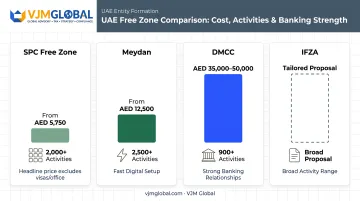
Cost, permitted activities, visa quota, and banking track record vary across zones. A rough comparison:
| Free Zone | Typical published cost | Activity range | Notes |
|---|---|---|---|
| DMCC | AED 35,000–50,000 (first year, typical) | 900+ activities | Established banking relationships |
| Meydan | From AED 12,500 (standard) | 2,500+ activities | Fast digital setup |
| SPC Free Zone | From AED 5,750 | 2,000+ activities | Headline price often excludes visas/office |
| IFZA | Tailored proposal, no published rate | Broad activity range | Quote depends on package scope |
These figures aren't apples-to-apples. Compare what's actually included — activity approvals, visa allocations, mandatory address, and renewal fees — not just the number on the homepage.
License Type and Budget
Select your license type (commercial, professional, industrial, or holding) based on your activity, not preference. Once you've picked a zone and license, budget for the full package:
- License fee
- Flexi-desk or office cost
- Visa costs
- Annual renewal fees
The most common misstep is choosing the cheapest free zone package without checking whether it supports the banking relationships or activity approvals the business actually needs. A cross-border advisory firm like VJM Global helps founders catch jurisdiction mismatches before money has already changed hands.
How to Start a One Person Company in the UAE – Step by Step
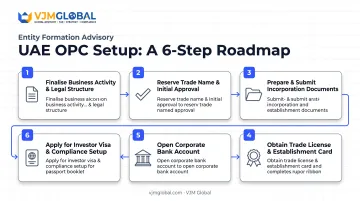
Breaking incorporation into clear stages helps first-time overseas founders avoid common delays. Three mistakes come up repeatedly: finalising a license before checking banking eligibility, underestimating visa processing time, and ignoring annual renewal costs when budgeting.
Step 1 – Finalise Business Activity and Legal Structure
UAE licensing is activity-specific, not generic. Identify the exact licensed activity first, then decide between a Mainland single-shareholder LLC or a Free Zone FZE based on where your clients actually are: local UAE market versus international trade.
Step 2 – Reserve Trade Name and Secure Initial Approval
Submit 2–3 proposed names that comply with UAE naming rules. Obtain initial approval from the relevant Free Zone Authority or the Department of Economic Development. Initial approval confirms the name and structure, not permission to start operating.
Step 3 – Prepare and Submit Incorporation Documents
Compile passport copies, proof of address, and (for certain activities) a business plan or MOA. If an Indian company is the corporate shareholder, its incorporation papers typically need attestation.
Here's a detail many founders miss: India's Hague Apostille status doesn't shortcut the UAE process. Even though India is a signatory to the Apostille Convention, UAE-bound documents generally still need India's Ministry of External Affairs attestation, then UAE Embassy/MoFA attestation.
A bundled apostille alone isn't accepted. Each document needs individual handling, and translations into Arabic or English may be required.
Step 4 – Obtain the Trade License and Establishment Card
Once documents clear, pay the licensing fees and receive the trade license along with the establishment/immigration card needed for visa processing.
This stage typically wraps up within 1–3 weeks depending on the authority. Published timelines vary; some free zones advertise same-day issuance for straightforward cases.
Step 5 – Open a Corporate Bank Account
This is where single-owner entities with Indian shareholders often hit friction. UAE banks apply full Customer Due Diligence checks, tracing ownership through to individuals holding 25% or more, or to the senior managing official.
Practical steps that improve approval odds:
- Maintain audited or clearly organised financials
- Show real business substance (contracts, invoices, a functioning office)
- Have at least one UAE-resident signatory where the bank requires it for digital onboarding
A trade license does not guarantee a bank account. Treat this as its own workstream, not an afterthought.
Step 6 – Apply for the Investor Visa and Set Up Post-Incorporation Compliance
With the license and establishment card in hand, apply for the owner's UAE residence/investor visa. In parallel:
- Register for VAT once turnover crosses the mandatory threshold
- Register for Corporate Tax with the Federal Tax Authority
- Set up bookkeeping from day one rather than reconstructing records later
From here, compliance is ongoing rather than a one-off task. VJM Global supports Indian founders on jurisdiction choice, VAT and corporate tax registration, and bookkeeping, so formation and filings stay under one roof.
Conclusion
Starting a one-person company in the UAE comes down to one decision for Indian founders: match mainland or free zone to what the business actually does. The lowest headline price often backfires once banking and activity approvals begin.
Before you file, lock in three priorities:
- Choose the structure for your activity, clients, and ownership goals—not the brochure rate
- Treat documentation accuracy and bank readiness as part of setup, not a follow-up task
- Plan visa renewals, tax filings, and compliance dates before the license is issued
A license in three days means little if the account takes three months. Get the structure and banking path right first; ongoing filings keep the company in good standing as it grows.
VJM Global helps Indian companies with UAE entity formation, banking-ready documentation, and ongoing tax and compliance support after incorporation.
Frequently Asked Questions
Can an Indian open a company in the UAE?
Yes. Indian citizens and companies can own 100% of most UAE mainland and free zone entities without a local sponsor. A short list of strategic-impact sectors, such as banking, telecoms, and defence, still require local participation set by the regulator.
What is OPC in the UAE?
In the UAE, OPC means a single-shareholder LLC under Federal Decree-Law No. 32 of 2021—not a separate company type like India's Companies Act OPC. The free zone equivalent is the FZE.
Do I need a local UAE sponsor for a one-person company?
Most commercial and professional activities now allow full foreign ownership with no local sponsor required. Exceptions apply to a defined list of strategic-impact activities, including fisheries services, which require 100% national participation.
What is the cost of setting up a one-person company in the UAE from India?
Free zone packages start from roughly AED 5,750 for basic setups and can run to AED 35,000–50,000 for established zones like DMCC once visas and premises are included. Mainland costs depend heavily on activity and external approvals, so a tailored quote is the practical next step.
Can I set up a UAE company without visiting the UAE?
Many free zones, including DMCC, support fully remote incorporation. Bank account opening is a separate matter: some banks offer digital onboarding for eligible applicants, while others require an in-person visit depending on the entity structure.
What is the difference between a mainland and free zone one-person company?
A mainland company can trade across the UAE and bid for government contracts, subject to activity approvals. A free zone company keeps 100% ownership but usually needs a mainland distributor or separate mainland presence to sell directly to local customers.