Introduction
Indian entrepreneurs, freelancers, and consultants are increasingly registering solo Pty Ltd companies in Australia to service clients across Australia and the wider APAC region.
Two-way trade grew 18% in the first year after the Australia-India Economic Cooperation and Trade Agreement (ECTA) came into force. A well-established Indian diaspora already anchors deep business and cultural ties between the two markets.
ASIC's online registration process is quick, and yes, a single Indian founder can own 100% of an Australian company. But a genuine "one person company" setup has catches many Indian founders miss—above all, the resident director requirement.
This guide walks through the exact steps, eligibility rules, documents, costs, common mistakes, and alternatives for incorporating a solo Australian company while based in India.
Key Takeaways
- Australia has no separate OPC vehicle—a one-person company is a Pty Ltd with one individual as sole director, shareholder, and optionally secretary
- Indians can own 100% of an Australian Pty Ltd, but ASIC requires one director "ordinarily resident" in Australia
- ASIC registration usually finishes online in under a day, with a one-time fee plus recurring annual charges
- After incorporation, get an ABN and TFN, consider GST registration, and review the ATO's PSI rules
- Cross-border firms like VJM Global can provide the Australian resident director so you keep full ownership without relocating
Step-by-Step Process to Register a One Person Company in Australia from India
Setting up a solo Pty Ltd involves six distinct stages. Miss any one of them, and ASIC will send your application back.
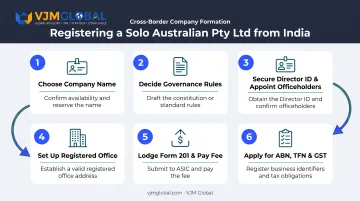
Step 1: Choose Your Company Name
Your company name must be unique on ASIC's national register. Run it through ASIC's online name-availability tool first, then cross-check it against IP Australia's trademark database to avoid disputes down the road.
Prepare 2-3 backup names. ASIC automatically rejects:
- Restricted terms such as "bank," "trust," or "royal" without regulatory consent
- Names implying government affiliation
- Offensive or misleading names
Step 2: Decide on Governance Rules
Most solo Pty Ltd companies skip a custom constitution and adopt ASIC's "replaceable rules" instead. This removes the cost and admin burden of updating legal documents every time company law changes. For a one-person company, it's the sensible default.
Step 3: Secure a Director ID and Appoint Officeholders
Before lodging anything, every director needs a Director ID. Most Indian founders apply on paper using form NAT 75433, with certified identity copies verified by a notary public or an Australian embassy or consulate. The online myID route only works if you already hold Australian identity documents.
Here's the part most Indian founders don't expect: Australian corporations law requires at least one director who ordinarily resides in Australia. A founder living permanently in India cannot be the company's only director.
You have two practical options:
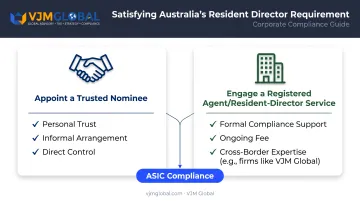
- Appoint a resident nominee director you trust personally
- Engage a registered agent offering a compliant resident-director service, such as VJM Global's local representation for foreign founders entering Australia
Step 4: Set Up a Registered Office and Principal Place of Business
The registered office must be a physical Australian street address, never a PO Box. It doesn't need to be where you actually trade from. Accountants and registered agents commonly provide this address for overseas owners, provided you keep the address owner's written consent on file.
Step 5: Lodge Form 201 via ASIC Connect and Pay the Registration Fee
Once your name, governance, director, and address details are locked in, lodge Form 201 online. The current ASIC fee for registering a share-capital company is AUD 636 (effective 1 July 2026). Approval is often near-instant, though ASIC doesn't publish a guaranteed turnaround, so budget a day or two for safety.
Step 6: Apply for Your ABN, TFN and GST Registration
Once ASIC issues your Australian Company Number (ACN), apply for:
- An Australian Business Number (ABN), needed for invoicing and dealing with the ATO
- A company Tax File Number (TFN)
- GST registration, compulsory once annual turnover crosses AUD 75,000
Non-residents can still get an ABN if the company is carrying on or starting an enterprise connected with Australia. Without an Australian TFN, you'll need to submit certified identity documents plus a written statement of your planned Australian business activities.
Eligibility Rules and Documents Indian Founders Must Prepare
There's no restriction on foreign shareholding in Australia. A single Indian individual can legally hold 100% of the shares in an Australian Pty Ltd and serve as a director, subject to the resident director rule below.
The Resident Director Requirement, Explained
At least one director must "ordinarily reside" in Australia. This isn't a formality. It's written into the Corporations Act, and ASIC checks for it before registering the company.
Non-resident founders typically satisfy this in one of two ways:
- Appointing a trusted local nominee director, such as a friend, family member, or business partner in Australia
- Partnering with a firm offering resident-director or registered-agent services, such as VJM Global's local representation for foreign founders
Core Documents to Prepare
- Passport copy
- Proof of Indian residential address
- Signed director and shareholder consent forms
- Written consent from the owner of the registered office address
Director ID for Non-Resident Applicants
Even as a non-resident director, you need a Director ID before appointment. Indian applicants without Australian identity documents typically use the paper pathway (form NAT 75433).
You submit two primary identity documents, or one primary plus one secondary document, certified by a notary or Australian consular official.
Watch the PSI Rules if You're a Solo Consultant
If you're billing clients as a freelancer or consultant through your Pty Ltd, check the ATO's Personal Services Income (PSI) rules before invoicing your first client. PSI applies when more than 50% of your income comes mainly from your own skills or effort, rather than from a genuine business structure with staff, premises, or multiple unrelated clients.
Where PSI rules apply, the ATO limits which deductions the company can claim and attributes the income back to you personally, often changing your tax outcome significantly. Review the position with an accountant familiar with cross-border Australian tax before you finalise your invoicing model.
Costs and Ongoing Compliance to Budget For
Plan for ASIC filing fees, optional agent or resident-director services, and ongoing tax obligations before you incorporate.
One-time costs:
- ASIC Form 201 registration fee: AUD 636
- Business name registration (only if you trade under a name different from the company name): a small additional fee
Recurring costs:
| Item | Amount | Due date |
|---|---|---|
| ASIC annual review fee | AUD 342 | Company's registration anniversary |
| Late fee (up to 1 month late) | AUD 102 | After missed due date |
| Late fee (over 1 month late) | AUD 428 | After missed due date |
Miss the annual review payment window, and penalties escalate fast. Directors also need to pass a solvency resolution within two months of the review date.
Registered Agent and Resident Director Fees
If you're using a resident director or registered agent service rather than a personal contact, budget for that provider's recurring fee separately from government charges. This is typically billed annually and varies by provider and scope of service.
Tax Obligations to Plan For
Beyond ASIC fees, budget for these tax and employment costs:
- Corporate tax: 25% for base-rate entities (turnover under AUD 50 million and passive income 80% or less of assessable income); 30% otherwise
- BAS lodgement: Required once GST-registered
- Superannuation: 12% guarantee once you pay yourself or an employee a wage or director's fee
Common Mistakes to Avoid
Even prepared Indian founders trip up on a few recurring issues.
- Assuming no local director is needed. ASIC rejects or delays applications that skip the resident director rule. Sort this out before lodging Form 201, not after.
- Treating the company account like a personal wallet. Your Pty Ltd is a separate legal entity. Only withdraw funds as business expenses, dividends from profit, or documented loan repayments, not casual personal transfers.
- Ignoring Personal Services Income (PSI) rules. Solo consultants who skip this check often discover unexpected tax liabilities or disallowed deductions years later during an ATO review.
Alternatives to Registering a One Person Pty Ltd Company
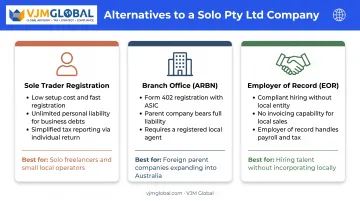
A full Pty Ltd isn't always the right first move. Consider these alternatives depending on your goals.
Sole Trader Registration
Suits founders testing the Australian market with minimal setup.
Key points:
- Lowest setup burden for early market tests
- Unlimited personal liability for business debts
- Hard to sustain a genuine sole-trader presence from India
- ABN entitlement for non-residents still requires an enterprise connected to Australia
Branch Office (ARBN) of an Existing Indian Company
Better suited to an established Indian company that wants an Australian presence without a new subsidiary.
Key points:
- ASIC registers the foreign company under Form 402 (no new incorporation)
- Indian parent remains fully liable for the branch’s obligations
- Useful when the parent already has the operating capacity to support Australia
Employer of Record (EOR) Engagement
Preferable when you only need to hire Australian talent, not invoice as an Australian legal entity.
VJM Global’s EOR support covers compliant hiring in Australia without a local company, including:
- Employment contracts and local HR compliance
- Payroll, superannuation, and Single Touch Payroll reporting
Limitation: with no Australian legal entity, you cannot invoice clients as an Australian business.
Frequently Asked Questions
Can an Indian be the sole director of an Australian company?
An Indian individual can be the sole shareholder, but ASIC requires at least one director who ordinarily resides in Australia. Most Indian founders meet this through a nominee resident director service.
Do I need to visit Australia to register my one person company?
No. Registration can be completed entirely online from India, provided you satisfy the resident director requirement and have a genuine Australian registered office address.
Can I use my Indian address as the company's registered office?
No. ASIC requires a physical Australian street address, not an overseas address or a PO Box, since it's where legal notices get sent.
Is Australia PR easy for Indians?
PR pathways are separate from company registration. They need a qualifying visa (skilled, business innovation, or employer-sponsored) and a points-based assessment. Owning a company does not grant PR automatically.
How long does the ASIC company registration process take?
Approval is often near-instant and usually within 24 hours once your application is correct. Add a few more days for ABN, TFN, GST registration, and opening a business bank account.
What tax rate will my one-person Australian company pay?
Eligible base-rate companies (turnover under AUD 50 million, within passive-income limits) pay 25% corporate tax; other companies pay 30%. Your rate depends on annual turnover and passive income.