This guide covers what ACRA is, how its online portal BizFile+ works, what you need to register a company, and what ongoing compliance looks like after incorporation.
Key Takeaways
- ACRA (Accounting and Corporate Regulatory Authority) is Singapore's national regulator for all business entities, public accountants, and corporate service providers
- Every registered business receives a Unique Entity Number (UEN) — the official ID used across all Singapore government interactions
- All ACRA registrations and filings go through BizFile+ at bizfile.gov.sg
- Ongoing compliance (annual returns, statutory registers, AGMs) is mandatory and carries real financial penalties
- Foreign entrepreneurs need a locally resident director and a Singapore registered address to incorporate
- Foreigners typically need a corporate service provider to file with ACRA on their behalf
What Is ACRA and Why Does It Matter?
ACRA — the Accounting and Corporate Regulatory Authority — is a statutory board under Singapore's Ministry of Finance responsible for business registration, financial reporting oversight, and the regulation of public accountants and corporate service providers.
It was established on 1 April 2004 through the merger of two predecessor bodies: the Registry of Companies and Businesses (RCB) and the Public Accountants' Board (PAB). The merger created a single centralised authority for corporate regulation in Singapore.
How ACRA Compares to Regulators in Other Countries
If you're coming from another jurisdiction, ACRA is the direct equivalent of:
- UK: Companies House
- Australia: ASIC (Australian Securities and Investments Commission)
- India: MCA (Ministry of Corporate Affairs)
- USA: State-level Secretary of State offices
For foreign entrepreneurs, the practical takeaway is straightforward: without ACRA registration, a business has no legal standing in Singapore — no ability to open bank accounts, sign contracts, or hire employees.
What ACRA Actually Covers
Many international businesses underestimate how far ACRA's reach extends. Registration is just the starting point — ACRA's oversight continues throughout the life of a business.
Its ongoing responsibilities include:
- Setting accounting standards for companies, charities, and co-operative societies
- Licensing and regulating public accountants and corporate service providers
- Enforcing annual filing requirements (financial statements, annual returns)
- Maintaining the public register of business entities and their key personnel
Key Functions of ACRA in Singapore
Business Registration
ACRA legally registers all types of business entities operating in Singapore, including:
- Private limited companies (Pte Ltd)
- Sole proprietorships and partnerships
- Limited liability partnerships (LLPs)
- Limited partnerships (LPs)
- Foreign company branches
- Variable capital companies (VCCs)
Registration gives the entity its legal identity — without it, a business cannot legally operate in Singapore.
Issuing the Unique Entity Number (UEN)
Every ACRA-registered entity receives a UEN — a standard identification number comparable to an individual's NRIC. From 1 January 2009, 51 Singapore government agencies use the UEN to interact with registered entities, covering everything from IRAS tax filings to MOM employment pass applications.
Maintaining Public Records
ACRA maintains publicly accessible records of directors, shareholders, and basic company information through BizFile+. Investors, banks, and business partners regularly purchase company Business Profiles to verify registration status, officers, and filing history.
However, the Central Register of Registrable Controllers (UBOs) is not publicly accessible. This register is reserved for law enforcement agencies investigating financial crimes such as money laundering — general public access is deliberately excluded.
Enforcing the Companies Act
ACRA monitors whether companies meet their ongoing obligations and has the authority to:
- Issue composition fines for late or missed filings
- Refer cases for court prosecution
- Strike companies off the register for repeated non-compliance
Regulating Public Accountants and Corporate Service Providers
ACRA sets licensing requirements and professional conduct standards for public accountants and corporate service providers (CSPs). CSPs providing company formation and ACRA filing services must now register under the CSP Act 2024. In practice, this means businesses should confirm their service provider holds a valid CSP registration before engaging them for incorporation or filing work.
BizFile+: ACRA's Online Portal
BizFile+ (bizfile.gov.sg) is ACRA's official digital portal for all business registration, filing, and compliance transactions. Every interaction with ACRA goes through this platform: name reservations, incorporation applications, annual return submissions, and company information updates.
The SingPass Requirement
To make any application or submission on BizFile+, users must log in with SingPass, Singapore's national digital identity system. Most foreign entrepreneurs cannot obtain SingPass before incorporation, which creates a practical barrier.
The solution: engage a registered corporate service provider (CSP). ACRA explicitly states that foreigners must use a CSP to register a business. A CSP can file transactions on your behalf using their own credentials.
Public Access for Verification
BizFile+ is also accessible to the public for information retrieval. Anyone can search for a company by name or UEN and access basic registration details. Detailed Business Profiles (showing UEN, entity name, business activities, date of incorporation, and key officers) can be purchased through the portal.
Banks, investors, and potential partners routinely pull a company's Business Profile before entering agreements. An outdated or incomplete profile can raise red flags — keeping your filings current is a credibility issue as much as a compliance one.
Requirements and Process for ACRA Company Registration
Pre-Registration Requirements
Before you can register, the following must be in place:
| Requirement | Detail |
|---|---|
| Locally resident director | At least one director ordinarily resident in Singapore (citizen, PR, or EP holder) |
| Company secretary | Must be appointed within 6 months of incorporation |
| Shareholder | At least one shareholder required |
| Registered address | Physical Singapore address; PO boxes are not accepted |
| Share capital | At least one issued share |
The Registration Process
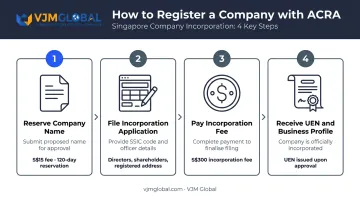
- Reserve a company name via BizFile+ — the fee is S$15 (non-refundable). An approved name is reserved for 120 days.
- File the incorporation application — include business activity (5-digit SSIC code), share capital details, constitution, and officer information.
- Pay the incorporation fee — S$300 for company registration.
- Receive your UEN and Business Profile — ACRA issues these upon approval.
Note: some business activities require referral-authority approval, which can add 14 to 60 days to the processing timeline.
The Two Hardest Requirements for Foreign Entrepreneurs
Two requirements trip up most foreign business owners:
- Locally resident director — if you have no Singapore contacts, nominee director services (provided by registered CSPs) are the standard solution
- Registered Singapore address — virtual office arrangements are widely used by foreign-incorporated companies to meet this requirement
Beyond these two requirements, entity structure and SSIC code selection matter from day one. Once incorporated, changing your registered entity type is not straightforward — errors here can require a full re-registration. Working with an advisor experienced in cross-border business setup helps avoid these mistakes before they happen.
Ongoing ACRA Compliance Obligations
Annual Filing Requirements
After incorporation, the key recurring obligations are:
- Annual Returns: Filed via BizFile+ within 7 months of financial year-end (non-listed companies)
- AGMs: Must be held within 6 months of financial year-end (unless exempt or dispensed with)
- Company information updates: Changes to directors, shareholders, and company details must be updated within 14 days
- Registrable Controller (UBO) updates: Central RORC filings must be submitted within 2 business days of updating the private register; entities incorporated from 16 June 2025 must file initial RORC information on the same day as registration
Financial Reporting
- Accounting records must be maintained for at least 5 years
- Financial statements must comply with Singapore Financial Reporting Standards (SFRS)
- Most companies must file financial statements in XBRL format via BizFile+
- Small company audit exemption applies if a private company meets at least 2 of 3 criteria: annual revenue ≤ S$10 million, total assets ≤ S$10 million, and ≤ 50 employees
Director Responsibilities
Directors are personally responsible for ensuring timely filings, accurate records, and compliance with the Companies Act. Non-compliance can result in personal enforcement actions — not just penalties on the company. Appointing a qualified company secretary is not optional; it is a statutory requirement that must be fulfilled within six months of incorporation.
International businesses managing obligations across both Singapore and India can work with VJM Global, which handles cross-border accounting, regulatory filings, and FEMA-related compliance for companies operating in multiple jurisdictions.
Penalties for ACRA Non-Compliance
Missing ACRA obligations carries real financial and legal consequences — and they escalate quickly.
Late Annual Return Penalties
| Filing Timeline | Penalty |
|---|---|
| Up to 3 months late | S$300 |
| More than 3 months late | S$600 |
This penalty framework has been in place since 30 April 2021.
Escalating Consequences
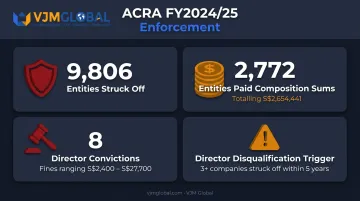
According to ACRA's FY2024/25 Annual Report, as of 31 March 2025:
- 9,806 entities were struck off for repeated offences
- 2,772 entities paid composition sums totalling S$2,654,441 for late annual returns and RORC filings
- 8 company-director convictions resulted in fines ranging from S$2,400 to S$27,700
- Directors with 3 or more companies struck off within 5 years face disqualification from holding future directorships
The Dormant Company Misconception
These penalties don't only apply to active businesses. All live Singapore-registered companies must file annual returns — including dormant and inactive ones.
Setting up a company and leaving it inactive does not remove filing obligations. This catches many foreign business owners off guard. Only formally striking off the company removes the requirement.
Frequently Asked Questions
What does ACRA do in Singapore?
ACRA is Singapore's national regulator that registers all business entities, issues UENs, and enforces the Companies Act. It also regulates public accountants and corporate service providers, maintains public records, and sits under the Ministry of Finance — essentially Singapore's Companies Registrar.
How do I check if a company is registered in Singapore?
Search by company name or UEN on the BizFile+ portal at bizfile.gov.sg. Basic registration status is publicly accessible. Detailed Business Profiles showing officers, activities, and filing history can be purchased through the same portal.
How do I check the owner of a company in Singapore?
Purchase a Business Profile via BizFile+, which will show directors and shareholders for any registered company. Note that ACRA holds beneficial owner (Registrable Controller) information in a non-public register accessible only by law enforcement agencies.
What is BizFile+ and how do I use it?
BizFile+ is ACRA's official online portal at bizfile.gov.sg, used for company registration, annual return filing, company information updates, and information retrieval. Filing requires SingPass login. Foreign entrepreneurs without SingPass must engage a registered corporate service provider to file on their behalf.
Do foreign entrepreneurs need a local director to register with ACRA?
Yes. At least one director who is ordinarily resident in Singapore (a citizen, permanent resident, or Employment Pass holder) is required. Foreign entrepreneurs without local contacts typically use nominee director services provided by registered corporate service providers.
What happens if I don't comply with ACRA requirements?
Non-compliance results in financial penalties starting at S$300, escalating composition sums, potential court prosecution, and in repeated cases, the company being struck off the register. Directors can be held personally liable, and accumulating strikes can lead to director disqualification.