Introduction
For Australian entrepreneurs expanding into Southeast Asia, the Singapore Private Limited Company (Pte Ltd) is the go-to incorporation structure — offering 100% foreign ownership, a 17% flat corporate tax rate, and one of the fastest registration processes in the region.
Yet many Australian founders approach Singapore incorporation with more questions than answers. What exactly is a Pte Ltd? How does it differ from the Pty Ltd structure you already know? What does it actually cost, and what are your ongoing obligations to the ATO once you've registered offshore?
This guide covers the full picture: a clear definition of the Singapore Pte Ltd, a side-by-side comparison with the Australian Pty Ltd, the mandatory registration requirements, and what you need to know about taxes — including the Double Taxation Avoidance Agreement (DTAA) — before you commit.
Key Takeaways
- A Singapore Pte Ltd is a separate legal entity with limited liability protection and a minimum paid-up capital of just SGD 1
- Foreign nationals, including Australians, can hold 100% ownership
- At least one Singapore-resident director and a qualified company secretary must be appointed
- Singapore's corporate tax rate is 17%, compared to Australia's 25–30%
- The full registration process can be completed remotely from Australia, typically within 1–3 business days
What Is a Singapore Private Limited Company?
Choosing the right structure is the first decision any foreign entrepreneur makes when entering Singapore. For most, that decision ends at the same place: a Private Limited Company, or Pte Ltd — a business entity incorporated under Singapore's Companies Act with a distinct legal identity entirely separate from its owners.
That separation matters practically. The company can own assets, enter contracts, and sue or be sued in its own name. Shareholders bear no personal liability beyond the value of their unpaid shares — so personal savings, property, and other assets remain protected if the business incurs debts or faces legal action.
Core Structural Features
Under the Singapore Companies Act, registration converts the entity into a body corporate with:
- 1 to 50 shareholders — individuals or corporate entities
- Limited liability for all shareholders, capped at the amount unpaid on shares held
- Perpetual succession — the company continues to exist regardless of changes in ownership or directorship
- Separate legal identity — capable of holding property and enforcing contracts independently
The word "private" has a specific legal meaning here. Shares cannot be offered to the public, and the entity cannot list on a stock exchange — that distinguishes it from a Public Limited Company. It is also distinct from a Company Limited by Guarantee, which is used for non-profits.
Those distinctions make the Pte Ltd the dominant incorporation choice for foreign entrepreneurs — whether based in the US, UK, Australia, or elsewhere. The low capital threshold, full foreign ownership rights, and straightforward compliance requirements make it the default starting point for anyone entering Singapore's market.
How Does a Singapore Pte Ltd Compare to an Australian Pty Ltd?
If you already operate an Australian Pty Ltd, the Singapore Pte Ltd will feel familiar in structure — both offer limited liability, separate legal entity status, and allow a single shareholder. The abbreviations even point to the same concept: "Private."
The structural similarities end there, though. Several operational and tax differences matter significantly for Australian founders before they register.
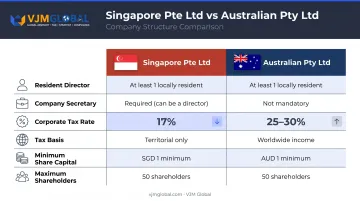
Key Differences at a Glance
| Feature | Singapore Pte Ltd | Australian Pty Ltd |
|---|---|---|
| Resident director | At least one director ordinarily resident in Singapore | At least one director who normally lives in Australia |
| Company secretary | Mandatory — must be appointed within 6 months | Optional for proprietary companies |
| Corporate tax rate | 17% flat | 25% (base rate entities) or 30% (others) |
| Tax basis | Territorial — Singapore-sourced income, plus foreign income received in Singapore | Worldwide — Australian tax residents declare global income |
| Minimum share capital | SGD 1 | No statutory minimum |
| Maximum shareholders | 50 | 50 non-employee shareholders |
How the Territorial Tax System Actually Works
Australia taxes its residents on worldwide income. Singapore taxes income sourced in Singapore, with foreign-sourced income generally exempt unless remitted into Singapore. That territorial system is a genuine structural advantage for many founders. It does not, however, automatically remove your Australian tax obligations.
There is also a residency test for the company itself. A Singapore Pte Ltd is only treated as a Singapore tax resident when its control and management is exercised in Singapore — in practice, this means where board-level decisions are made.
Incorporating in Singapore while running all decisions from Australia could undermine the tax residency position entirely.
Key Benefits of Setting Up a Singapore Private Limited Company
Limited Liability Protection
Shareholders' personal financial exposure is capped at the amount they invested. A lawsuit or debt incurred by the company does not put personal savings or property at risk, which matters when operating across unfamiliar markets.
Attractive Tax Environment
Singapore's tax structure is competitive:
- 17% flat corporate tax rate, well below Australia's 25–30%
- Zero capital gains tax on gains from asset sales
- No withholding tax on dividends paid to shareholders, per IRAS guidance
- Startup Tax Exemption (SUTE): qualifying new companies receive a 75% exemption on the first SGD 100,000 of chargeable income and 50% on the next SGD 100,000, for the first three consecutive Years of Assessment
To qualify for SUTE, the company must meet all of the following:
- Incorporated and tax resident in Singapore
- No more than 20 shareholders
- All shareholders are individuals, or at least one individual holds 10%+ of issued ordinary shares
- Not an investment holding or property development company
100% Foreign Ownership
Unlike many other Asian jurisdictions, Singapore imposes no foreign ownership restrictions on a Pte Ltd. Australian entrepreneurs can hold all shares outright, without requiring a local partner or nominee shareholder.
Global Credibility and Banking Access
A Singapore-registered company signals legitimacy in international markets. It typically facilitates:
- Faster onboarding with global payment processors
- Access to both traditional banks and digital banking platforms
- Credibility with international clients, particularly in B2B and cross-border contexts
E-commerce operators, tech companies, and consultancies targeting Asian markets tend to see the most direct benefit.
Gateway to Southeast Asia
Singapore's strategic position at the centre of Southeast Asia, combined with an English-speaking business environment and strong IP protections (Singapore ranked 5th globally in the WIPO Global Innovation Index 2025), makes it a natural regional holding or operating base. Singapore has also concluded Double Taxation Agreements with around 100 jurisdictions.
Requirements to Register a Singapore Private Limited Company
1. At Least One Singapore-Resident Director
Under Section 145 of Singapore's Companies Act, every Pte Ltd must have at least one director who is ordinarily resident in Singapore — a Singapore citizen, permanent resident, or holder of an eligible Employment Pass or Personalised Employment Pass.
Australian founders who do not reside in Singapore must appoint a nominee director. Professional advisory firms such as VJM Global, which has supported 250+ Australian businesses, can connect founders with qualified nominee director services.
2. Minimum Paid-Up Capital of SGD 1
There is no meaningful capital barrier to entry. The minimum required share capital is SGD 1. Additional capital can be issued at any stage as the business grows.
3. Registered Local Office Address
The company must maintain a physical registered address in Singapore — not a PO Box — that is accessible to the public for at least three hours during ordinary business hours each business day. Any change of address must be reported to ACRA within 14 days. Failure to maintain a valid registered address can attract a fine of up to SGD 5,000 plus a default penalty.
4. Company Secretary
A qualified, Singapore-resident company secretary must be appointed within 6 months of incorporation. The sole director cannot also serve as the company secretary. Responsibilities include maintaining statutory registers, managing filing deadlines, and ensuring ongoing ACRA compliance.
5. Auditor and Data Protection Officer
An auditor must be appointed within 3 months of incorporation — unless the company qualifies for the small company exemption by meeting at least two of the following:
- Annual revenue ≤ SGD 10M
- Total assets ≤ SGD 10M
- 50 or fewer employees
Companies must also appoint a Data Protection Officer (DPO) in compliance with Singapore's Personal Data Protection Act (PDPA).
How to Register a Singapore Private Limited Company from Australia
Step 1: Engage a Corporate Service Provider (CSP)
ACRA requires foreigners to engage a registered Corporate Service Provider (CSP) — also referred to as a Registered Filing Agent — to reserve a company name and submit the incorporation application via the BizFile+ portal. The entire process can be completed remotely; no travel to Singapore is required.
Step 2: Reserve Your Company Name and Submit Documents
The proposed company name is submitted to ACRA for approval and, once approved, reserved for up to 120 days. Required information includes:
- Passport copies for all shareholders and directors
- Proof of residential address for all parties
- Details of the company secretary and registered office address
- Share capital details and company constitution
ACRA government fees:
- Name application: SGD 15
- Company registration: SGD 300
Most registrations are processed within a few days of payment. Complex applications or those referred to other authorities may take up to 15–60 working days.
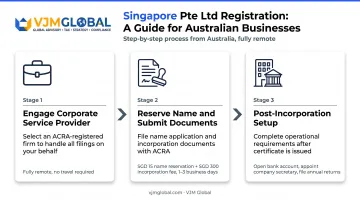
Step 3: Post-Incorporation Setup
After incorporation, immediate tasks include:
- Open a corporate bank account — DBS and OCBC serve foreign-owned companies, while digital providers like Aspire and Airwallex offer fully online onboarding with no minimum balance
- File annual returns with ACRA (late filing penalties can reach SGD 600)
- Register for GST if annual taxable turnover exceeds SGD 1 million
- Hold an AGM or qualify for the private company AGM exemption (financial statements sent to all members within 5 months of financial year end)
Tax Implications for Australian Business Owners
Singapore's Territorial Tax System
Singapore taxes income sourced in Singapore at a 17% corporate rate. Foreign-sourced income is generally not taxed unless remitted into Singapore (and even then, an exemption may apply if) the income was taxed offshore at a headline rate of at least 15%.
This contrasts sharply with Australia, where Australian tax residents must declare income earned anywhere in the world.
Incorporating in Singapore does not automatically remove your Australian tax obligations. If you remain an Australian tax resident, the ATO can still tax foreign profits. The "control and management" test also matters for the Singapore side: if all strategic decisions are made in Australia, the Singapore Pte Ltd may not qualify as a Singapore tax resident , which undermines the structure's core tax advantage.
The Australia-Singapore DTAA
Australia and Singapore have a Double Taxation Avoidance Agreement in force (concluded 1969, updated via MLI in 2021). For business owners, it works like this:
- Corporate tax paid in Singapore: Australia provides a credit against any Australian tax liability on the same income, preventing double taxation
- Foreign Income Tax Offset (FITO): Australian residents who pay tax overseas can claim additional relief through this ATO mechanism
Controlled Foreign Company (CFC) Rules
Australian-resident shareholders of a Singapore Pte Ltd need to understand Australia's CFC provisions. These rules can attribute foreign profits back to Australian residents (even if those profits are never remitted to Australia) where an Australian resident holds a substantial interest in the foreign entity.
The interaction between CFC rules, the DTAA, and Singapore tax residency requirements is genuinely complex. Getting professional advice before establishing your Singapore structure is essential for full compliance with both ATO and IRAS obligations. VJM Global's international tax advisory team works across cross-border structures and DTAA compliance for Australian clients, helping them map obligations across both jurisdictions.
Frequently Asked Questions
What is a private limited company in Singapore?
A Singapore Private Limited Company (Pte Ltd) is a business entity with a distinct legal identity separate from its owners, offering limited liability to up to 50 shareholders. It is the most common incorporation structure for both local and foreign entrepreneurs due to its low capital requirements, tax efficiency, and clean governance framework.
Can an Australian open a business in Singapore?
Yes. Australians can fully own a Singapore Pte Ltd as a 100% beneficial owner. The entire registration process can be completed remotely from Australia through a Corporate Service Provider registered with ACRA.
Does Singapore have a double tax treaty with Australia?
Yes. Australia and Singapore have a Double Taxation Avoidance Agreement (DTAA) in force, which prevents the same income from being taxed in both countries and provides credit mechanisms for tax paid in either jurisdiction — reducing the effective burden for cross-border businesses.
Do I have to pay tax in Australia if I operate a Singapore company?
It depends on your Australian tax residency status. Australian tax residents are subject to tax on worldwide income, including Singapore Pte Ltd profits, though the Australia-Singapore DTAA provides relief against double taxation. Professional advice is essential before structuring any cross-border arrangement.
How long does it take to register a Singapore Private Limited Company?
Once all documents are submitted through a Corporate Service Provider, ACRA typically approves straightforward applications within 1–3 working days. Complex cases or those requiring referral to other authorities can extend the timeline to 15–60 working days.
Do I need to travel to Singapore to register a company?
No travel is required for incorporation — the process is fully remote via a Corporate Service Provider. However, some traditional Singapore banks may require an in-person visit for corporate account opening, while digital-first providers like Aspire and Airwallex allow fully online onboarding.