Yet many first-time founders still mix up a private limited company with a sole proprietorship, an LLC, or a public limited company. That confusion leads to the wrong entity choice, and unwinding it later is expensive and time-consuming.
This article breaks down exactly what a private limited company is, its core features, how it stacks up against other structures, and what registering one actually involves.
Key Takeaways
- Private limited companies are separate legal entities with limited liability and no public share sales
- They differ from public companies in ownership caps, capital rules, and reporting duties
- Labels vary by country—Ltd, Pvt Ltd, Pty Ltd, GmbH—for the private limited form
- Setup requires a name, directors, shareholders, and filing with the national registrar
What Is a Private Limited Company?
A private limited company is an independent legal entity owned by private shareholders. It's distinct from the people who own it, and it cannot list its shares on a stock exchange.
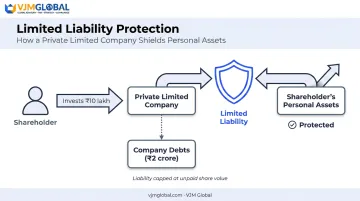
That independence brings a critical benefit: limited liability. Shareholders are only responsible for company debts up to the unpaid value of their shares.
Say a small business owner invests ₹10 lakh for shares in her private limited company. If the company later collapses under ₹2 crore of debt, creditors can't touch her personal savings or her house. In most cases, her exposure stops at that original ₹10 lakh investment.
This works because of separate legal personality. The company can:
- Own property and assets in its own name
- Enter contracts independently of its shareholders
- Sue, or be sued, without dragging owners into the lawsuit personally
Depending on where you incorporate, the same structure goes by different names:
- Ltd in the United Kingdom
- Pvt Ltd in India
- Pty Ltd in Australia
- GmbH in Germany
Who actually forms these? Mostly:
- Startups looking for credibility without going public
- Family businesses that want liability protection
- SMEs scaling past the sole-proprietorship stage
- Subsidiaries of larger foreign companies entering a new market
That last group matters. A foreign parent company setting up an Indian subsidiary, for instance, almost always chooses a private limited structure specifically because it separates the parent's liability from the local entity's obligations.
Key Features & Characteristics of a Private Limited Company
Ownership, Shareholders & Directors
Every jurisdiction sets its own rules, and they vary more than most founders expect.
- UK: Requires just 1 shareholder minimum, with no statutory cap. That sole shareholder can also serve as the sole director.
- India: Needs at least 2 members (capped at 200 under Section 2(68) of the Companies Act 2013) and 2 directors. A One Person Company is the exception and may have a single director.
Management rules extend beyond headcount: a company secretary is often optional for private companies, while public companies usually must appoint one.
Share Transfer & Capital Requirements
Private limited companies restrict how shares move. Transfers typically require board approval or trigger pre-emption rights, meaning existing shareholders get first refusal before shares go to an outsider.
Capital requirements have loosened globally:
- India removed its former ₹100,000 minimum paid-up capital requirement in 2015.
- UK companies can set share values as low as £1.
- Germany's GmbH still requires €25,000 minimum share capital before incorporation, per the GmbH Act.
Naming & Ongoing Compliance
That "Ltd" or "Pvt Ltd" suffix isn't decorative. It legally signals limited liability status to anyone extending credit or entering a contract with the business.
Regardless of jurisdiction, private limited companies face recurring obligations:
- Annual confirmation statements or annual returns
- Financial statement filings
- Corporate tax returns
- In many countries, statutory audits above certain thresholds
Miss these deadlines and penalties follow in nearly every jurisdiction—compliance is ongoing, not a one-time filing.
Private Limited Company vs Other Business Structures
Private Limited Company vs Public Limited Company
The core difference comes down to who can own shares and how much scrutiny follows.
| Factor | Private Limited | Public Limited |
|---|---|---|
| Share sale to public | Not permitted | Permitted, can list on exchange |
| Company secretary | Usually optional | Mandatory in most jurisdictions |
| AGM requirement | Often not mandatory | Required within 6 months of year-end |
| Audit exemption | Available for small companies | Not available |
| Minimum directors | 1–2 (varies by country) | 2–3 (varies by country) |
Thresholds differ by jurisdiction—for example, India requires at least two directors for a private company, while the UK allows one. Overall, a private company carries lighter governance: no mandatory AGM in many cases, no mandatory company secretary in most small setups, and audit exemptions for smaller firms based on turnover and headcount.
Private Limited Company vs LLC/Sole Proprietorship
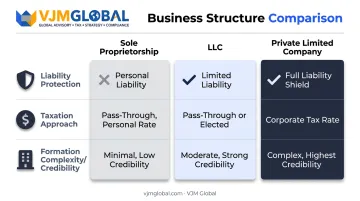
A sole proprietorship offers zero separation between owner and business. Debts, lawsuits, and tax liability all land directly on the individual. There's no entity to shield personal assets.
An LLC sits closer to a private limited company, but taxation differs. In the US, a single-member LLC defaults to disregarded-entity treatment (taxed like a sole proprietorship) unless the owner files IRS Form 8832 to elect corporate taxation. A private limited company, by contrast, is taxed as a corporation from day one in most jurisdictions.
So when should a business pick the private limited route over these alternatives?
- Credibility with banks and investors is a priority
- Equity funding is on the roadmap
- Liability protection needs to be airtight
- Plans call for scaling beyond a founder-operator model
Advantages and Disadvantages of a Private Limited Company
A private limited company trades extra compliance for liability protection and credibility. Whether that tradeoff pays off depends on your risk profile and growth plans.
Advantages
- Limited liability shields personal assets from business debts and lawsuits
- Stronger credibility with banks, investors, and enterprise customers who prefer contracting with an incorporated entity
- Easier equity access than a sole proprietorship, while founders keep control since shares stay off public markets
Disadvantages
- Heavier compliance load than a sole proprietorship, including annual filings and, past certain size thresholds, statutory audits
- No public fundraising—you cannot offer shares to the general public the way a listed company can
- Ongoing professional fees for incorporation, annual filings, and audits that sole proprietors typically avoid
Weigh these honestly against your situation. A freelancer with no employees and minimal liability risk may not need the compliance overhead. A startup planning to raise a Series A almost certainly needs the private limited structure.
How to Register a Private Limited Company: Key Steps
The specific forms differ by country, but the underlying sequence is largely the same.
- Choose and reserve a unique company name that does not conflict with existing registered entities
- Decide on directors and shareholders, and confirm each meets local minimum requirements
- Prepare incorporation documents, such as the memorandum and articles of association or the local equivalent
- File with the relevant national authority (Companies House in the UK, the MCA in India, or the Secretary of State in relevant US states)
- Complete post-incorporation essentials: open a business bank account, register for tax (corporate tax, VAT, or GST), and track statutory filing deadlines
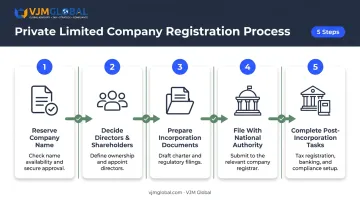
In India specifically, the typical incorporation sequence runs through digital signature certificates, director identification numbers, name approval, and certificate issuance, usually completing in around 13 working days when documentation is in order.
Documentation requirements, timelines, and regulator quirks vary enormously once you cross borders. A memorandum that satisfies Companies House won't necessarily satisfy the MCA or Delaware's Division of Corporations.
VJM Global supports entity formation across 100+ countries, using each market's own regulators and statutory instruments rather than a single template.
A team of CPAs and Chartered Accountants helps foreign companies enter new markets, domestic businesses complete routine incorporation, and multinationals coordinate compliance across multiple jurisdictions.
Frequently Asked Questions
What is the US equivalent of a UK limited company?
The closest equivalents are a US LLC or a C-Corporation (Inc.). A UK Ltd is a private company limited by shares, while US structures vary by state and desired tax treatment.
How is a UK limited company treated for US tax purposes?
A UK Ltd is generally treated as a foreign corporation for US tax purposes. US persons with ownership stakes often face reporting on Form 5471 and related international information returns.
What is the minimum number of shareholders required for a private limited company?
Most jurisdictions require at least one shareholder. Several countries, including India and the UK, allow single-member or One Person Company structures.
Can a private limited company raise money from the public?
No. Private limited companies cannot offer shares to the general public or list on a stock exchange, unlike public limited companies.
Is a private limited company the same as an LLC?
Both offer limited liability, but taxation, share structure, and governing law differ by jurisdiction. For example, a US LLC is often taxed as a pass-through by default, while most private limited companies are taxed as separate corporate entities.
What documents are required to register a private limited company?
Typical filings include:
- Identity and address proof for directors and shareholders
- Memorandum and articles of association (or local equivalent)
- Proof of the registered office address