Introduction
UK business owners eyeing the American market quickly discover a structural puzzle: the Private Limited Company (Ltd) they know from Companies House has no direct US counterpart. The US doesn't operate a centralised registration system — companies form at the state level, and the two primary entity types (LLC and C-Corporation) each serve different strategic purposes.
This gap creates genuine confusion. UK founders often waste months researching the wrong entity type or incorporating in the wrong state before their first US dollar of revenue arrives.
This guide cuts through that confusion. It maps UK Ltd concepts to their closest US equivalents, breaks down the tax and governance differences between LLCs and C-Corporations, and outlines exactly how a UK company can build a legal US presence.
What this guide covers:
- How a UK Private Limited Company compares to US entity types
- Key differences in tax treatment, liability, and governance
- Which US structure suits different UK business goals
- The practical steps to incorporate and operate in the US
Key Takeaways
- The two closest US equivalents to a UK Ltd are the LLC (pass-through tax, flexible structure) and the C-Corporation (preferred for investors and equity funding)
- US companies register at state level: Delaware and Wyoming are the top choices for foreign founders
- A UK Ltd can own a US LLC or C-Corp as a foreign parent, with no US residency required
- Expect federal and state tax layers — US compliance is more involved than a single UK Corporation Tax return
- British citizens can own a US company freely, but physically working in the US requires a visa
What Is the US Equivalent of a UK Ltd Company?
The short answer: there isn't one. UK law created a single, standardised Private Limited Company structure. US law offers a menu of options, and the right choice depends entirely on what a UK company needs from its US presence.
The LLC — The Closest Structural Match
A Limited Liability Company (LLC) is the functional parallel most UK founders reach for first. Like a UK Ltd, it protects members' personal assets from business debts. Members (the US term for owners) are not personally liable for the LLC's obligations solely by virtue of their membership — this protection is codified directly in Delaware's LLC Act.
The biggest operational difference is taxation. LLCs default to pass-through treatment under IRS rules: profits flow directly to members' personal tax returns, with no separate federal corporate tax at the entity level. A multi-member LLC is taxed as a partnership; a single-member LLC is a disregarded entity — both contrast with a UK Ltd, which pays Corporation Tax as a standalone entity. One trade-off: LLCs cannot issue preferred stock in the structured way US venture capital firms expect, which limits their usefulness for companies seeking institutional investment.
The C-Corporation — The Investor-Preferred Option
When a UK company's US ambitions involve raising venture capital or planning a future listing, the C-Corporation is the standard vehicle. Key reasons Delaware C-Corps dominate venture-backed deals:
- Multiple share classes — common and preferred stock can be issued to suit investor terms
- Court of Chancery — Delaware's Court of Chancery offers a specialised legal forum with deep corporate case law
- Investor familiarity — a Stanford Law School study of nearly 5,000 startup Series A charters found Delaware charters reached 100% of sampled companies by 2022, up from 54% in 2004
One cost to weigh: C-Corps pay federal tax at 21% (per IRS Publication 542), and distributing profits as dividends creates a second layer of tax — unlike the more straightforward dividend treatment under a UK Ltd structure.
Which Should a UK Company Choose?
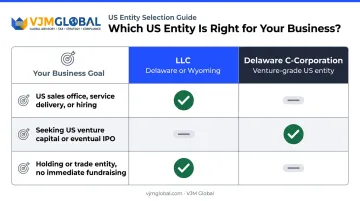
| Goal | Recommended Structure |
|---|---|
| US sales office, service delivery, or hiring | LLC (Delaware or Wyoming) |
| Seeking US venture capital or eventual IPO | Delaware C-Corporation |
| Holding or trade entity, no immediate fundraising | LLC (Delaware or Wyoming) |
UK Ltd vs US Business Entities: Key Differences Explained
Both systems offer limited liability protection, but the governance, tax, and compliance mechanics diverge significantly. UK founders entering the US market need to account for three key differences: how entities are formed and governed, how profits are taxed, and what ongoing compliance obligations apply.
Formation and Governance
A UK Ltd is registered with Companies House under a relatively standardised Articles of Association framework. The US system is more flexible but demands more upfront legal work:
- LLC: Governed by an Operating Agreement, which can be customised extensively to define ownership splits, profit distributions, voting rights, and management structure
- C-Corp: Governed by a Certificate of Incorporation and Bylaws, with a formal board structure and shareholder rights framework
- Jurisdictional layering: A US entity registers in one state but may need to "foreign qualify" in every additional state where it physically operates — a compliance requirement with no UK equivalent
Taxation Comparison
The tax structures differ more than most UK founders expect:
UK Ltd:
- Corporation Tax at 25% on profits above £250,000; 19% on profits of £50,000 or less (GOV.UK)
- Dividends distributed to shareholders from after-tax profits
US LLC:
- No federal corporate tax at entity level by default
- Profits pass through to members and are taxed on personal returns
- State-level taxes may still apply
US C-Corporation:
- 21% federal corporate tax on taxable income
- Dividends taxed again at shareholder level (double taxation)
- State corporate taxes vary by state
The UK-US Double Taxation Convention (in force since 31 March 2003) prevents the same income from being taxed in both countries.
Under IRS treaty tables, UK-resident recipients of US-source dividends face a standard withholding rate of 15% — reduced to 5% where qualifying conditions are met, with a potential exemption for certain 80%-owned corporate subsidiaries.
Ongoing Compliance Requirements
| Requirement | UK Ltd | US LLC | US C-Corp |
|---|---|---|---|
| Annual accounts filing | Companies House | No equivalent | No equivalent |
| Confirmation/annual report | Companies House | Annual state report + tax | Annual report + franchise tax |
| Tax return | HMRC (Corporation Tax) | Form 1065 or disregarded | Form 1120 (federal) |
| Board meetings/minutes | Not mandatory | Not required | Required |
Delaware example: LLCs pay ~$300/year in state tax; C-Corps face a $50 filing fee plus a minimum $175 franchise tax.
How UK Companies Can Set Up a US Business Entity
Physical presence in the US is not required to form an entity — the entire process can be completed remotely. What is required is a clear sequence of steps, executed in the right order.
Step 1 — Choose Your Entity Type and State
Revisit the decision framework from the section above. Once entity type is settled, choose a state of incorporation:
- Delaware: Default choice for C-Corps; also widely used for LLCs. Strong legal infrastructure, investor familiarity
- Wyoming: Popular LLC choice — low fees, strong privacy protections, minimal ongoing requirements
- Operating state: If the business will have employees or a physical office in, say, California or New York, it will also need to register there as a foreign entity
Step 2 — Appoint a Registered Agent
Every US state requires a registered agent — a person or commercial service with a physical street address in the state of formation who receives legal documents and government correspondence on behalf of the company. Delaware requires every business entity to maintain a registered agent with a physical Delaware street address.
This differs from the UK's registered office concept: US registered agents are almost always commercial service providers charging annual fees, not the company's own address.
Step 3 — File Formation Documents
- LLC: File Articles of Organization with the state Secretary of State
- C-Corp: File a Certificate of Incorporation
Delaware's official filing fees are modest: $110 for an LLC Certificate of Formation and a minimum of $109 for a corporation (varying with authorised stock). Expedited options are available — same-day processing costs $100–$200; next-day is $50–$100.
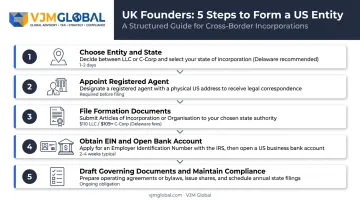
Step 4 — Obtain an EIN and Open a US Bank Account
An Employer Identification Number (EIN) is the US equivalent of a UK company's UTR. Non-US residents cannot apply online — the IRS requires applications by phone at +1 267-941-1099 or by fax/post. Fax applications return in approximately 4 business days; postal applications take around 4 weeks.
Opening a US business bank account is the step most UK founders find frustrating. Traditional banks (Chase, Bank of America, Wells Fargo) may require a branch visit for certain entity types or circumstances.
Fintech alternatives like Mercury and Relay have made remote account opening far more practical. Mercury explicitly supports US companies with non-resident founders, while Relay accepts US-registered businesses owned by non-US citizens, provided the business has an operating presence in the US.
Step 5 — Draft Governing Documents and Maintain Compliance
Don't skip this step. A properly drafted Operating Agreement (for LLCs) or Bylaws and Shareholder Agreement (for C-Corps) defines:
- Ownership percentages and capital contributions
- Profit distribution mechanics
- Decision-making authority and voting thresholds
- Dispute resolution procedures
Ongoing compliance includes annual state reports, registered agent maintenance, federal and state tax returns, and — for C-Corps — board meeting minutes. UK companies with a US subsidiary must also navigate transfer pricing rules governing transactions between the UK parent and the US entity.
These obligations are easy to miss when UK and US requirements aren't managed in parallel. VJM Global has supported 250+ UK businesses through exactly this challenge, with CPAs and Chartered Accountants covering Form 1120 and Form 1065 filings and transfer pricing compliance from its New York office.
Tax and Compliance Obligations for UK Companies Operating in the USA
A UK company with a US subsidiary faces compliance obligations in both jurisdictions simultaneously — and the two systems don't always align.
US Tax Filing Requirements
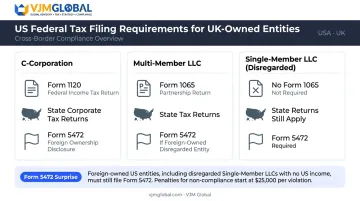
A UK-owned US entity must file:
- Form 1120 (C-Corp federal income tax return) or Form 1065 (multi-member LLC partnership return)
- State corporate tax returns in the state of formation, plus any state where the business has nexus
- Form 5472: Required for 25% foreign-owned US corporations and foreign-owned disregarded entities — this is a common filing requirement that surprises UK founders who assumed a simple LLC structure had no IRS reporting obligations
The Permanent Establishment Risk
A UK company that starts US sales activity — hiring US-based sales staff, signing contracts from a US location — before formally registering a US entity may inadvertently create a permanent establishment (PE).
Under Article 5 of the UK-US Double Taxation Convention, a PE arises from a "fixed place of business through which the business of an enterprise is wholly or partly carried on." A dependent agent who habitually concludes contracts on behalf of the UK company can also trigger PE status.
Once a PE exists, US tax obligations apply — regardless of whether a formal entity has been registered.
Sales Tax vs UK VAT
US sales tax operates nothing like UK VAT. There is no national rate — each state sets its own rules. After the Supreme Court's decision in South Dakota v. Wayfair (2018), states can impose sales tax collection obligations based on economic nexus alone. South Dakota's threshold, for example, is:
- $100,000 in sales delivered into the state, or
- 200 transactions into the state within a calendar year
A UK-owned US business selling across multiple states will likely need to register and file sales tax returns in each one where these thresholds are crossed.
Common Challenges UK Companies Face When Expanding to the USA
Banking Friction
This is the most consistently cited practical obstacle. Traditional US banks may require directors to be physically present for account opening, particularly for multi-member or multi-manager LLCs. Mercury explicitly supports remote account opening for non-resident founders with sufficient documentation. Relay accepts foreign-owned US entities but requires evidence of operating presence.
Having these documents ready in advance cuts down on processing delays:
- Formation documents and operating agreement
- EIN confirmation letter from the IRS
- Proof of US business address
Multi-State Compliance
UK founders often assume that incorporating in Delaware means filing only in Delaware. That assumption breaks down the moment the business has employees, an office, or regular sales activity in another state — all of which can trigger foreign qualification requirements.
California and New York, two of the most commercially active states, both require foreign entities to register before conducting intrastate business. Each registration adds annual fees, state tax returns, and reporting deadlines.
Visa and Work Authorisation
Owning a US company requires no visa. Physically working in the US for that company is a different matter. British citizens have two primary visa routes:
- E-2 Treaty Investor visa: Available to UK nationals (the UK is on the US treaty country list) who invest a substantial amount in a US business and intend to direct its operations
- L-1 visa: For executives, managers, or specialised knowledge employees transferring from a UK parent to the US subsidiary — the L-1A covers executive/managerial roles; the L-1B covers specialised knowledge
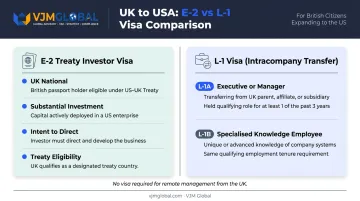
Managing a US company remotely from the UK — without physically entering the US to work — does not require visa authorisation.
Frequently Asked Questions
What is the US equivalent of a UK Ltd company?
The closest equivalents are the LLC (for operational simplicity and pass-through taxation) and the C-Corporation (for investor appeal and equity fundraising). The right choice depends on whether the UK company's US goals are operational, investment-focused, or a holding structure.
Can a British citizen do business in the USA?
Yes. British citizens can legally own and operate a US business entity without US residency or citizenship. Physical work in the US requires an appropriate visa (such as the E-2 Treaty Investor visa), but remote ownership and management from the UK requires none.
Do I need to be physically present in the US to register a US company?
No. Formation documents can be filed remotely, and a registered agent service fulfills the physical address requirement. Traditional US bank accounts may require an in-person visit, though fintech options like Mercury and Relay support remote account opening for foreign-owned entities.
Can a UK Ltd company own a US LLC or C-Corp?
Yes. A UK Limited Company can be the parent entity — sole member of an LLC or sole shareholder of a C-Corp. This parent-subsidiary structure is how most UK businesses establish a US legal presence without dissolving their UK entity.
What is the difference between an LLC and a C-Corp for a UK company expanding to the US?
An LLC offers pass-through taxation and simpler administration, making it well-suited for operational subsidiaries. A C-Corp is the preferred structure for US venture capital or future stock market listings, as it supports preferred share issuance and meets investor expectations.
Do UK companies pay US taxes if they expand there?
Yes — a US subsidiary carries federal and state tax obligations. The UK-US Double Taxation Convention prevents dual taxation on the same income, but the two systems interact in complex ways, so professional cross-border tax advice is essential before repatriating profits.