
But the reality is messier. Many founders struggle with DICA's registration portal, foreign ownership rules, and a tax and investment framework that keeps shifting. The World Bank reported Myanmar's real GDP contracted 2.0% in FY2025/26, and only 45% of surveyed firms had returned to pre-earthquake activity levels by mid-2026.
This guide walks through entity options, the registration process, tax obligations, and where a cross-border advisory partner fits into the picture.
Key Takeaways
- Keep foreign ownership at or below 35% to stay locally classified; above that, the company is foreign-classified
- DICA sets no blanket minimum capital requirement for registration
- Registration runs through DICA's MyCO portal in stages, though official timelines aren't guaranteed
- Use the Singapore–Myanmar DTAA in force since 30 March 2000 to manage cross-border tax
- Plan for power outages, banking friction, and post-earthquake recovery gaps with local expertise
Why Singapore Businesses Are Looking at Myanmar
Myanmar's ASEAN Free Trade Area membership, in place since 1997, gives Singapore companies theoretical access to a market wedged between two of the world's largest economies. That's the strategic case.
The near-term numbers tell a more cautious story. Myanmar's GDP contracted 2% in the last fiscal year, and manufacturing and agriculture are still lagging behind pre-earthquake output, according to the World Bank's June 2026 Economic Monitor.
Sectors still drawing interest:
- Manufacturing and textiles (labour-cost arbitrage)
- Food and beverage
- Logistics and trading
- Tourism, once infrastructure stabilises
Singapore brands have tested the market before. BreadTalk entered via a master franchise agreement with Myanmar Bakery, targeting a Yangon launch in early 2017. Around the same time, Singapore Myanmar Investco brought in names like Crystal Jade Kitchen and IPPUDO for downtown Yangon outlets.
These are historical entry points, not proof every outlet is still trading today. Treat them as evidence that Singapore brands can enter, not that demand has been validated at current conditions.
Bottom line: ASEAN access supports a long-term play. The GDP and recovery data argue for staged investment, not a big upfront bet.
Choosing the Right Business Structure
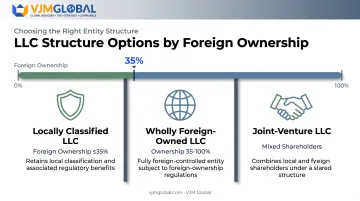
Myanmar's Companies Law uses a 35% threshold to decide whether an entity counts as local or foreign. Get this wrong and you could trigger sector restrictions you didn't expect.
Limited Liability Company Options
There are three practical LLC paths:
- Locally classified LLC – foreign ownership or control stays at or below 35%. The entity remains subject to local classification even with foreign shareholders.
- Wholly foreign-owned LLC – ownership exceeds 35%, up to 100%. This is foreign-classified regardless of the exact percentage above the threshold.
- Joint-venture LLC – combines Myanmar and foreign shareholders. Whether it's treated as local or foreign again comes down to that same 35% test.
A common myth worth killing here: there's no general US$50,000 minimum capital requirement. DICA states plainly that incorporation itself has no such floor.
Certain regulated activities or Myanmar Investment Commission approvals may still impose their own capital conditions, so check the specific activity before assuming you're free of any threshold.
Branch Office and Overseas Corporation Registration
Singapore parent companies wanting a direct presence without a separate legal entity can register as an overseas corporation using Form A-8. Under current terminology, this covers what used to be called branch and representative offices.
The catch: the branch structure leaves the Singapore parent exposed. There's no liability shield the way an LLC provides. Form A-8 requires:
- Evidence of the parent's incorporation or good standing
- The parent's constitution, translated where required
- An ordinarily resident authorised officer with ID
- A Myanmar registered office address
Representative Office
A rep office (also filed under Form A-8) works for market research and liaison, not revenue generation. Registration alone doesn't authorise trading, so keep its mandate strictly non-commercial if that's the licence condition.
Which structure fits?
| Goal | Best fit |
|---|---|
| Full control, own liability | Wholly foreign-owned LLC |
| Local partner access, licences, land | Joint-venture LLC |
| Market testing, no local entity | Overseas corporation (rep office) |
| Direct trading presence, parent-level backing | Overseas corporation (branch) |
Step-by-Step Process to Register a Company in Myanmar
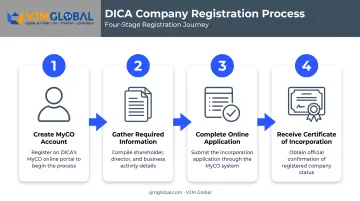
DICA's official sequence has four stages: create a MyCO account, gather required information, complete the online application, and receive the Certificate of Incorporation. Below, those stages are grouped into pre-registration and filing, followed by the post-incorporation work that usually causes the real delays.
Step 1: Pre-Registration Requirements
Start by reserving a compliant company name (must end in "Limited" or "Ltd.") through the MyCO portal. You'll also need:
- A Myanmar registered office address
- At least one director who is ordinarily resident in Myanmar
- Director consent forms and NRC or passport copies
- Share structure and capital currency (MMK or USD) laid out in the constitution
Since there's no universal capital minimum, focus your pre-registration effort on securing a resident director and a real office address instead of over-preparing capital documentation.
Step 2: Submitting Incorporation Documents
Form A-1 requires the model constitution (or a certified custom version), supporting IDs, name consent where needed, and the filing fee. DICA reviews the application and issues the Certificate of Incorporation once satisfied.
Be realistic about timelines. DICA's own portal doesn't publish a fixed processing window or a temporary-permit step. Advisers commonly estimate 5-13 business days including banking, but treat that as an estimate, not a guarantee.
Step 3: Post-Incorporation Compliance
This is where most delays actually happen. A 2025 DICA directive tightened requirements for the first annual return, due within two months of incorporation:
- Email evidence of a bank account in the company's name
- Police recommendations confirming the registered office
- Similar verification for resident director addresses (non-resident members are exempt from this specific check)
You'll also need to:
- Submit the Business Taxpayer Registration Form at least one month before commencing business
- Register for tax with the Internal Revenue Department
- Sort out work permits if you're relocating Singapore staff (a separate process from company registration)
A company seal is optional, not mandatory, which surprises a lot of first-time founders.
Managing this without flying to Yangon repeatedly is often why founders use a cross-border advisory firm for document preparation, filings, and regulator coordination.
VJM Global provides that support across its covered entity-formation markets. Myanmar is not currently among its confirmed markets, so Singapore founders should verify coverage directly before assuming Myanmar-specific support is available.
Tax Obligations and Compliance for Singapore Investors
Myanmar's 2024 Union Taxation Law sets the general corporate income tax rate at 22%, and DFDL reports the 2025 law retained this rate. Commercial tax on most goods and services sits at 5%, subject to exemptions.
The Singapore-Myanmar DTAA
The treaty entered into force on 30 March 2000. It caps withholding tax at the source for several income types:
- Dividends: up to 5% where the beneficial owner holds at least 25% of the payer, otherwise 10%
- Interest: 8% for banks and financial institutions, 10% otherwise
- Royalties: 10% for patents, designs and equipment; 15% for other royalties
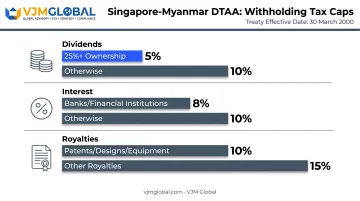
These are treaty ceilings, not automatic rates. You still need residence certificates and eligibility checks before claiming reduced withholding.
Ongoing Filing Obligations
- IRD annual return: due within three months of financial year-end
- DICA annual return: first one within two months of incorporation, then annually within one month of your incorporation anniversary
- Social security contributions: apply to any local hires; confirm current employer and employee rates with Myanmar's Social Security Board before you run payroll
Missing IRD or DICA deadlines can trigger penalties, so build both dates into your compliance calendar from day one.
Key Challenges and How to Manage Them
Myanmar entry friction is real, but most of it is manageable if you plan buffers and local operating habits up front.
Regulatory delays. DICA's 2025 directive added bank-account and police-verification steps to the first annual return. These take real calendar time, even though no official delay figure exists.
- Treat portal submission as a milestone, not the finish line
- Build extra weeks into your launch schedule for bank and police checks
- Track first annual return requirements as soon as the entity is live
Infrastructure limitations. A World Bank firm survey found average operating capacity of just 74%, with more than half of firms citing power outages as disruptive. Practical workarounds:

- Budget for backup power at any physical site
- Use multiple internet and banking providers where possible
- Keep buffer liquidity for unplanned operational gaps
Compliance overhead. Bookkeeping, tax filings, payroll and annual returns pile up quickly once you are operational. Singapore founders usually get more done by handing the statutory stack to a multi-market firm that files under Myanmar's own rules.
- Outsource bookkeeping, tax and payroll instead of running them from Singapore ad hoc
- Use a provider that applies each market's regulators and filing calendar (VJM Global runs this model across 16+ markets)
- Keep founders on customers and supply chain, not return deadlines
Frequently Asked Questions
Which business is most profitable in Myanmar?
Manufacturing, textiles, agriculture and tourism often offer the strongest returns. Profitability still hinges on your capital, market access and compliance capacity—there is no single best sector without that fit.
What is the best business to start in Myanmar with $10,000?
There is no blanket US$50,000 incorporation minimum, so $10,000 can fund a lean service venture or a minority joint-venture stake—not a large standalone private limited company. Choose a low-overhead model first.
Can a Singapore company own 100% of a Myanmar business?
In most sectors, yes. Foreign ownership above 35% simply reclassifies the entity as foreign, and full ownership is generally permitted unless the activity falls under Myanmar's restricted investment list.
How long does it take to register a company in Myanmar from Singapore?
Advisers commonly estimate 5-13 business days including bank account opening, but DICA doesn't publish an official service standard. Post-incorporation verification steps can extend this further.
Does Myanmar have a tax treaty with Singapore?
Yes. The Singapore–Myanmar Double Taxation Avoidance Agreement has been in force since 30 March 2000 and caps withholding tax on dividends, interest and royalties for qualifying investors.
Do I need to travel to Myanmar to set up a business from Singapore?
Often for some steps—especially bank account opening and certain verifications. A local advisory partner familiar with DICA can cut travel needs, but may not remove them entirely.