But Australian founders quickly hit unfamiliar territory: eROC, BOI, the Companies Act No. 7 of 2007, and a registration process that has to be managed remotely across a five-and-a-half-hour time difference. Getting documentation right the first time matters, because delays add up fast when you're coordinating from Sydney or Melbourne.
This guide walks through eligibility, the step-by-step registration process, realistic costs and timelines, and post-registration compliance. We'll also cover how firms like VJM Global support cross-border incorporation and back-office coordination for Australian businesses expanding overseas.
Key Takeaways
- Full foreign ownership is allowed in most sectors; a Pvt Ltd needs only one director and 1–50 shareholders
- Registration happens entirely online through Sri Lanka's eROC portal
- You must appoint a licensed local Company Secretary and keep a genuine Sri Lankan registered address
- Government filing fees stay low, but VAT and secretarial costs sit on top
- Missed tax registration, VAT thresholds or Annual Returns trigger real penalties
Why Australian Businesses Are Choosing Sri Lanka
Sri Lanka sits close to South and Southeast Asian markets, runs on an English-speaking commercial system, and offers noticeably lower operating costs than Singapore or Hong Kong. For Australian businesses testing regional expansion, those three factors often outweigh the usual Asia-entry alternatives.
The investment picture backs this up. Sri Lanka's Board of Investment reported realised FDI of US$203 million in Q1 2025, a 90% jump from the same quarter in 2024. Ports, manufacturing and tourism/leisure accounted for the bulk of that inflow, with Australia named among the proposal-source countries.
Sectors seeing genuine momentum include:
- IT and BPO — programming and consultancy grew 12.8% in 2025
- Tourism and hospitality — accommodation and food services grew 12.4%
- Manufacturing — up 6.2% for the year
- Export trading and agri-processing — steady demand from regional supply chains
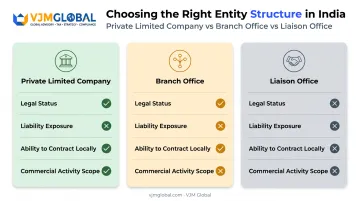
That momentum only helps if you pick the right vehicle. A Pvt Ltd suits these entrants better than a branch or liaison office because it is a distinct legal entity with limited liability.
Unlike a liaison office, it can contract locally and run full commercial operations. Unlike a branch, liability stops with the Sri Lankan company rather than flowing back to the Australian parent.
Requirements for Registering a Private Limited Company in Sri Lanka
Before you touch the eROC portal, it helps to know exactly what the Registrar expects.
Company name rules:
- Must be unique and not identical to an existing company
- Must end in "(Private) Limited" or "(Pvt) Ltd"
- Cannot include restricted words like "National," "Sri Lanka," "President," or "Municipal" without ministerial consent
Directors and shareholders:
- Minimum one director and one shareholder — the same person can fill both roles
- Foreign nationals are eligible; passport details are required at filing
- A private company can have up to 50 shareholders
Registered local address: You need a physical Sri Lankan address for official correspondence. A PO Box won't be accepted, so this is one area where Australian founders often need local support.
Mandatory Local Company Secretary
Every Sri Lankan company must appoint a secretary under the Companies Act. For companies with a stated capital of at least LKR 500,000 or annual turnover above LKR 1 million, that secretary must hold a Registrar-issued Certificate of Practice under the 2023 regulations.
This requirement applies regardless of foreign ownership, so it's not something you can waive by structuring the company differently.
Articles of Association: These follow the Act's First Schedule model articles unless you adopt customised ones. For private companies, the articles must explicitly prohibit public share offers and enforce the 50-shareholder cap.
BOI approval is only needed if you're entering restricted sectors, such as certain manufacturing categories, retail below a foreign-capital threshold, or activities where non-resident shareholding would exceed 40% of voting shares. A standard Pvt Ltd in most service or trading sectors doesn't need it.
Step-by-Step Registration Process via eROC
Sri Lanka's Department of the Registrar of Companies runs registration through eROC, its online single-window system. Here's how it flows:
- Create an eROC account and verify your email to unlock the registration modules.
- Search and reserve your company name. Have two or three backup options ready in case your first choice is taken or flagged.
- Prepare and upload the required forms. Upload Form 1 (incorporation), Form 18 (director consent), Form 19 (secretary consent), and your Articles of Association as PDFs.
- Pay government fees online through the portal for name reservation and the incorporation filing itself.
- Wait for Registrar review and receive your digital Certificate of Incorporation once approved.
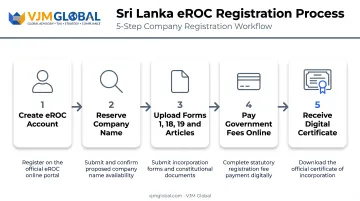
Every step happens remotely. There's no need to fly to Colombo.
Still, the Australia–Sri Lanka time difference and unfamiliar form rules trip up many first-time filers. A rejected Form 18 or 19 over a formatting error costs days you don't get back, so a lot of Australian businesses use professional support to file correctly the first time.
Cost of Registration and Realistic Timelines
Sri Lanka's official 2026 fee gazette sets out the core government charges:
| Item | Fee (excl. VAT) |
|---|---|
| Company name approval | LKR 2,600 |
| Private company registration (Form 1) | LKR 5,200 |
| Form 18 / Form 19 | Fee schedule not itemised in current gazette |
| Standard VAT rate | 18% |
These government fees are low next to places such as Singapore, and modest once you think in Australian dollars. Most of your real budget goes to a licensed Company Secretary and, typically, a registered address arrangement.
Realistic timeline:
- Name approval: roughly 2-3 business days
- Incorporation review: roughly 5-7 business days
- Total: about two weeks from account creation to certificate if your documents are complete on first submission
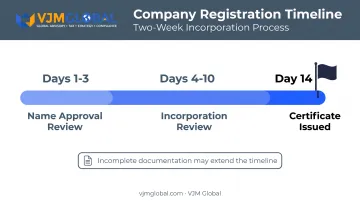
Incomplete paperwork is the single biggest cause of delay. Missing passport certifications or inconsistent director details between forms will bounce your application back into the queue.
Post-Registration Compliance and How VJM Global Supports Australian Businesses
Getting your Certificate of Incorporation isn't the finish line. There are immediate and ongoing obligations to manage.
Immediately after incorporation:
- Obtain a Taxpayer Identification Number (TIN) through the Inland Revenue Department's e-services
- Register for VAT if taxable turnover exceeds LKR 15 million per quarter or LKR 60 million over 12 months (standard rate: 18%)
- Open a corporate bank account, which typically requires your incorporation certificate, director identification, and Articles
Ongoing obligations:
- Hold your first Annual General Meeting within 18 months of incorporation
- File your Annual Return (Form 15) within 30 working days after that AGM
- Maintain statutory registers and records on an ongoing basis
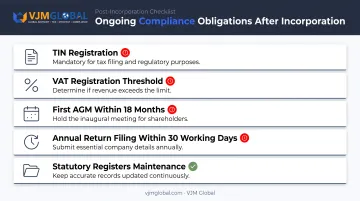
Non-compliance isn't a soft warning. Companies face fines of up to LKR 100,000, and individual defaulting officers can be fined up to LKR 50,000 personally.
Coordinating these duties across two jurisdictions is where an Australian-owned entity often gets stuck. VJM Global provides accounting, tax, payroll, and compliance support across 100+ countries through local professionals in each market.
For an Australian business with a Sri Lankan subsidiary, that means someone tracking your Sri Lankan filing calendar while your finance team at home stays on bookkeeping, management reporting, tax advisory, and payroll coordination—without you needing to master every local statutory deadline.
Frequently Asked Questions
What are the requirements to register a private limited company in Sri Lanka?
You need at least one director and shareholder (which can be the same person), a genuine registered Sri Lankan address, a licensed local Company Secretary, and Articles of Association consistent with the Companies Act's model provisions.
How do I register a private limited company in Sri Lanka?
Registration runs through the eROC portal: reserve your company name, submit Forms 1, 18 and 19 with your Articles, pay the government fees online, and wait for the Registrar to issue your digital Certificate of Incorporation.
How much does it cost to register a private limited company in Sri Lanka?
Government fees are currently LKR 2,600 for name approval and LKR 5,200 for registration, excluding 18% VAT. Secretarial and registered-address services add further cost depending on your provider.
Can Australian nationals own 100% of a Sri Lankan Pvt Ltd company?
Yes, in most sectors. Restrictions apply mainly to specific export-quota industries, primary resource extraction, and certain sectors where non-resident ownership above 40% requires prior BOI approval.
Do I need to travel to Sri Lanka to register my company?
No. The entire registration process, from name reservation to receiving your Certificate of Incorporation, is completed online through the eROC portal.
What ongoing compliance is required after incorporation?
You'll need a Taxpayer Identification Number, plus VAT registration if turnover crosses the LKR 60 million annual threshold. File an Annual Return (Form 15) within 30 working days of your first AGM, which must be held within 18 months of incorporation.