Most guides on entering Sri Lanka focus on the Private Limited Company, the default vehicle for a straightforward subsidiary. But if your plan involves raising local capital, bringing in a Sri Lankan joint venture partner, or eventually listing on the Colombo Stock Exchange, the Private Ltd structure won't get you there. You need a Public Limited Company (PLC).
This guide walks through what a Sri Lankan PLC actually is, who can form one, the registration steps, ongoing tax and compliance duties, and how it stacks up against the alternatives.
Key Takeaways
- Only a PLC can raise capital publicly or list on the Colombo Stock Exchange (CSE)
- Companies Act No. 7 of 2007 requires 2 shareholders and 2 directors minimum for a public company
- No statutory minimum share capital—CSE listing sets its own capital thresholds
- Corporate tax is 30% for 2025/26, before VAT and dividend withholding
- US–Sri Lanka tax treaty (in force since 2004) shapes dividend repatriation planning
What Is a Public Limited Company (PLC) in Sri Lanka?
A Sri Lankan PLC is a company incorporated under the Companies Act No. 7 of 2007 and registered with the Registrar of Companies (ROC). It has a separate legal identity from its shareholders, so the company can own assets, sign contracts, and be sued in its own name.
Shareholder liability is limited to the amount subscribed for shares. Where a PLC differs from a standard private company is governance and access to capital markets.
On minimum shareholder count, advisory sources still disagree. The 2007 Act sets the baseline at 2 shareholders. A more recent amendment, Act No. 12 of 2025, would allow a single shareholder, but only after the government issues a commencement gazette.
No such gazette had been confirmed at the time of writing. Verify the current figure with the Registrar of Companies before filing; do not rely on older guides that cite 7.
Governance and the "PLC" Name
A public company under the Act must have at least 2 directors and a company secretary at all times. Only public companies may offer shares to the public and pursue a Colombo Stock Exchange (CSE) listing.
One detail that trips up a lot of foreign founders: the "PLC" suffix itself is tied to listed status. A company can be structured as a public company under the Act, but under Sri Lanka's naming conventions, it only carries the "PLC" designation once it actually lists on the CSE. Before that, even a public company is named "Limited" or "Ltd." It's a subtle distinction, but it matters if you're negotiating with a Sri Lankan partner who expects a listed entity.
There's no statutory minimum share capital. Shares in Sri Lanka don't carry a par or nominal value; stated capital simply reflects what's been received or is due for issued shares. If you do plan to list, however, the CSE imposes its own thresholds (covered below).
PLC vs. Private Ltd, at a Glance
| Feature | Private Ltd | Public company / PLC |
|---|---|---|
| Ownership | Closely held | Built for public fundraising |
| Share offers | Articles must prohibit public offers | May offer shares to the public |
| Shareholder cap | Maximum 50 | No cap |
| Disclosure | Lighter requirements | Audited accounts and public financial disclosure |
Why US Businesses Consider a Sri Lankan PLC
Most US companies entering Sri Lanka don't need a PLC. A standard private entity handles routine market entry fine. A PLC becomes relevant when the plan involves scale.
Access to local capital markets is the biggest draw. A PLC can raise funds through the Colombo Stock Exchange (CSE), bringing in Sri Lankan and regional investors alongside US ownership.
That matters for capital-intensive projects such as infrastructure, manufacturing, or energy, where funding entirely from the US isn't efficient or where local-currency financing reduces exchange-rate exposure.
That path fits a broader shift: with the economy growing again and reform momentum continuing post-crisis, US investors are weighing larger, longer-horizon plays in Sri Lanka rather than small pilot operations.
Joint ventures with local partners are the other common trigger. Many established Sri Lankan family conglomerates and business groups expect a formal board, a qualified company secretary, and public disclosure standards before they'll commit to a joint venture.
A PLC's built-in governance framework signals that level of seriousness in a way a small private company sometimes can't.
A few scenarios where a PLC makes practical sense:
- Raising local currency for a capital-heavy project (hospitality, manufacturing, energy)
- Entering a joint venture where the Sri Lankan partner expects public-company-grade governance
- Building toward an eventual CSE listing as an exit or fundraising milestone
Requirements to Register a PLC in Sri Lanka as a US Business
Before filing anything, US founders need to lock down a few structural pieces.
Shareholders, Directors, and the Secretary
- Shareholders: 2 minimum under the current Act (confirm before filing, given the pending 2025 amendment)
- Directors: at least 2; neither the Act nor established Sri Lankan corporate law firms document a local residency requirement
- Company secretary: mandatory at all times; prescribed qualifications apply once turnover or stated capital cross set levels
Check the ROC’s current registered-secretary list for credential rules, which are not published uniformly.
Many third-party guides claim Sri Lanka requires a resident director, similar to India or Singapore. That claim does not hold up against the Act itself. The 2025 amendment instead introduces a Sri Lanka-resident "authorised person" who maintains beneficial ownership records: a compliance role, not a board seat.
Registered Office and Foreign Ownership Limits
Every PLC needs a physical Sri Lankan registered office address. A P.O. Box will not satisfy the ROC. This address receives all official correspondence and appears on public filings.
Foreign ownership is generally open, but not unconditionally:
- 100% ownership is permitted in most sectors
- Prohibited entirely for non-residents: pawn broking, and retail trade where non-resident capital is below US$5 million
- Capped at 40% unless the Board of Investment approves more: quota-restricted goods, crop cultivation/primary processing, mining, local timber, mass communication, education, freight forwarding, travel agencies, and shipping agencies
- Prior sector approval required: air transport, defence-related industries, hazardous materials, currency/security document production, mechanised gem mining, and lottery operations
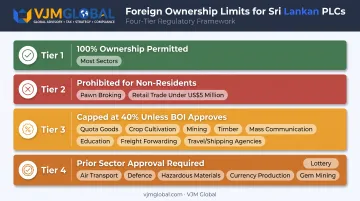
Verify your specific sector against the current Department of Foreign Exchange rules before you structure ownership — these categories shift.
Documentation for US Shareholders
US shareholders and directors need certified copies of passports for identity verification. Foreign corporate shareholders must also disclose ultimate beneficial ownership in the filing. With the 2025 amendment’s focus on beneficial ownership transparency, expect this requirement to tighten, not loosen.
Step-by-Step Registration Process for US Businesses
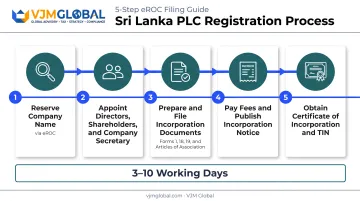
Sri Lanka's incorporation process runs primarily through the eROC online portal, which helps US founders coordinate remotely across time zones. Most of the process doesn't require physical presence in Colombo. That said, complete documentation upfront saves significant back-and-forth.
Step 1: Reserve Your Company Name
Search and reserve your proposed name through eROC. The ROC will reject names that are:
- Identical or confusingly similar to an existing company
- Misleading about the company's purpose or status
- Using restricted terms like "President," "Municipal," "National," "State," or "Sri Lanka" without prior consent
Confirm reservation fees and the validity window on the current eROC fee schedule. Third-party figures vary and often aren't current.
Step 2: Appoint Directors, Shareholders, and a Company Secretary
Your 2 directors, 2 shareholders, and licensed company secretary all need to be finalized before you file. Their signed consent forms are a filing requirement, not a formality you can complete afterward.
Step 3: Prepare and File Incorporation Documents
You'll submit through eROC:
- Form 1 — core company details
- Form 18 — consent, filed for each director
- Form 19 — company secretary's consent
- Articles of Association
Only eROC system-generated forms are accepted; downloaded templates from third-party sites won't clear the system. Foreign shareholders also need to complete beneficial ownership disclosure at this stage.
Step 4: Pay Fees and Publish the Incorporation Notice
ROC filing fees for a public company include the Articles filing, the Form 1 fee (notably higher for public companies than private ones), and per-director/secretary consent fees, all subject to VAT. Confirm the live total at eROC checkout rather than relying on older published rates, since VAT and fee schedules have changed in recent cycles.
One detail founders often miss: it's the Registrar, not the company, who publishes the incorporation notice. Following a 2019 amendment, the Registrar has 60 working days to publish notice of the new company (name, registration number, and registered office) in a daily newspaper circulating in Sinhala, English, and Tamil.
Step 5: Obtain Your Certificate of Incorporation and TIN
Once approved, you'll receive your Certificate of Incorporation. Realistic timelines from established Sri Lankan corporate law firms put full incorporation at 3 to 10 working days with complete documentation, and longer if foreign shareholder paperwork or eROC system issues cause delays.
From there:
- Register for a Tax Identification Number (TIN) with the Inland Revenue Department
- Open a corporate bank account, which typically requires the Certificate of Incorporation, TIN, and board resolution
- Set up your compliance calendar for annual returns, audits, and (if applicable) CSE reporting
For US founders managing this from abroad, the on-the-ground filing work generally needs a Sri Lanka-licensed company secretary or registered agent.
A firm like VJM Global can help with the broader structuring question: whether a PLC is the right vehicle for your capital-raising goals, and how the Sri Lanka entity should sit alongside accounting, tax, and compliance obligations in your other markets.
Tax and Compliance Obligations for PLCs in Sri Lanka
A Sri Lankan PLC is taxed as a resident company on its worldwide income, and the obligations don't end at incorporation.
Corporate Tax and VAT
The standard corporate income tax rate is 30% for the 2025/26 year of assessment, according to the Inland Revenue Department's tax chart. Sector-specific rates apply in some industries, so don't assume 30% blindly without checking your business category.
VAT registration becomes mandatory once taxable turnover exceeds:
- Rs 15 million per quarter or Rs 60 million per 12 months (general threshold)
- Rs 3 million per quarter or Rs 12 million per year (financial services)
The standard VAT rate has been 18% since January 2024.
Dividends and the US Tax Treaty
Dividends distributed by a Sri Lankan company carry a 15% withholding tax, effective since 2023. For US shareholders, this is where the tax treaty matters.
A US-Sri Lanka income tax treaty has been in force since July 12, 2004, confirmed by the US Department of the Treasury. Under the treaty, the maximum withholding rate on dividends caps at 15%, matching the domestic rate rather than cutting it further.
Structure dividend repatriation with a tax advisor who knows both systems. Treaty relief can still change treatment of other income categories even when the dividend rate stays the same.
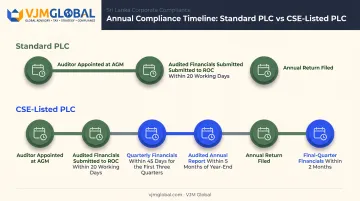
Annual Compliance
Every PLC must:
- Appoint an auditor at each Annual General Meeting
- Submit signed audited financial statements to the ROC within 20 working days of signing
- File an annual return with shareholder, office, capital, director, secretary, and charge details
PLCs listed on the CSE take on extra reporting on top of the ROC filings above:
- Audited annual reports within 5 months of year-end
- Quarterly financials within 45 days for the first three quarters
- Final-quarter financials within 2 months (or half-yearly reporting on the Empower Board)
PLC vs. Private Limited Company vs. Branch Office: Choosing the Right Structure
Here's how the three main entry structures compare for a US company:
| Factor | PLC | Private Ltd | Branch Office |
|---|---|---|---|
| Shareholders/Directors | 2 minimum each | 1 shareholder, 1 director minimum | No local shareholders; parent's directors apply |
| Liability protection | Limited to subscribed capital | Limited to subscribed capital | None: parent company remains liable |
| Public capital raising | Yes, via CSE listing | Not permitted (capped at 50 shareholders, no public offers) | Not applicable |
| Compliance burden | Highest: audit, ROC filings, CSE rules if listed | Moderate: audit and annual return required | ROC registration within 1 month, annual parent financials |
| Foreign ownership | Sector-based caps/exclusions apply | Same sector rules apply | Same sector rules, plus benchmarks like the US$100,000 parent net-worth guideline for income-generating branches |
A PLC fits US businesses planning large-scale capital raising, a CSE listing, or a joint venture where the local partner expects public-company governance.
A Private Ltd suits standard market entry: testing the market, running operations, and no public fundraising ambitions.
A Branch Office works if you are extending an existing US parent's operations into Sri Lanka without a new local entity. Its income tax treatment can run as high as 40% depending on eligibility.
If you're not sure which structure fits, that's a decision worth making before you file rather than after. VJM Global works with businesses across more than a dozen markets to think through this kind of structuring question, matching the entity type to the actual business goal rather than defaulting to whatever's fastest to set up.
Frequently Asked Questions
What are the public limited companies in Sri Lanka?
This usually refers to companies listed on the Colombo Stock Exchange. Well-known examples include Access Engineering PLC, Aitken Spence PLC, Cargills (Ceylon) PLC, and Amana Bank PLC. These are existing listed companies, not the formation route a US business would take to create a new PLC.
What is the minimum number of shareholders required for a PLC in Sri Lanka?
The Companies Act No. 7 of 2007 sets the baseline at 2 shareholders, not 7. A 2025 amendment could lower this to 1, but only once formally commenced by gazette. Confirm the current status before filing.
Can a US company fully own a PLC in Sri Lanka?
Yes, in most sectors. Some industries carry a 40% foreign ownership cap unless the Board of Investment approves more, and a few require prior sector-specific approval, so verify your industry first.
How long does it take to register a PLC in Sri Lanka?
Expect roughly 3 to 10 working days once you submit complete documentation. Delays typically stem from incomplete paperwork or foreign shareholder verification requirements.
What is the corporate tax rate for a PLC in Sri Lanka?
The standard rate is 30% for the 2025/26 assessment year. VAT (18%) and dividend withholding tax (15%) may also apply depending on turnover and distributions.
Does a PLC have to be listed on the Colombo Stock Exchange?
No. Public company status permits a CSE listing but doesn't require one. An unlisted public company still technically carries the "Limited" designation rather than "PLC," which only applies once the company actually lists.