The registration process itself is genuinely simple. What separates a smooth setup from a costly headache is everything around it — the structure you choose, how you manage Australian tax residency rules, and whether banking access is sorted before you need it.
This guide walks through the exact steps, the documents you'll need, the tax and compliance factors that trip people up, and the alternatives worth considering before you incorporate.
Key Takeaways
- Australians can own 100% of a UK Ltd as sole director and shareholder, no visa required
- You'll need a UK registered office, one director, and Companies House registration
- The UK-Australia tax treaty prevents double taxation, but Australian CFC rules still apply
- Banking and tax-residency planning cause more problems than incorporation itself
- Cross-border advice before incorporating costs far less than fixing mistakes later
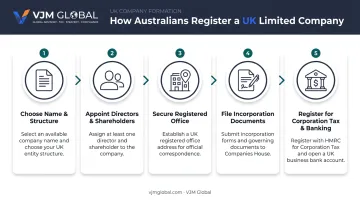
Step-by-Step: How to Set Up a UK Ltd From Australia
Step 1: Choose Your Company Name and Structure
Start by checking name availability through the Companies House name availability checker. Your chosen name must end in "Limited" or "Ltd," avoid restricted words, and can't duplicate an existing registered name.
You'll also need to decide on structure:
- Standalone UK Ltd: a fully independent legal entity, separate from your Australian business
- Branch or establishment of your existing Australian company: no new legal person is created
- Subsidiary structure: a UK Ltd owned by your Australian parent company
The right choice depends on your liability appetite and tax planning goals, not just speed of setup.
Step 2: Appoint Directors and Shareholders
UK company law requires at least one director. That director doesn't need to live in the UK and can also be the company's sole shareholder. There's no rule preventing 100% Australian ownership.
Decide your share structure early: even a simple 100-share, single-shareholder setup needs to be documented correctly at incorporation, since amending it later adds paperwork.
Step 3: Secure a UK Registered Office Address
This is mandatory and often the first thing Australian founders underestimate. Your registered office:
- Must be a physical UK address (a PO Box alone isn't accepted)
- Appears permanently on the public Companies House register
- Receives statutory correspondence from Companies House and HMRC
Rather than renting UK premises they'll never visit, many Australian founders use a registered office and local agent service. Cross-border formation specialists such as VJM Global provide this address on the client's behalf, which keeps personal addresses off the public record and ensures statutory notices don't get missed across time zones.
Step 4: File Incorporation Documents With Companies House
You'll need to prepare and submit:
- Memorandum of Association: a statement that founding members agree to form the company
- Articles of Association: the rules governing how the company is run
- Statement of capital: details of shares issued and their value
- People with Significant Control (PSC) details: anyone holding more than 25% of shares or voting rights
Filing fees and turnaround times vary by route:
| Route | Fee | Typical timing |
|---|---|---|
| GOV.UK digital filing | £100 | Usually within 24 hours |
| Same-day software filing | £156 | Same day |
| Paper IN01 form | £124 | 8–10 days |
Digital filing through Companies House's published fee schedule is the fastest and cheapest route for most straightforward incorporations.
Step 5: Register for Corporation Tax and Set Up Banking
Once your company starts trading, you must notify HMRC of Corporation Tax liability within three months of your accounting period beginning, not from your incorporation date.
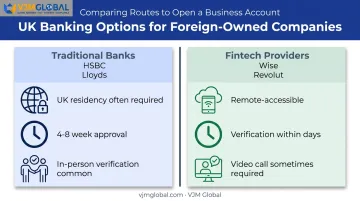
For banking, you have two broad paths:
- Traditional UK banks (HSBC, Lloyds): often require UK residency or a UK mobile number, which can rule out Australian-only ownership structures for standard products
- Multi-currency fintech providers (Wise, Revolut): generally more accessible remotely, though verification still requires proof of business activity, funding sources, and beneficial ownership
Even fintech accounts sometimes need a video call or supplementary document exchange before approval, so don't assume same-day setup.
What You Need Before Setting Up a UK Company From Australia
Preparation reduces delays — particularly around identity verification and the registered office, where non-residents often get stuck.
Documents & identity requirements: Each director and shareholder needs a valid passport and proof of address. Banks and Companies House increasingly request certified or notarised copies rather than plain scans, so sort this before you start the clock on incorporation.
Registered office & local support: Beyond the mandatory registered office, many founders bring in a UK-based accountant or formation agent to handle Companies House filings and HMRC registrations directly, rather than managing paperwork from an Australian time zone.
Tax & compliance readiness: Before incorporating, get a working understanding of current UK Corporation Tax rates and thresholds, plus how Australian CFC and tax residency rules might apply to your specific setup. Reviewing this with a cross-border advisor such as VJM Global before you file, rather than after, avoids restructuring costs down the line.
Banking readiness: UK banks will ask overseas-owned companies for:
- Source of funds documentation
- A clear description of business activity
- Beneficial ownership details for anyone holding 25% or more
Having these ready in advance shortens what's often the slowest part of the entire setup.
Key Factors That Affect Tax, Compliance and Banking Outcomes
How you structure ownership, residency, and banking access determines whether your UK company runs smoothly or becomes an ongoing compliance headache.
UK-Australia Double Taxation Agreement (DTA)
The 2003 Australia-UK Double Taxation Convention determines which country holds taxing rights over specific income types, preventing the same profit being taxed twice. Applied correctly, it can reduce withholding tax and clarify where dividends, royalties, or service income are actually taxed. Applied incorrectly, you end up paying more than you should, or filing incorrectly in both countries.
Australian Tax Residency and CFC Rules
Here's the part that catches Australian founders off guard: incorporating in the UK doesn't automatically keep your company outside Australian tax jurisdiction. If the company is centrally managed and controlled from Australia, meaning high-level decisions are made there rather than just day-to-day operations, the ATO may treat it as an Australian tax resident regardless of where it's incorporated.
This can trigger worldwide income reporting obligations and Controlled Foreign Company attribution for the Australian owner. It's a factual test based on where control genuinely sits, not where board minutes are signed.
Registered Office and Director Residency
No UK residency is required for directors. However, your registered office address affects how statutory notices are delivered and what's visible on the public record.
A professional registered office service, rather than a personal address, protects director privacy and helps meet compliance deadlines even when you're managing everything from Sydney or Melbourne. Providers such as VJM Global offer this service alongside broader UK compliance support for Australian-owned entities.
Banking and Payment Infrastructure
UK banks apply enhanced due diligence to foreign-owned companies. This can add weeks to account opening:
- Traditional banks: often 4-8 weeks for foreign-owned companies
- Fintech providers: sometimes a few business days once verification clears
Research current timelines before you assume the account will be ready when you need it.
Common Mistakes and Compliance Challenges for Australian Founders
The incorporation process is rarely where things go wrong. The real risk sits in what happens before and after.
- Incorporating before mapping tax residency exposure: founders register the company first and only discover CFC attribution risk once the ATO comes asking questions
- Treating the registered office as optional: using a residential address without understanding it becomes permanently public
- Missing Companies House deadlines: confirmation statements and annual accounts have strict windows, and managing them remotely across time zones makes it easy to lose track
- Going it alone on cross-border compliance: few founders have visibility into both UK and Australian rules at once, so issues surface only after they've already cost money
Confirmation statements are due at least every 12 months. Late annual accounts attract penalties starting at £150, rising to £1,500 the longer they remain overdue.
None of this is complicated once you know the calendar. The problem is simply not knowing it exists. Firms working across both jurisdictions, such as VJM Global, which has supported 250+ Australian and 250+ UK businesses, help founders catch these issues before they turn costly.
Alternatives to Setting Up a UK Ltd Company From Australia
A full UK Ltd isn't always the right first move. The best structure depends on your trading volume, risk exposure, and how long you plan to operate in the UK.
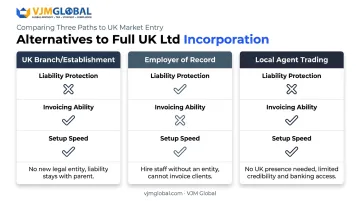
UK Branch or Establishment of Your Australian Company
This suits businesses that want to trade under their existing Australian entity without creating a new legal person. Liability stays with the Australian parent, and you'll still need to register with Companies House and file annual documents — but you skip creating a second, entirely separate legal entity.
Employer of Record (EOR) Instead of Incorporating
If your immediate goal is hiring UK-based staff or testing the market, an EOR lets you employ someone in the UK without setting up payroll or an entity at all. VJM Global runs UK EOR arrangements exactly for this scenario, handling payroll and compliance while you employ staff without an entity. It's a fast, low-commitment option, but it doesn't let you invoice UK clients directly, so it's not a substitute for a trading entity.
Trading Directly From Australia With a Local Agent
For low-volume market testing, trading through a UK-based agent or distributor can work without any UK legal presence. The trade-off: it limits your credibility with UK clients and locks you out of UK-specific banking, contracts, and tax reliefs that only locally incorporated companies can access.
Conclusion
Setting up a UK private limited company from Australia is legally straightforward, and yes, it can be done entirely from your home office with no visa or residency requirement.
The expensive mistakes rarely come from the incorporation form itself. They come from skipping tax residency planning and underestimating how long banking and compliance setup takes.
The founders who get the best outcomes balance speed of registration with long-term stability across both tax systems. VJM Global's cross-border team advises on this before you file, not after — coordinating UK incorporation with your Australian tax position from day one.
Frequently Asked Questions
Can a non-UK resident open a UK limited company?
Yes. Non-residents can own 100% of a UK Ltd and act as sole director and shareholder. You don't need a UK visa or personal UK address, only a registered office for the company.
Does the UK have a double taxation agreement with Australia?
Yes, the UK-Australia DTA has been in force since 2003. It helps prevent the same income being taxed in both countries, though applying it correctly to your specific situation needs professional advice.
Do I need to visit the UK to register a company from Australia?
No. Incorporation can be completed fully online through Companies House. Some banks, however, may still request in-person or video-based identity verification before opening an account.
How long does it take to register a UK limited company from Australia?
Companies House digital filing typically processes within 24 hours. Bank account opening usually takes longer, ranging from a few days with fintech providers to several weeks with traditional banks.
Will I need to pay tax in both the UK and Australia?
UK Corporation Tax applies to UK profits, while Australian Controlled Foreign Company (CFC) and tax residency rules may also apply depending on where the company is controlled from. Dual tax planning before incorporation is essential.
What ongoing compliance is required after the company is set up?
Companies must file annual accounts and a confirmation statement with Companies House, plus Corporation Tax returns with HMRC. Directors based in Australia should also track CFC reporting obligations back home.