Setting one up looks simple on paper: reserve a name, file some forms, get a company number. In practice, outcomes hinge on things that are easy to underestimate from Germany - director residency compliance, governance obligations, and knowing exactly how a public company differs from Australia's far more common Pty Ltd. Get these wrong and you're looking at delays, stalled applications, or a structure that costs more to run than it needs to.
This guide covers what a public limited company actually means in Australia, the exact registration steps from Germany, the requirements and costs involved, and the mistakes that trip up German businesses most often.
Key Takeaways
- Full foreign ownership is allowed in most sectors once director residency rules are met
- Public companies face heavier rules than a Pty Ltd: three directors, a resident secretary, audits, and AGMs
- Register with ASIC for a company number first, then with the ATO for tax
- Annual ASIC fees for public companies run far higher than Pty Ltd rates, before audit costs
- Formation specialists can handle ASIC and ATO filings without directors travelling to Australia
What Is a Public Limited Company in Australia (and How Does It Compare to German Entities)?
An Australian public company limited by shares - the "Ltd" - is created and regulated under the Corporations Act 2001, with ASIC as the registrar. Unlike a proprietary company, its shares can be offered to the public and, eventually, listed on the ASX.
That's the point of choosing this structure over a Pty Ltd: access to a far wider pool of capital than private shareholders alone could provide.
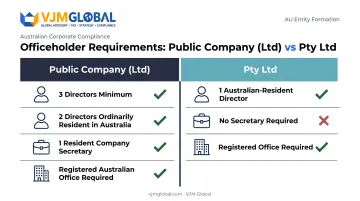
Governance requirements scale up accordingly. A public company needs:
- A minimum of 3 directors, with at least 2 ordinarily resident in Australia
- At least 1 company secretary, also ordinarily resident in Australia (this can be one of the directors)
- A registered Australian office address, open during standard business hours
Compare that to a Pty Ltd, which needs just one Australian-resident director and no secretary at all, according to ASIC's rules on company officeholders.
That gap is the single biggest thing German founders underestimate when they assume the two structures are just different flavours of the same paperwork.
How It Compares to a Pty Ltd and German Structures
Australia has no entity literally called a "PLC" - that's a British term with no legal equivalent here. This mapping is the practical guide:
| Australian entity | Closest German equivalent | Built for |
|---|---|---|
| Public company (Ltd) | Aktiengesellschaft (AG) | Public capital raising, broad shareholder base |
| Proprietary (Pty Ltd) | GmbH | Private ownership, simpler governance |
The Ltd is the AG counterpart. The Pty Ltd sits closer to a GmbH - privately held, with one resident director and lighter compliance.
If your business currently trades as a German UG (haftungsbeschränkt) - the low-capital "mini-GmbH" that can be formed with as little as €1 in share capital - the jump to an Australian public company is substantial. You're moving from minimal governance to mandatory audits, AGMs, and multiple resident officeholders. It's a different scale of operation, not just a different country.
Foreign ownership isn't usually the obstacle. Australia permits full foreign ownership across most sectors. Certain regulated industries and larger or national-security-sensitive transactions require notification to the Foreign Investment Review Board, with thresholds varying by investor type and sector, per FIRB's monetary threshold guidance.
For most German SMEs setting up a standard operating company, FIRB won't be the bottleneck - the governance and audit burden usually is.
Step-by-Step Process to Register a Public Limited Company in Australia from Germany
The registration path itself is well-defined. Where German businesses lose time is in the sequencing - some steps have to happen before others, and skipping ahead causes rework.
Step 1: Choose the Right Structure and Confirm Public Company Eligibility
Before filing anything, confirm you genuinely need public company status. If you're not raising capital from outside shareholders, planning an ASX listing, or bringing in a large investor base, a Pty Ltd will do the job with far less overhead.
Once you're sure, check whether you can staff the resident director and secretary requirements. This is where applications stall most often.
Step 2: Reserve a Company Name and Obtain Director Identification Numbers
Run your proposed name through ASIC's Check Name Availability tool. It must be unique and end in "Limited" or "Ltd" - not "PLC," which isn't a recognised Australian suffix.
Every proposed director, German nationals included, needs a Director ID before appointment. Directors apply personally.
Those without an Australian identity history typically use the paper-based verification route with certified passport copies, because the standard online path relies on Australian-linked identity data. Build in extra time here.
Step 3: Appoint Local Directors, a Company Secretary and a Registered Office
ASIC expects local presence from day one. At minimum you need:
- Two directors ordinarily resident in Australia
- One company secretary ordinarily resident in Australia
- A physical registered office address (a PO box will not satisfy ASIC)
Few German founders have this local presence already in place. Many use a registered agent or formation partner to supply the resident officeholders and address rather than relocating staff.
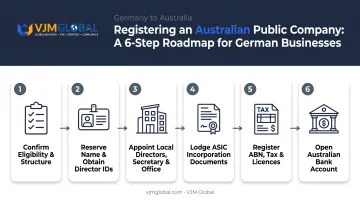
Step 4: Prepare and Lodge Incorporation Documents with ASIC
Lodge registration online with ASIC. Paper Form 201 has not been accepted since 2019. File a constitution if you are adopting one, plus signed consents from every director and secretary.
The ASIC registration fee for a public company with share capital is A$636. Once approved, ASIC issues an Australian Company Number (ACN), which every later tax and licensing registration will reference.
Step 5: Register for ABN, Tax and Any Required Licences
With your ACN in hand, complete the core tax registrations with the ATO:
- Apply for an Australian Business Number (ABN) and Tax File Number (TFN) - often in the same application
- Register for GST once turnover is expected to cross A$75,000 (due within 21 days of hitting that threshold)
- Confirm any sector licences, especially in financial services, construction or healthcare
Step 6: Open an Australian Business Bank Account
German directors typically need the following to open a corporate account:
- Certified ID and proof-of-address documents
- ACN, ABN and company constitution
Some major banks still require an in-person branch visit for company accounts, especially public companies where KYC checks run deeper. Digital-first providers are usually more remote-friendly, though scrutiny is still tighter than for a simple Pty Ltd.
Requirements, Costs and Ongoing Compliance for German Businesses
Documents and Eligibility Requirements
Core documents needed to register and stay compliant:
- Valid passport for each director and secretary
- Notarised proof of address for overseas directors
- A Director ID for every appointed director
- Tax File Number registration for the company
- Company constitution (public companies typically adopt a bespoke one)
If your business is already trading in Germany, confirm you're in good standing there first: current Handelsregister registration, up-to-date Finanzamt filings, and no outstanding compliance issues. This can come up during banking or audit onboarding in Australia.
Cost Breakdown: Initial and Ongoing
One-time costs:
- ASIC registration fee (public company with share capital): A$636
- Name reservation and registered agent/office fees
- Certification and notarisation of German-issued documents
Ongoing costs - and this is where public companies diverge sharply from a Pty Ltd:
- ASIC annual review fee: A$1,591 for a public company, versus A$342 for an ordinary proprietary company, according to ASIC's fee schedule
- Statutory audit fees, which vary by company size and complexity
- A company secretary retainer, if engaging one externally
Businesses that only budget for the one-time registration fee are routinely caught out by what it costs to maintain public company status year after year.
Ongoing Governance Obligations
Public companies carry statutory obligations a Pty Ltd simply doesn't:
- An annual ASIC review, including a director solvency resolution within two months of the review date
- A mandatory AGM - the first within 18 months of registration, then at least once every calendar year
- Audited financial statements lodged with ASIC every year, regardless of company size
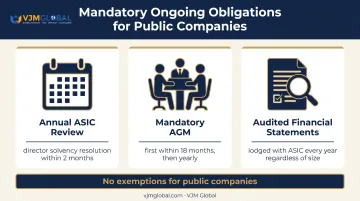
Small proprietary companies often qualify for reporting exemptions. Public companies never do - size doesn't change the obligation.
Those fixed obligations are why cost planning matters before you incorporate. VJM Global provides entity formation, registered agent services, and audit/accounting support in Australia and 100+ other countries, so German businesses can map both the one-time registration cost and the recurring statutory bill before committing to the structure.
Common Mistakes and Challenges German Businesses Face
German businesses usually clear registration without major trouble. Friction shows up later, when teams underestimate what running a public company actually demands.
- Assuming Pty Ltd simplicity applies. Public companies need three directors (two Australian-resident) and a resident secretary. Teams staffed for a Pty Ltd often scramble for officeholders mid-application.
- Director ID left too late. Every director needs one before appointment, and verification takes longer without an Australian identity history. Start early or the whole registration stalls.
- Banking timelines run longer than expected. Remote account opening isn't guaranteed for public companies. Stricter KYC checks mean some banks still want an in-person visit or extended verification.
- Sector approvals treated as optional. FIRB notification and industry licensing turn on sector and transaction size, not company type. Assuming "foreign ownership is generally allowed" covers everything is an avoidable error.
Conclusion
Registering a public limited company in Australia from Germany is achievable. It does demand heavier governance, clearer upfront cost planning, and a stronger local presence than a standard Pty Ltd. The ASIC and ATO registration steps are rarely the hard part—most of that work can be done remotely.
What derails German businesses is underestimating the ongoing rules:
- Resident director and company secretary requirements
- Audit and AGM obligations after incorporation
- Time needed for document certification and Director ID applications from outside Australia
Get the structure right on day one, and budget for what it costs to run the company—not only what it costs to set up. That planning avoids expensive corrections later.
VJM Global works across Australia and Germany on formation, registered agent services, and ongoing compliance, and can help you choose the right entity and stay compliant from the outset.
Frequently Asked Questions
What is a public limited company in Australia?
It's a company limited by shares, registered under the Corporations Act 2001 and regulated by ASIC, using the suffix "Limited" or "Ltd." Unlike a Pty Ltd, it can offer shares to the public and potentially list on the ASX.
What is a UG company in Germany?
A UG (haftungsbeschränkt) is Germany's low-capital "mini-GmbH," formable with as little as €1 in share capital. An Australian public company brings a much higher bar: stricter governance, audits, and AGMs.
Can a German business fully own a public company in Australia?
Yes, full foreign ownership is generally permitted across most sectors. Certain regulated industries or larger transactions may require notification to the Foreign Investment Review Board first.
Do I need to live in Australia to register a public company?
No. Founders and shareholders don't need to relocate. A public company still needs at least three directors (two ordinarily resident in Australia) and one resident company secretary.
How much does it cost to set up a public company in Australia from Germany?
Budget for the ASIC registration fee, local agent and registered-office fees, and document certification up front. Ongoing costs run well above Pty Ltd levels—the annual review fee is higher before you add audit and secretarial work.
What's the difference between a Pty Ltd and a public company (Ltd) in Australia?
A Pty Ltd caps non-employee shareholders at 50, needs one resident director, and often qualifies for reporting exemptions. A public company has no shareholder cap, needs three directors plus a resident secretary, and always files audited financial statements.