Whether you're incorporating for the first time, managing an existing company, or helping a foreign investor establish an Australian entity, knowing the full 2026/27 fee schedule is essential. Miss a deadline and you're looking at $102 to $428 in avoidable penalties. Overlook the business name fee and you'll be caught off guard at registration.
This guide covers every major ASIC fee effective 1 July 2026 — registration, annual review, late fees, business names, deregistration, and the total cost picture for running a company in Australia.
Key Takeaways
- The ASIC fee to register a new Pty Ltd company is $636 from 1 July 2026 (up from $611 in 2025/26)
- Annual review fees are $342 for a standard Pty Ltd and $70 for a special purpose SMSF trustee company (no GST applies)
- Late payment triggers fees of $102 (up to one month late) or $428 (more than one month late)
- ASIC fees cover only the government portion — professional and compliance fees add significantly to your total setup cost
ASIC Company Registration & Annual Review Fees 2026/27
All fees below are effective from 1 July 2026 and apply through 30 June 2027. GST does not apply to ASIC fees under Commonwealth law (Division 81 of the GST Act).
New Company Registration Fees
When you lodge Form 201 with ASIC to incorporate a company, payment is required before ASIC can complete the registration.
| Company Type | 2026/27 Fee | 2025/26 Fee |
|---|---|---|
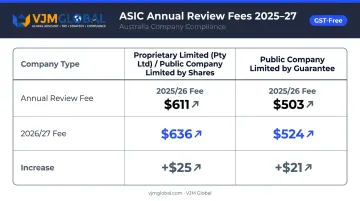
| Proprietary Limited (Pty Ltd) or Public Company Limited by Shares | $636 | $611 |
| Public Company Limited by Guarantee | $524 | $503 |
Annual Review Fees
ASIC sends every registered company an annual statement on or around the anniversary of its registration date. This statement includes the annual review fee, which must be paid to maintain the company's active status.
2026/27 annual review fees:
- Pty Ltd (standard): $342
- Public Company: $1,591
- Special Purpose Company (e.g., sole-purpose SMSF trustee): $70
Payment is due by the date shown on the annual statement, which is usually two months after the annual review date. Missing this deadline triggers an automatic late payment penalty, so the two-month payment window should be tracked closely in your compliance calendar.
Special Purpose Company Eligibility
The reduced $70 annual review fee applies only to companies that meet both criteria:
- The company's sole purpose is to act as trustee of a regulated superannuation fund
- The company's constitution prohibits distribution of income or property to members
If a company's activities expand beyond this scope, it loses eligibility for the reduced fee. Companies uncertain about their eligibility should confirm with ASIC or a registered agent before lodging at the reduced rate.
Complete ASIC Fee Schedule 2026/27: All Fee Types
Registration and annual review aren't the only costs to plan for. Here's every other ASIC fee that may apply across your company's lifecycle.
Company Name Fees
| Action | 2026/27 Fee |
|---|---|
| Reserve a company name (Form 410) | $65 |
| Change an existing company name (Form 205) | $524 |
Reserving a name before registering locks it in while you complete the process. The $65 reservation fee is separate from the $636 registration fee — both apply.
Business Name Registration Fees
Business name registration is distinct from company registration. Many Pty Ltds trade under their company name and don't need a separate business name. If you want to operate under a different trading name, separate fees apply:
- 1-year registration or renewal: $47
- 3-year registration or renewal: $108
Late Lodgement and Late Payment Fees
These penalties apply to late annual review payments and late lodgement of statutory forms (for example, Form 484 for changes to company details must be lodged within 28 days of the change):
| Timing | Late Fee |
|---|---|
| Up to 1 month late | $102 |
| More than 1 month late | $428 |
Voluntary Deregistration Fee
To voluntarily deregister a company using Form 6010, the 2026/27 fee is $52. This covers situations such as closing an SMSF corporate trustee company or winding down a dormant entity.
10-Year Prepayment Option
ASIC allows eligible companies to prepay their annual review fee up to 10 years in advance at a discounted rate. Key points before committing:
- Locks in your rate and shields against future CPI-driven increases
- ASIC does not offer refunds on advance payments
- Check current prepayment rates on the ASIC website before paying
How ASIC Fees Are Calculated: CPI Indexation
Under the Corporations (Fees) Regulations 2001 and the Corporations (Review Fees) Regulations 2003, most ASIC fees are indexed annually against the March-quarter Consumer Price Index, with any increase taking effect on 1 July each year.
This means fees rise incrementally each year — roughly 3–4% in recent years. The Pty Ltd registration fee shows the pattern clearly:
| Financial Year | Pty Ltd Registration Fee |
|---|---|
| 2023/24 | ~$576 |
| 2024/25 | ~$597 |
| 2025/26 | $611 |
| 2026/27 | $636 |
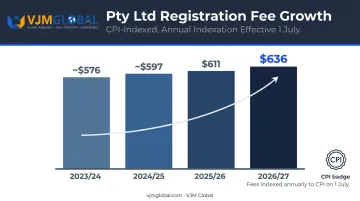
Note: The 2026/27 figure is verified from ASIC's primary sources. Earlier years are approximate figures based on available third-party data — verify against archived ASIC schedules for precise historical amounts.
Not every fee increases every year by the same percentage. In years of low CPI, some fees may hold steady. Always check ASIC's official fee indexation page for the most current figures, as any published guide can become outdated after 1 July.
Total Cost of Registering and Running a Company in Australia
The A$636 ASIC registration fee is the government component only. The real cost of incorporating and maintaining a company is higher once professional services are factored in.
What You're Typically Paying For Beyond ASIC Fees
Professional costs vary by complexity, but most businesses should budget for:
- Incorporation services — preparation and lodgement of Form 201, company constitution, and initial ASIC setup
- Shareholder and director agreements — legally sound documentation of ownership structure and governance
- Ongoing ASIC compliance management — tracking annual review dates, lodging Form 484 for company changes, and managing statutory deadlines
- Accounting and bookkeeping — post-incorporation financial records, BAS lodgements, and tax compliance
- Annual tax return preparation — income tax obligations that begin the moment the company trades
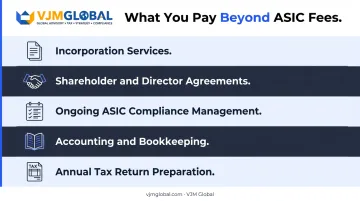
None of these have a fixed price — costs depend on business complexity, structure, and whether you're engaging a sole practitioner or a multi-service firm.
Foreign Investors and Overseas Companies
For international businesses establishing an Australian entity, the compliance picture is more involved. In addition to ASIC registration, foreign investors need to consider:
- Appointing at least one locally resident director (required under the Corporations Act)
- Understanding Australian corporate governance obligations
- Managing ongoing ASIC annual review lodgements from overseas
- Australian tax registration (ABN, GST, PAYG) separate from ASIC obligations
Working with advisers who understand both the Australian regulatory environment and cross-border obligations reduces compliance risk and avoids costly filing errors. VJM Global has supported 250+ Australian businesses across 15+ industries with services including BAS claims, GST compliance, PAYG payroll, and year-end financial reporting.
Common Mistakes That Lead to Higher ASIC Costs
Paying Annual Review Fees Late
Miss the two-month payment window after your annual review date and you're looking at a late fee of $102 to $428, depending on how overdue the payment is. Leave it unpaid for 12 months or more, and ASIC may begin deregistration proceedings.
To avoid this: Set a calendar reminder the moment your annual statement arrives, or have a registered agent or accountant manage the deadline on your behalf.
Falling for ASIC-Related Scams
On 22 May 2026, ASIC issued a warning about unsolicited business-name renewal and company-review notices — a known tactic where third-party operators send invoices mimicking official ASIC correspondence. Genuine ASIC emails come from addresses ending in @asic.gov.au only.
To avoid this: Pay fees only through the ASIC portals or via a trusted professional adviser. Always verify an unsolicited invoice before paying.
Overlooking the Business Name Fee
Registering a Pty Ltd and registering a business name are two separate processes. Your company registration only covers the exact name on the ASIC record — it does not protect a trading name that differs from it.
To avoid this: If you plan to operate under a different name, budget for a separate business name registration:
- 1-year registration: $47
- 3-year registration: $108
Conclusion
ASIC fees for 2026/27 are straightforward once you know the schedule: $636 to register a new Pty Ltd, $342 for the annual review, and a range of additional fees for name changes, statutory form lodgements, and — if things go wrong — late penalties up to $428. All fees are GST-free and updated each 1 July through CPI indexation.
The government fee covers only the registration itself. Running a compliant Australian company also means accounting for professional services, ongoing compliance management, and the time spent tracking annual review deadlines. Missing those deadlines costs more than the original fee — the $428 late penalty alone can exceed the annual review charge. Working with experienced compliance professionals keeps those costs predictable and avoids the compounding effect of missed obligations.
Frequently Asked Questions
How much is the ASIC company registration fee?
From 1 July 2026, the fee to register a new proprietary (Pty Ltd) company or public company limited by shares is $636. A public company limited by guarantee costs $524 to register. GST does not apply to either fee.
What are the ASIC company registration fees for 2026 and 2027?
The fees effective from 1 July 2026 apply through 30 June 2027 (the full 2026/27 financial year). The Pty Ltd registration fee is $636 and the annual review fee is $342. Fees for 2027/28 will be set ahead of 1 July 2027 based on the March 2027 CPI figure.
Are ASIC fees subject to GST?
GST does not apply to ASIC fees under Commonwealth law. However, if a professional service provider — such as an accountant or registered agent — charges a fee for managing the lodgement on your behalf, their service fee will typically be subject to GST.
What happens if I don't pay my ASIC annual review fee on time?
A late payment fee of $102 applies if payment is made up to one month after the due date, rising to $428 if more than one month late. If the fee remains unpaid for 12 months or more, ASIC may deregister the company.
Can I prepay ASIC annual review fees to lock in savings?
Yes. ASIC offers a 10-year prepayment option for annual review fees at a discounted rate, providing cost certainty and some protection against future CPI-driven increases. Check the current prepayment rates on the ASIC website for exact amounts — note that ASIC does not offer refunds on advance payments.
Do SMSF trustee companies pay lower ASIC fees?
Yes. Eligible special purpose companies — those whose sole purpose is to act as trustee of a regulated superannuation fund, and whose constitution prohibits income distribution to members — qualify for a reduced annual review fee of $70 for 2026/27, compared to $342 for a standard Pty Ltd.